Prepared by the LSE Editorial Team. Reviewed by Joseph Andrade, Jr., RN, NRP.
Joseph is an active firefighter, paramedic, and registered nurse working in emergency and vascular access care, as well as an OSHA Outreach instructor and safety officer. He has spent his career on the response side of emergencies, from the fireground to the ambulance to the hospital bedside, and now trains civilians, workplaces, and first responders in the skills that save lives.
The deadliest day for a worker in the heat is often the first day. Not the hottest day of the summer. The first one. Bodies adjust to extreme heat over about a week, and the people who have not adjusted yet are the ones who go down first. I have watched strong, capable workers drop on a jobsite because nobody built the day around that simple fact.
Heat is the leading weather-related killer in the United States, and here is the part that should change how every crew runs a summer shift: heat illness is preventable. This is a guide to the three things that keep a crew alive when the temperature climbs. Prevent it, recognize it, and respond fast when it happens anyway.
Prevent: water, rest, shade, and the acclimatization no one talks about
OSHA’s core message on heat has stayed the same for years because it works. Water. Rest. Shade. Acclimatize. Three of those are obvious. The fourth is the one that quietly saves lives and gets skipped the most.
Acclimatization: protect the new guy first
Acclimatization is the process of letting the body adapt to working in heat. It is not optional, and it is not toughness. It is physiology. A worker who has not built up heat tolerance is far more likely to suffer serious heat illness in the first few days on a hot job.
OSHA’s recommendation is to ease people in. Start new workers at no more than 20 percent of full heat exposure on day one, then increase by about 20 percent each day across the first week. The same applies to experienced workers coming back from a week or more off, because heat tolerance fades fast when you lose it.
The practical version for a crew lead is a single question at the start of a hot shift: who is new this week? Build the day around them, and the whole crew is safer.
Water and rest, done right
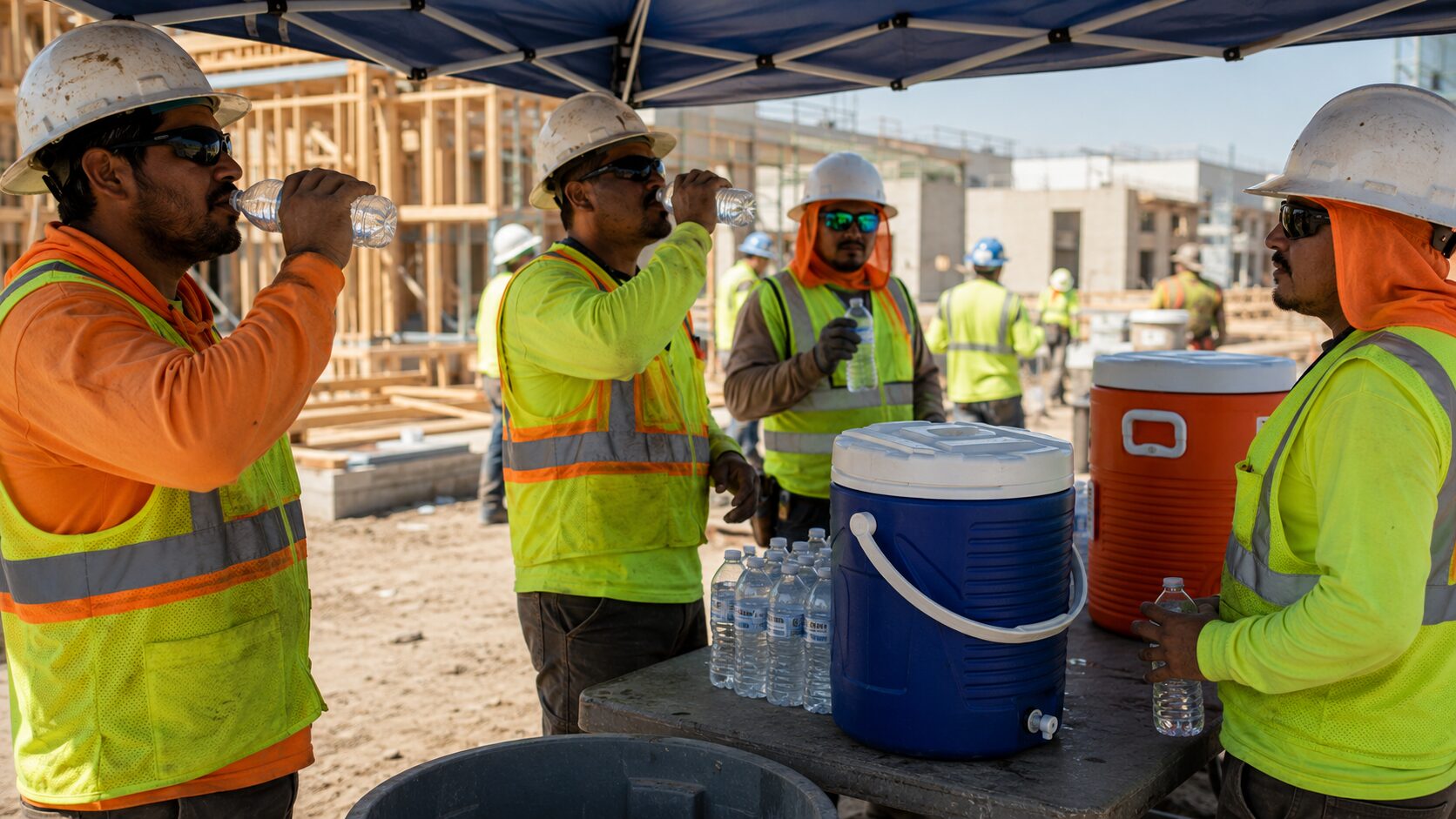
- Water. Drink before you feel thirsty. Small amounts, often. In extreme heat, that can mean about one quart per hour. Keep it within easy reach so nobody has to choose between hydration and the schedule.
- Rest. Take breaks in the shade and slow the pace as the heat index climbs. Breaks are not a luxury on a hot day. They are how the body sheds heat before it becomes an emergency.
- Shade. Give the crew a real place to cool down, not a sliver of shadow next to a truck.
Kill the machismo
The fastest way to lose a worker in summer is a culture that punishes the person who speaks up. Tell the crew plainly that early symptoms are stop-work signals, not weakness. A buddy system helps here. Pair newer workers with experienced ones so someone always has eyes on them.
Recognize: heat exhaustion versus heat stroke
Heat illness does not always announce itself with a dramatic collapse. It often starts with a headache and a worker who quietly slows down. Catching it at heat exhaustion usually means a stop, a rest, and a recovery. Missing it can mean heat stroke, which is a true medical emergency. Every crew lead should be able to tell the two apart.
Heat exhaustion (serious, treat right away)
Signs include heavy sweating, headache, dizziness, nausea, weakness, muscle cramps, and cool, clammy skin.
What to do: stop work, move the person to shade, loosen heavy gear, have them sip cool water, and cool them with wet cloths and a fan. Stay with them. If they are not improving within a few minutes, call 911.
Heat stroke (life-threatening)
Signs include hot skin that may be dry or sweaty, confusion, slurred speech, stumbling, seizures, loss of consciousness, and a body temperature at or above 103 degrees Fahrenheit.
What to do: call 911 immediately. Move the person to shade. Cool aggressively. Cold water immersion is best if it is available. If not, soak the person with water and fan them, and place ice packs on the neck, armpits, and groin. Do not give fluids to anyone who is not fully alert, because it can cause choking.
A rule worth saying out loud on every hot jobsite: if a worker is confused, stumbling, or stops sweating in the heat, treat it as heat stroke until proven otherwise. Cooling fast is what saves brains and lives.
Respond: the written heat plan
OSHA’s posture on summer heat is straightforward. Employers are responsible for protecting workers from foreseeable hazards, and summer heat is about as foreseeable as a hazard gets. The cheapest insurance is a written plan and a trained crew, and OSHA has been increasing its focus on heat through a national emphasis program and a proposed federal heat standard. Under that proposed standard, an initial heat index around 80 degrees Fahrenheit and a high-heat trigger around 90 degrees are used as action points. Those thresholds are planning benchmarks from the proposed rule, not settled law, so treat them as a smart baseline rather than a compliance guarantee, and always verify current requirements for your state.
What a basic written heat plan covers
- Acclimatization schedule for new and returning workers, with a gradual ramp over the first week.
- Water within easy reach for every worker, roughly one quart per hour in extreme heat.
- Rest breaks in shade, scaled up as the heat index rises.
- Training so every crew lead can recognize heat exhaustion and heat stroke and act.
- Buddy system on every shift in high heat.
- Emergency procedure for calling 911 and cooling a worker fast on scene.

The crews that get through summer without an incident are not luckier than everyone else. They planned better.
Key Takeaways
- Heat is the leading weather-related killer of US workers, and heat illness is preventable.
- Acclimatization matters most. Ease new and returning workers in over the first week.
- Water, rest, and shade are the daily basics. Drink before thirst, break in real shade.
- Heat exhaustion is serious and treatable. Heat stroke is a 911 emergency that needs aggressive cooling.
- If a worker is confused, stumbling, or stops sweating, treat it as heat stroke until proven otherwise.
- A written heat plan plus a trained crew is the cheapest insurance an employer can buy.
Frequently Asked Questions
What is acclimatization, and why does it matter?
Acclimatization is the body adapting to work in heat over several days. Workers who have not acclimatized are at much greater risk of serious heat illness, especially during the first days of hot work.
What is the difference between heat exhaustion and heat stroke?
Heat exhaustion commonly includes heavy sweating, headache, dizziness, weakness, nausea, and cool or clammy skin. Heat stroke may include confusion, slurred speech, seizures, loss of consciousness, or very high body temperature and requires immediate 911 activation and aggressive cooling.
How much water should a worker drink in extreme heat?
OSHA guidance commonly recommends frequent small amounts, which may approach roughly one quart per hour during extreme heat and heavy work. Conditions, medical factors, and employer plans matter, so workers should follow current site guidance and avoid waiting for thirst.
Does OSHA require a written heat plan?
Employers must protect workers from recognized heat hazards. Federal and state requirements continue to evolve, and some jurisdictions have specific heat rules. Verify the current requirements that apply to the worksite.
Can LSE train a crew on heat safety?
Yes. LSE provides heat-illness prevention training and related OSHA Outreach classes for crews, subject to the agreed scope, site conditions, and current trainer authorization.
Get your crew ready before the next heat wave
Summer work is when your people are most exposed and most valuable. A trained crew and a simple written plan turn a scary afternoon into a near miss instead of a tragedy.
We teach OSHA 10, OSHA 30, and onsite heat-illness prevention for crews, and we can provide a heat-plan template to help begin the written program. Review what to expect at an OSHA 10 class and the LSE resource library, then browse our classes or contact us to schedule a session.
Training excellence, real-world readiness.
Sources
- OSHA, Heat Illness Prevention. https://www.osha.gov/heat (Supports the water, rest, shade, acclimatize framework, heat as the leading weather-related killer, and symptom and first-aid guidance.)
- OSHA, Heat Injury and Illness SBREFA. https://www.osha.gov/heat/sbrefa (Supports worker heat fatality data and the rulemaking and enforcement context.)
- CDC MMWR, Heat Illness and Death Among Workers. https://www.cdc.gov/mmwr/preview/mmwrhtml/mm6331a1.htm (Supports the first-week acclimatization risk.)
This article is for general education and awareness. It is not legal advice, medical advice, or a guarantee of OSHA compliance. Heat rules vary by state and change over time. Verify current requirements and adapt any plan to your worksite. In an emergency, call 911.