Prepared by the LSE Editorial Team. Reviewed by Joseph Andrade, Jr., RN, NRP.
Joseph works across emergency response, healthcare, and workplace safety and develops practical training for civilians, employers, and first responders.
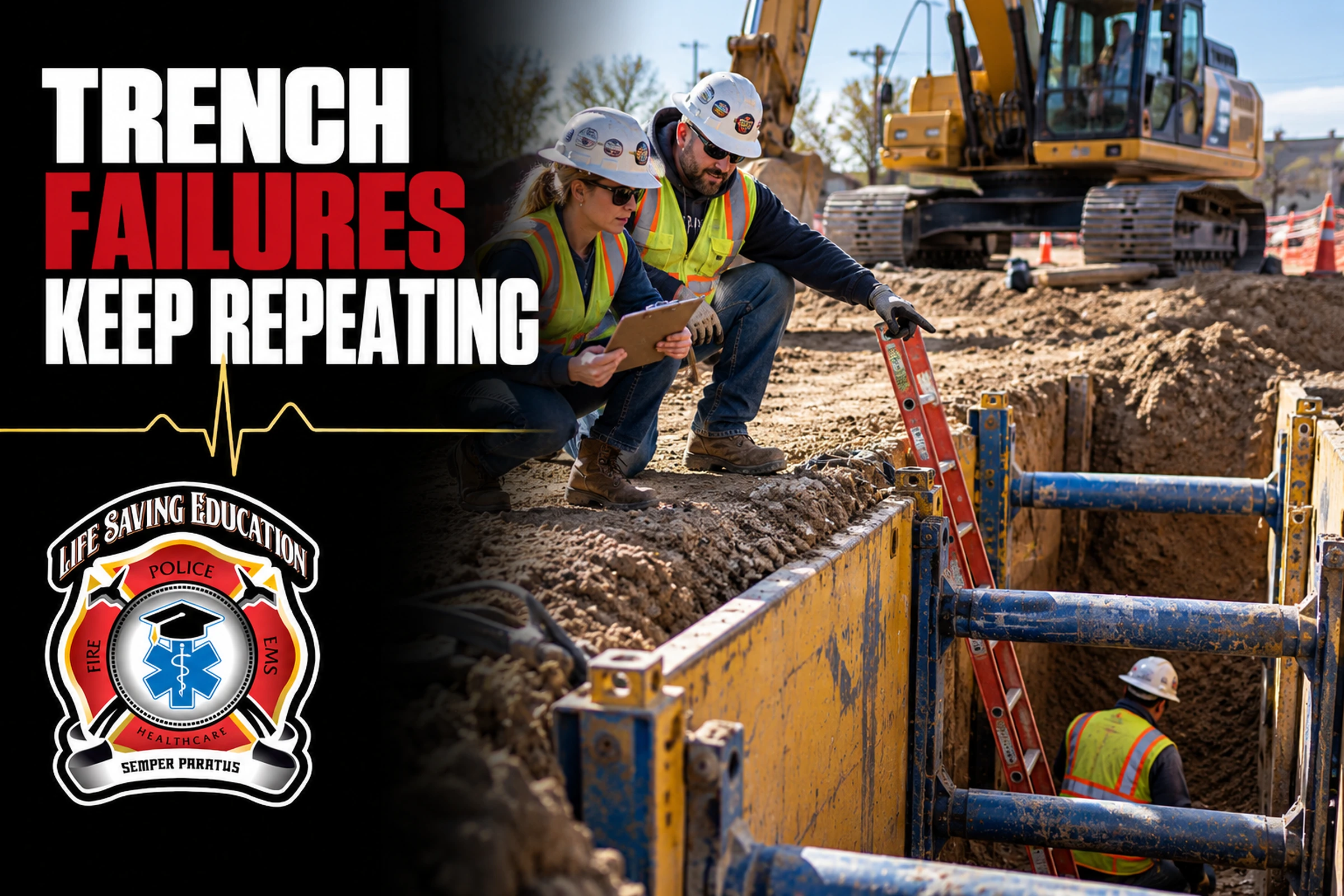
Three OSHA announcements. Three different projects. Three different parts of the country. The same basic hazards keep appearing.
On October 7, OSHA announced citations after a fatal Pennsylvania trench collapse. Workers had been installing storm sewer 12 feet below grade when a trench wall failed and engulfed a worker.
On October 16, OSHA publicized citations involving six New York and New Jersey construction employers at the Monroe Commons project in New York. The agency described a steep, unstable excavation embankment nearly 75 feet high and proposed $648,094 in combined penalties.
On October 22, OSHA announced $380,664 in proposed penalties against an Illinois utility contractor after investigators observed employees working in an unprotected trench deeper than eight feet. The employer received repeat citations involving safe egress, cave-in protection, and the required setback for excavated materials and equipment.
These cases are not final judicial determinations. Employers can contest citations, and proposed penalties can change. Still, the pattern is worth teaching.
None of the core trench-safety requirements are new. So why do the same failures keep showing up?
| Case | OSHA announcement | What OSHA described | Proposed penalties |
|---|---|---|---|
| Pennsylvania | October 7 | Fatal collapse of a 12-foot storm-sewer trench | $254,884 |
| New York (Monroe Commons) | October 16 | Unstable embankment nearly 75 feet high; six employers cited | $648,094 combined |
| Illinois | October 22 | Employees in an unprotected trench deeper than eight feet | $380,664 |
These are OSHA citations and proposed penalties, not final judicial determinations. Employers can contest them.
📋 Three OSHA Trench Cases in Two Weeks
Pennsylvania: the fatal 12-foot trench
OSHA opened its Pennsylvania investigation after a worker was killed when an inadequately protected trench wall collapsed. The agency cited an alleged failure to protect workers from cave-ins, along with repeat violations involving competent-person inspections and removing employees from hazardous conditions.
Serious citations also involved training, safe exit, material setback, and protection from roll-in hazards. Proposed penalties totaled $254,884.
New York: excavation safety at a different scale
The Monroe Commons case involved a much larger excavation. OSHA described an unstable embankment nearly 75 feet high that was not adequately sloped or shored.
Six employers were cited. Allegations included cave-in and struck-by hazards, falling or rolling soil and rock, lack of daily competent-person inspections, fall protection, chemical hazards, and failure to ensure required professional-engineer design for the deep excavation.
OSHA issued 23 serious and five willful citations and proposed $648,094 in combined penalties.
Illinois: the ordinary-looking trench
OSHA’s Illinois inspection was initiated under its National Emphasis Program on Trenching. Investigators reported seeing employees in an unprotected trench deeper than eight feet.
The agency cited three repeat violations: no safe means of egress, no adequate trench protective system, and excavated materials or equipment not kept at least two feet from the edge. OSHA also issued a serious citation involving protective hardhats against falling objects.
Proposed penalties totaled $380,664.
The Illinois case is important because it looks ordinary. It is the kind of utility trench that workers and supervisors may encounter repeatedly. That familiarity can be dangerous.

⚠️ The Trench Safety Rules Are Not Mysterious
Cave-in protection
Workers in trenches five feet deep or greater generally require an adequate protective system unless the excavation is made entirely in stable rock.
Safe egress
Trenches four feet deep or more require a safe means of egress, such as a ladder, stairway, or ramp, positioned so workers do not have to travel more than 25 lateral feet.
Spoil and equipment setback
Spoils and equipment should be kept at least two feet from the edge or otherwise retained so they cannot fall or roll into the excavation.
Competent-person inspections
A competent person should inspect the excavation before work, daily before each shift, as needed during the shift, and after rainstorms or other hazard-increasing events.
Deep excavation engineering
Protective systems for excavations deeper than 20 feet require registered-professional-engineer design or approved tabulated data as required by the standard.
🔗 Related: The Trench Was 12 Feet Deep: What a Pennsylvania Fatality Teaches About Excavation Emergencies
⚠️ Why Familiar Trenches Still Fail
Familiarity can normalize risk
A trench can look the same at 10 a.m. as it did at 8 a.m. That does not mean it is the same system. Soil can change. Water can accumulate. Spoil piles can move. Equipment can approach the edge. Vibration can increase. Utilities can be exposed. Protective equipment can shift. And the crew gets comfortable.
When workers enter an unprotected trench and nothing happens, the absence of an immediate collapse can be misinterpreted as evidence that the condition is safe. It is not. It is evidence that the collapse has not happened yet.
A competent person needs authority
OSHA defines the competent-person role around hazard recognition and authority to take prompt corrective measures. The second half matters.
A person who can identify a hazard but cannot stop production does not provide the control the job needs. A name on a form is not a protective system.
The two-foot rule is not housekeeping
Material near the edge can increase loading on the excavation and can roll or fall onto workers. Equipment can create additional loading and vibration. The two-foot setback is therefore connected to both collapse and struck-by risk.

Egress has to work when the trench becomes dangerous
A ladder is useful because a worker may need to leave immediately. If it is too far away, blocked, unstable, outside the protective system, or positioned where the worker cannot reach it quickly, the presence of a ladder does not solve the problem.
📋 Planning, Weather, and Shared Worksites
Multi-employer worksites need a shared excavation plan
The New York case shows why subcontractor boundaries matter. Different employers may perform different tasks around the same excavation, and responsibility can become ambiguous.
A stronger system answers who owns the excavation plan, who controls access, who conducts and documents inspections, who approves changes, who communicates engineered design, who coordinates equipment placement, who stops work after rain or changing conditions, and how subcontractors are briefed.
Why a trench box on site is not enough
Equipment availability and equipment use are different things. A trench box can be present and still be the wrong size, incorrectly positioned, outside the work area, installed improperly, incompatible with the excavation, or undermined by changing conditions.
Weather should change the inspection
Rain is not just an inconvenience. Water can change soil behavior and introduce accumulation hazards. OSHA identifies rainstorms and other hazard-increasing events as triggers for competent-person inspection.
If the conditions changed, assume the inspection needs to change too.
Pre-job planning is a safety control
Planning should address underground utilities, soil conditions, protective-system selection, access and egress, traffic, equipment placement, spoil management, water control, adjacent structures, atmospheric hazards where applicable, and emergency procedures.
🔗 Related: When the Ground Gives Way: First-Arriving Firefighters at a Trench Rescue
✅ What OSHA 10 and OSHA 30 Should Teach
OSHA 10 and OSHA 30 should teach recognition, not false qualification
OSHA Outreach courses are awareness and hazard-recognition education. They should not be represented as automatically qualifying someone to serve as an excavation competent person.
For OSHA 10 learners, the reaction should be simple: If the trench does not look protected, do not assume someone else checked it. Ask before entering.
For OSHA 30 learners and supervisors, training can go deeper into competent-person responsibilities, preplanning, inspection triggers, subcontractor coordination, and stop-work authority.
LSE teaches OSHA 30 training and OSHA 10 training onsite in the Washington, DC region and across the East Coast. Students earn an OSHA Outreach student course completion card, not a competent-person qualification.
Use the three cases as one classroom exercise
Give one group the Pennsylvania 12-foot storm-sewer trench, another the deep New York multi-employer excavation, and another the ordinary-looking Illinois utility trench. Ask each group what can kill someone first, what should happen before entry, who has authority to stop work, what conditions require inspection, and what makes the job different from the others.
The fire-service connection
A trench collapse quickly becomes a technical-rescue problem. But the existence of a rescue team does not reduce the employer’s obligation to prevent collapse. Prevention and rescue are connected by the same soil mechanics, but they are not the same discipline.

🔗 Related: What Is OSHA 30? What the Course Covers and Who Needs the Card
📋 LSE Bottom Line
Three OSHA announcements in roughly two weeks should not be treated as three unrelated headlines. The recurring controls are too similar.
Protect the trench. Provide egress. Control the edge. Inspect the excavation. Give the competent person real authority. Use engineering when the excavation requires it. Train workers to recognize when the system is missing.
Trench collapses are fast. Prevention has to happen before anyone climbs down.
✅ Key Takeaways
- OSHA announced trench cases in Pennsylvania, New York, and Illinois between October 7 and October 22. The same basic hazards appear in all three.
- Trenches 5 feet deep or more generally need a protective system unless the excavation is entirely in stable rock.
- Trenches 4 feet deep or more need a safe way out within 25 lateral feet.
- Keep spoils and equipment at least two feet from the edge.
- A competent person needs the authority to stop work, not just a name on a form.
- OSHA 10 and OSHA 30 build hazard recognition. They do not make someone a competent person.
❓ Frequently Asked Questions
How deep does a trench have to be before OSHA requires a protective system?
Workers in trenches 5 feet deep or greater generally need an adequate protective system unless the excavation is made entirely in stable rock. Excavations deeper than 20 feet need a protective system designed by a registered professional engineer or approved tabulated data.
When does a trench need a ladder or other way out?
Trenches 4 feet deep or more need a safe means of egress, such as a ladder, stairway, or ramp, positioned so workers do not travel more than 25 lateral feet.
How far back do spoils and equipment need to be from a trench?
At least two feet from the edge, or retained so they cannot fall or roll into the excavation.
How often does a competent person inspect a trench?
Before work, daily before each shift, as needed during the shift, and after rainstorms or other events that increase the hazard.
Does an OSHA 10 or OSHA 30 card make someone a competent person?
No. OSHA Outreach courses are awareness and hazard-recognition education. They should not be represented as automatically qualifying someone to serve as an excavation competent person.
Training You Can Count On. When Seconds Count.
Teach Crews to Spot a Missing Trench Control
LSE teaches OSHA 10 and OSHA 30 Outreach classes onsite in the Washington, DC region and across the East Coast, with real trench cases built into the discussion.