Confined Space Training
Life Saving Education is owned and led by Joe Andrade.
Joe and the LSE instructor team are firefighters, paramedics, registered nurses, OSHA Outreach instructors, and safety officers, in various combinations. Joe is an active firefighter, paramedic, and registered nurse working in emergency and vascular access care, and an OSHA Outreach instructor and safety officer. The team trains civilians, workplaces, and first responders in the skills that save lives.
Confined space training should match the role a worker actually performs. An employee who only needs to recognize a permit space has different responsibilities from an authorized entrant, attendant, entry supervisor, or rescue team member.
Life Saving Education provides confined space training for industrial, municipal, utility, construction, maintenance, environmental, and emergency-response teams. Training can cover awareness, authorized entry, attendant duties, entry supervision, atmospheric monitoring, permit systems, and non-entry rescue.
The regulatory framework also depends on the type of work. General industry permit-required confined spaces are addressed by OSHA 29 CFR 1910.146, while construction work is covered by 29 CFR 1926 Subpart AA. Employers should identify which standard applies before assigning training or entry duties.
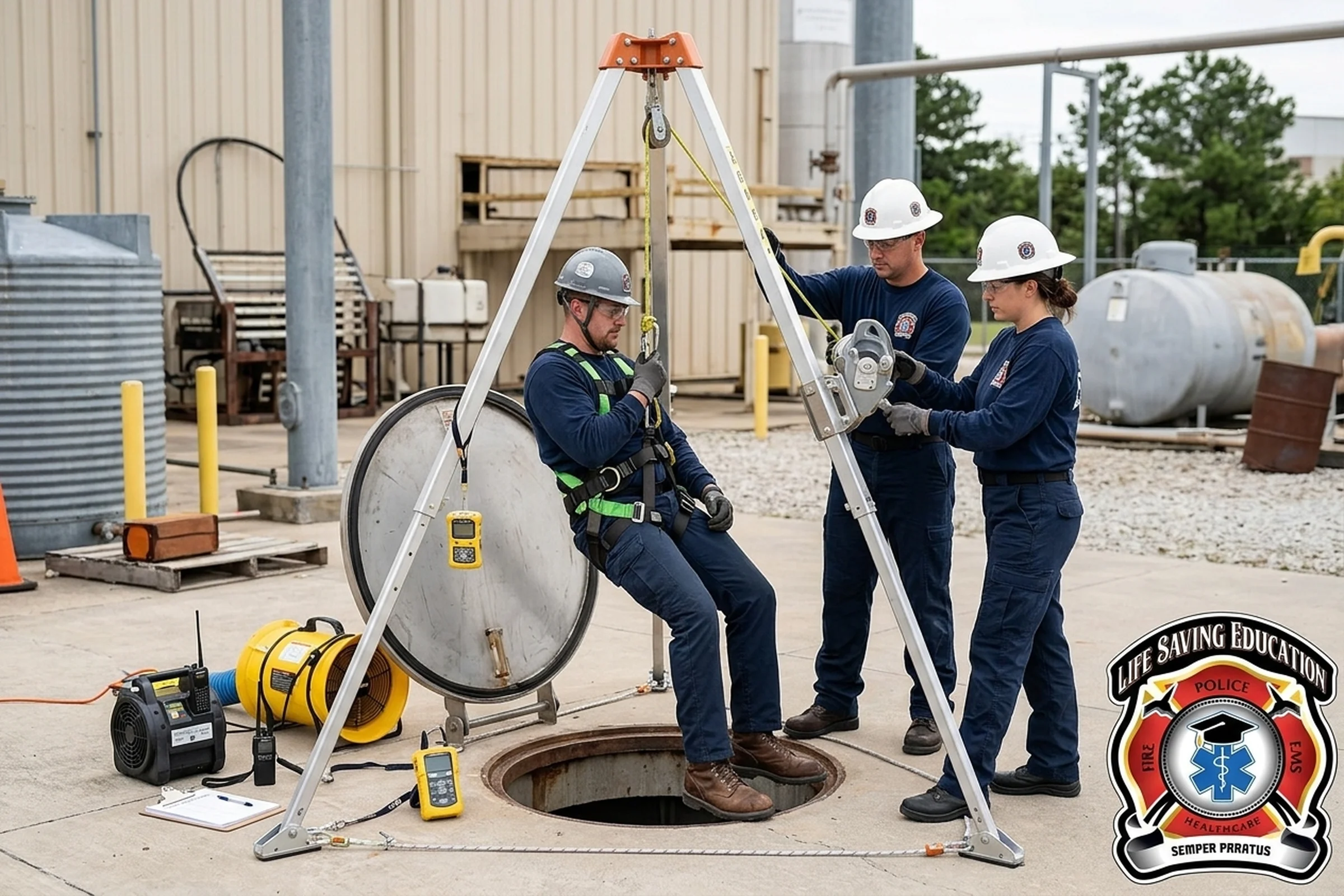
Confined Space Training Options
Life Saving Education offers multiple training paths so employers can match instruction to employee responsibilities:
- Confined Space Awareness for employees who need to recognize confined and permit-required spaces, understand entry restrictions, and know when to stop and notify the appropriate person.
- Confined Space Authorized Entrant and Attendant for workers who enter permit spaces or monitor entrants from outside.
- Confined Space Entrant, Attendant and Entry Supervisor for organizations that need role-based training through the permit authorization and oversight level.
- Confined Space Non-Entry Rescue for teams that use retrieval systems to remove an entrant without sending another worker into the space when non-entry rescue is feasible.
What Is a Confined Space?
Under OSHA’s general-industry definition, a confined space is large enough and configured so an employee can bodily enter and perform work, has limited or restricted means of entry or exit, and is not designed for continuous employee occupancy.
Examples can include tanks, vessels, silos, storage bins, hoppers, vaults, pits, manholes, sewers, boilers, and other enclosed or partially enclosed spaces. The appearance of the space is not what determines whether the rule applies.
When Does a Confined Space Become Permit-Required?
A permit-required confined space has one or more additional serious hazards. Depending on the standard and work activity, those hazards can include:
- a hazardous atmosphere or the potential to contain one,
- engulfment hazards,
- an internal configuration that could trap or asphyxiate an entrant,
- electrical, mechanical, thermal, or other recognized serious hazards,
- or conditions that could impair an employee’s ability to self-rescue.
Employers need a system for identifying these spaces and controlling unauthorized entry before work begins.
Authorized Entrant, Attendant and Entry Supervisor
Permit-space programs depend on clearly assigned roles.
Authorized Entrant
The authorized entrant enters the permit space and must understand the hazards, use required equipment, maintain communication, recognize warning signs or symptoms, and exit when required by the permit program or attendant.
Attendant
The attendant remains outside the space and monitors authorized entrants. The attendant tracks who is inside, maintains communication, watches for changing conditions, orders evacuation when necessary, summons rescue, and performs no duty that interferes with the primary responsibility to monitor and protect entrants.
Entry Supervisor
The entry supervisor verifies that acceptable entry conditions are present, confirms required testing and equipment are in place, authorizes entry, ensures rescue services are available, and terminates the entry when the work is complete or conditions are no longer acceptable.
Atmospheric Testing Is a Core Skill
Many confined space hazards cannot be detected by sight or smell. Atmospheric monitoring is therefore one of the most important parts of a permit-space program.
Training should help workers understand why instruments are used, what they can and cannot detect, how sampling location affects results, and why conditions may need to be monitored throughout the entry rather than checked only once.
A standard four-gas monitor may be useful for common hazards such as oxygen concentration, combustible gases, carbon monoxide, and hydrogen sulfide, but the instrument must match the hazards reasonably expected in the specific space. A meter cannot warn about a contaminant it is not designed to detect.
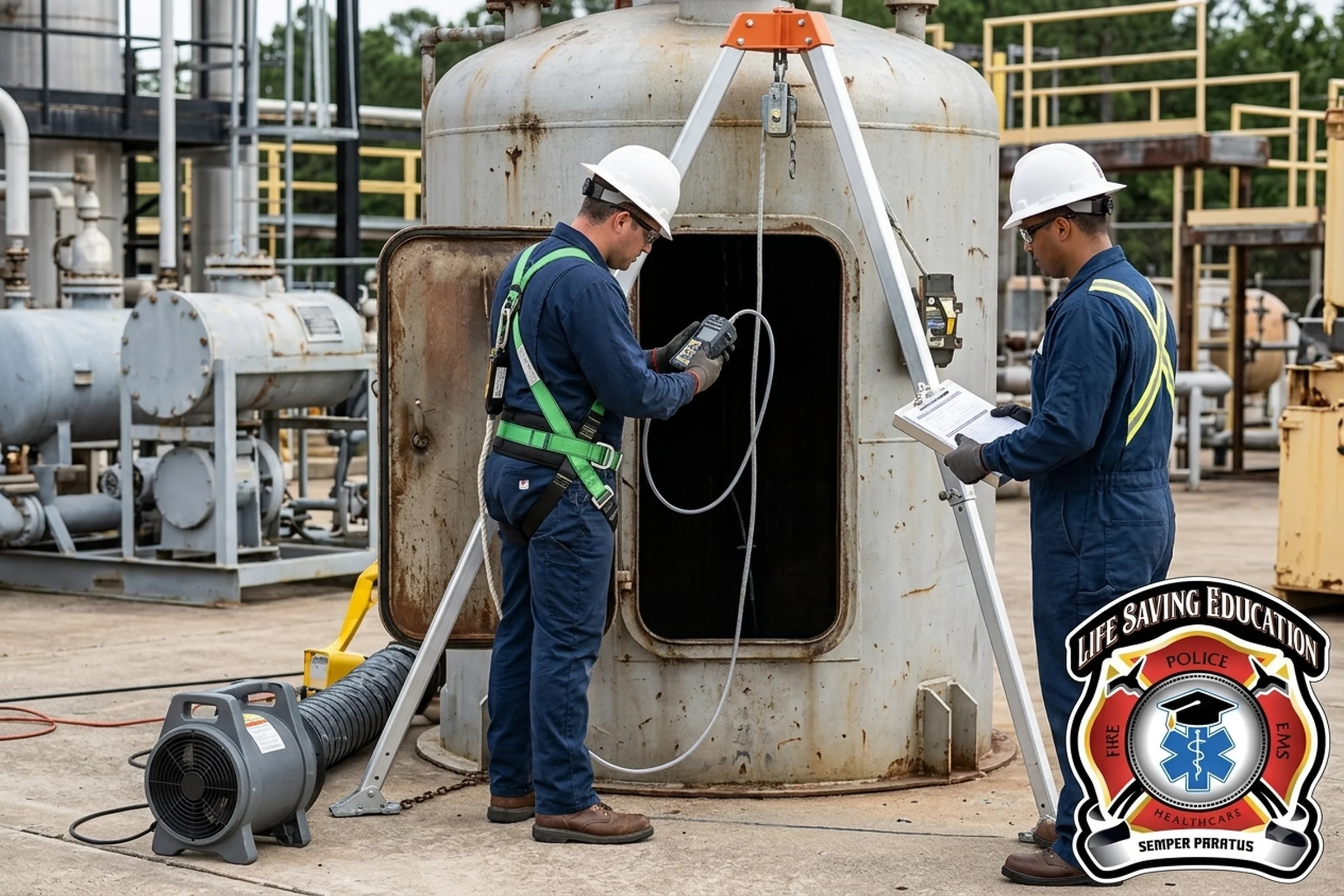
Ventilation Does Not Replace Testing
Forced-air ventilation can help control atmospheric hazards, but turning on a blower does not prove the space is safe. Airflow can be inadequate, poorly positioned, interrupted, or unable to reach dead spaces. Work inside the space can also introduce new hazards.
The goal is not simply to “ventilate the tank.” The goal is to establish and maintain acceptable entry conditions and verify those conditions with appropriate testing and monitoring.
Isolation and Hazard Control
Before entry, the employer needs to address the hazards that could enter or energize the space. Depending on the system, controls may include lockout/tagout, blanking or blinding, disconnecting or misaligning piping, controlling moving equipment, preventing vehicle movement, releasing stored energy, or otherwise isolating the space from hazardous energy and material.
Confined-space safety is therefore not an atmospheric-monitoring program alone. It is an entry-control system that combines hazard evaluation, isolation, testing, communication, equipment, supervision, and rescue planning.
Confined Space Rescue Must Be Planned Before Entry
A rescue plan should exist before an employee crosses the opening. Waiting until an entrant collapses to decide who will respond is not a rescue plan.
When non-entry retrieval is feasible, a properly configured retrieval system can allow an entrant to be removed without exposing a second employee to the space. When entry rescue is required, the rescue service must have the training, equipment, respiratory protection, staffing, and capability needed for the specific hazards and geometry of the space.
For a deeper discussion of why unplanned rescue attempts can create additional victims, read Confined Space Safety: Why Rescuers Become Victims.
For a real-world OSHA case involving a tanker trailer, see Tanker Trailer Confined Space Safety: OSHA Lessons.
General Industry vs. Construction Confined Space Rules
| Work setting | Primary OSHA framework | What employers should recognize |
|---|---|---|
| General industry | 29 CFR 1910.146 | Applies to permit-required confined space entry in general-industry workplaces, subject to the standard’s scope and exclusions. |
| Construction | 29 CFR 1926 Subpart AA | Requires a competent person to identify confined and permit spaces where employees may work and includes construction-specific coordination and entry requirements. |
Employers should not assume that a course labeled simply “confined space” automatically satisfies every requirement for every industry. Training needs to match the applicable rule, employer program, employee role, and hazards.
Who Needs Confined Space Training?
Organizations commonly seeking confined space training include:
- utilities and public works departments,
- water and wastewater operations,
- industrial maintenance teams,
- manufacturing and process facilities,
- environmental and remediation contractors,
- construction contractors,
- mechanical and facility-maintenance companies,
- transportation and tanker operations,
- municipal and government organizations,
- and fire, rescue, or emergency-response teams that may support confined-space incidents.
Onsite Confined Space Training
Confined space instruction is especially useful when it can be connected to the employer’s actual spaces, equipment, permits, monitors, retrieval systems, and procedures.
Where the course requirements and site safety rules allow, Life Saving Education can provide onsite group training and incorporate realistic examples from the organization’s work environment.
Request onsite confined space training or review our East Coast service areas.
What Employers Should Have Ready
Organizations planning role-specific training get better results when they can provide:
- a list or examples of the spaces employees may enter,
- the work performed inside those spaces,
- known or potential atmospheric and physical hazards,
- the employee roles that need training,
- existing entry permits or written procedures,
- the atmospheric monitors currently used,
- retrieval and rescue equipment,
- and the current rescue arrangement or designated rescue service.
Frequently Asked Questions
What is the difference between confined space awareness and entrant training?
Awareness training is appropriate for employees who need to recognize a confined or permit space and understand entry restrictions. Authorized entrants need additional training on the hazards, equipment, communication, entry procedures, and actions required while inside the space.
Can an entry supervisor also be an attendant?
Under OSHA’s general-industry standard, an entry supervisor may also serve as an attendant or authorized entrant if that person is properly trained and equipped for each role and can perform all required duties.
Does every confined space require an entry permit?
No. The permit requirements apply to permit-required spaces when entry is conducted under the permit-space provisions. Employers must evaluate the space and applicable standard before deciding what procedures are required.
Is a four-gas meter always enough?
No. The instrument must be capable of detecting the hazards reasonably expected in the space. Additional sensors or instruments may be necessary when other contaminants are possible.
Can we use the fire department as our rescue plan?
An employer that relies on an outside rescue service must evaluate whether that service can respond appropriately to the specific permit-space hazards and perform the needed rescue. Simply writing “call 911” does not by itself establish that capability.
Can Life Saving Education train our crew at our facility?
Yes. Onsite group training is available based on location, course scope, class size, site conditions, and scheduling.
Build a Confined Space Program Your Crew Can Actually Use
Choose the course that matches the employee’s role, or contact Life Saving Education if your organization needs help mapping awareness, entrant, attendant, supervisor, or non-entry rescue training across a team.
Contact Life Saving Education about confined space training or request an onsite group-training quote.
This page provides general training information and does not replace an employer-specific confined space evaluation, written permit-space program, rescue assessment, or the requirements of the OSHA standard applicable to the work being performed.