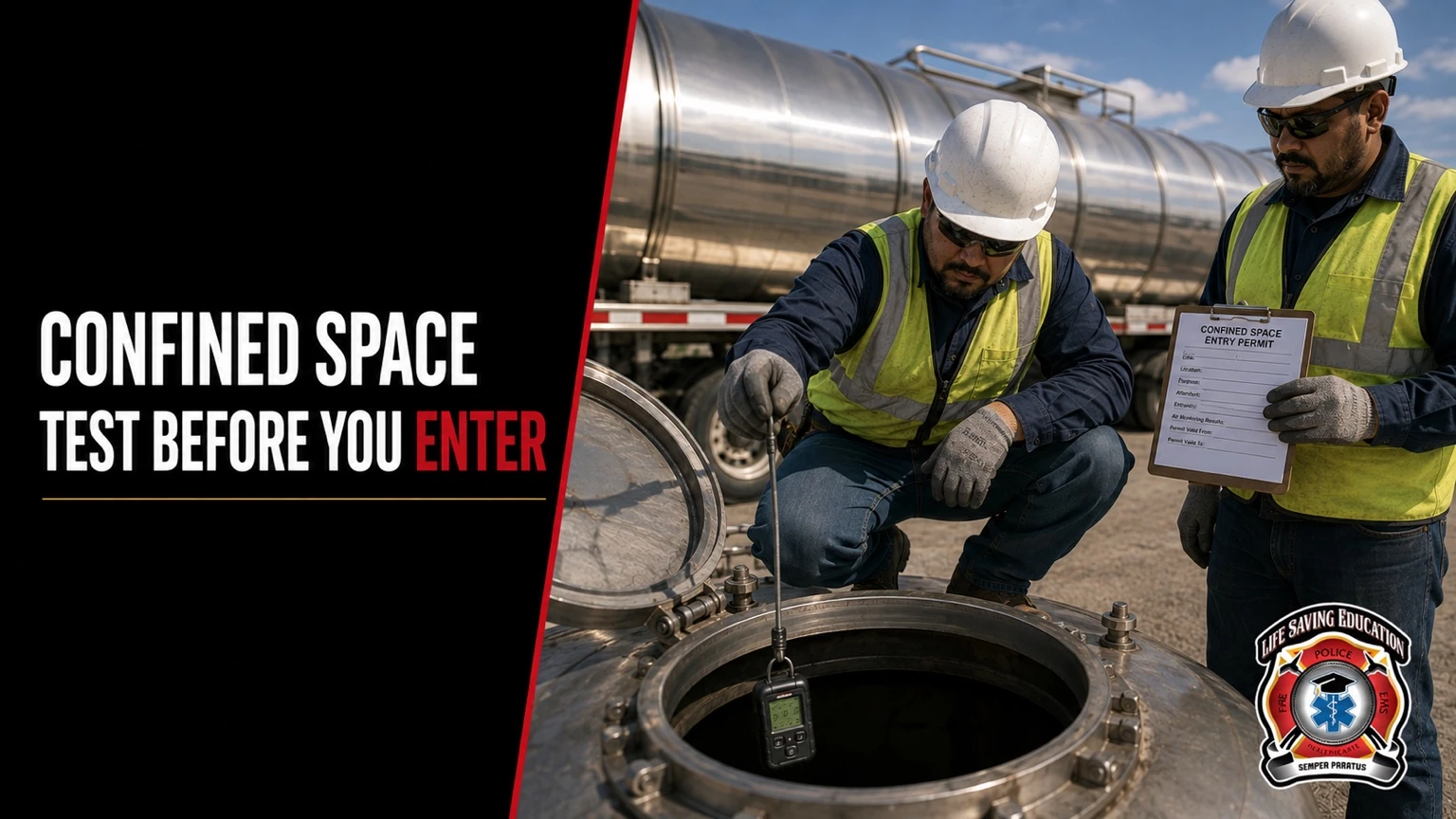
By Joe Andrade. Firefighter, paramedic, PICC/IVT registered nurse, and lead instructor at Life Saving Education. I teach confined space, HAZWOPER, hazmat, and emergency medical response, and I have been the person called when a routine job turned into a body recovery.
I have crawled into spaces that everyone on scene swore were safe. A tank that "was empty." A trailer somebody "just needed to look inside." That phrase, just look inside, has killed more people than most workers will ever realize, and confined space safety is the discipline built specifically to stop it.
On January 7, 2026, a 63-year-old worker at a FleetPride facility in Corpus Christi, Texas, went to inspect a tanker trailer. It was an ordinary assignment on an ordinary day. He died from asphyxiation.
Six months later, the U.S. Department of Labor’s Occupational Safety and Health Administration announced the result of its investigation. The story below is built on OSHA’s own findings and on the confined space standard those findings rest on. It is not a story about a freak accident. It is a story about a preventable one.
What OSHA Found at FleetPride
Following its investigation, OSHA cited FleetPride for 16 serious and three other-than-serious violations. The agency reported that the alleged violations included failure to implement a confined space program, deficiencies in its respiratory protection program, and exposing workers to electrical hazards. OSHA proposed $264,380 in penalties.
FleetPride is not a small operation. It is one of the largest heavy-duty truck and trailer parts distributors in the country, headquartered in Irving, Texas, with a service network that routinely puts technicians inside tankers, trailers, and other enclosed equipment. The Corpus Christi facility sits near Annaville on Interstate 37.
Two things matter about where the case stands now.
First, these citations are allegations, not final findings. The employer has the right to respond. FleetPride has 15 business days from receiving the citations to comply, request an informal conference with OSHA’s area director, or formally contest the findings before the independent Occupational Safety and Health Review Commission. In a statement, the company said it is reviewing the citations, requested an informal settlement conference, and expressed condolences to the worker’s family and coworkers.
Second, the company’s own response contains the clearest lesson in the whole case. FleetPride stated that after the incident it unilaterally suspended all tank entry work across the company and had not restarted those operations. That is the correct instinct. When you do not yet know your program can protect the next entrant, the safe move is to stop entering. Every employer reading this can ask the same question today, before OSHA ever shows up: if a worker crossed the opening of a tank on my site this afternoon, would anything actually be protecting them?
This case is worth studying precisely because nothing about it looked dramatic. That is how most confined space deaths happen.
The Space Did Not Have to Look Dangerous
When people picture a confined space, they picture sewers, underground vaults, chemical tanks, or narrow tunnels. Something that looks the part.
OSHA’s definition does not care how dramatic the space looks. It is built on the characteristics of the space, not its appearance.
Under OSHA’s general industry standard (29 CFR 1910.146), a confined space is one that:
- Is large enough and configured so a worker can bodily enter and perform work
- Has limited or restricted means of entry or exit
- Is not designed for continuous employee occupancy
Tanks, vessels, silos, storage bins, hoppers, vaults, and pits are common examples. A tanker trailer parked in a familiar yard, entered only for inspection or cleaning, can meet every part of that definition. Familiarity is not a safety control. The trailer does not know it is in a friendly workplace.
Confined space versus permit-required confined space
Not every confined space carries the same legal weight. The dividing line is hazard.
| Confined space | Permit-required confined space | |
|---|---|---|
| Definition | Large enough to enter, limited entry/exit, not for continuous occupancy | A confined space that also has one or more serious hazards |
| Trigger | The physical characteristics of the space | Hazardous atmosphere, engulfment risk, entrapment configuration, or another recognized serious hazard |
| What it requires | Awareness and controls to prevent unsafe entry | A full written permit-space program: evaluation, testing, permits, attendant, rescue |
The phrase that carries the most weight in the standard is potential to contain. A permit-required confined space does not need to be full of toxic gas when the worker walks up. Previous contents, cleaning chemicals, residues, rust, welding, solvents, biological activity, or simply inadequate ventilation can create a hazardous atmosphere. Under 1910.146, employers are expected to treat spaces as permit-required until pre-entry procedures prove otherwise, not the reverse.
The Hazard You Cannot See, Smell, or Feel

A dangerous confined space atmosphere usually gives no warning.
Workers cannot judge oxygen level, flammability, or toxic gas concentration by smell or appearance. Some toxic gases impair judgment or drop a person before they recognize anything is wrong. Oxygen-deficient air looks and smells exactly like normal air. This is the core reason a tanker trailer can kill a healthy, experienced worker in seconds.
That is why atmospheric testing is not paperwork. It is the only way to know.
OSHA requires employers running a permit-space program to identify and evaluate hazards before anyone enters, and to test or monitor to confirm that acceptable entry conditions exist and stay that way during the work. The standard frames testing around two distinct jobs: evaluation (understanding what hazards the space could hold) and verification (confirming conditions are actually safe right now).
The traditional testing sequence exists for a physical reason.
| Order | Test for | Why this order |
|---|---|---|
| 1 | Oxygen | Most gas sensors and your own survival depend on adequate oxygen first |
| 2 | Combustible gases and vapors | A flammable atmosphere can kill everyone before toxicity ever matters |
| 3 | Toxic gases and vapors | Assessed once oxygen and flammability are established |
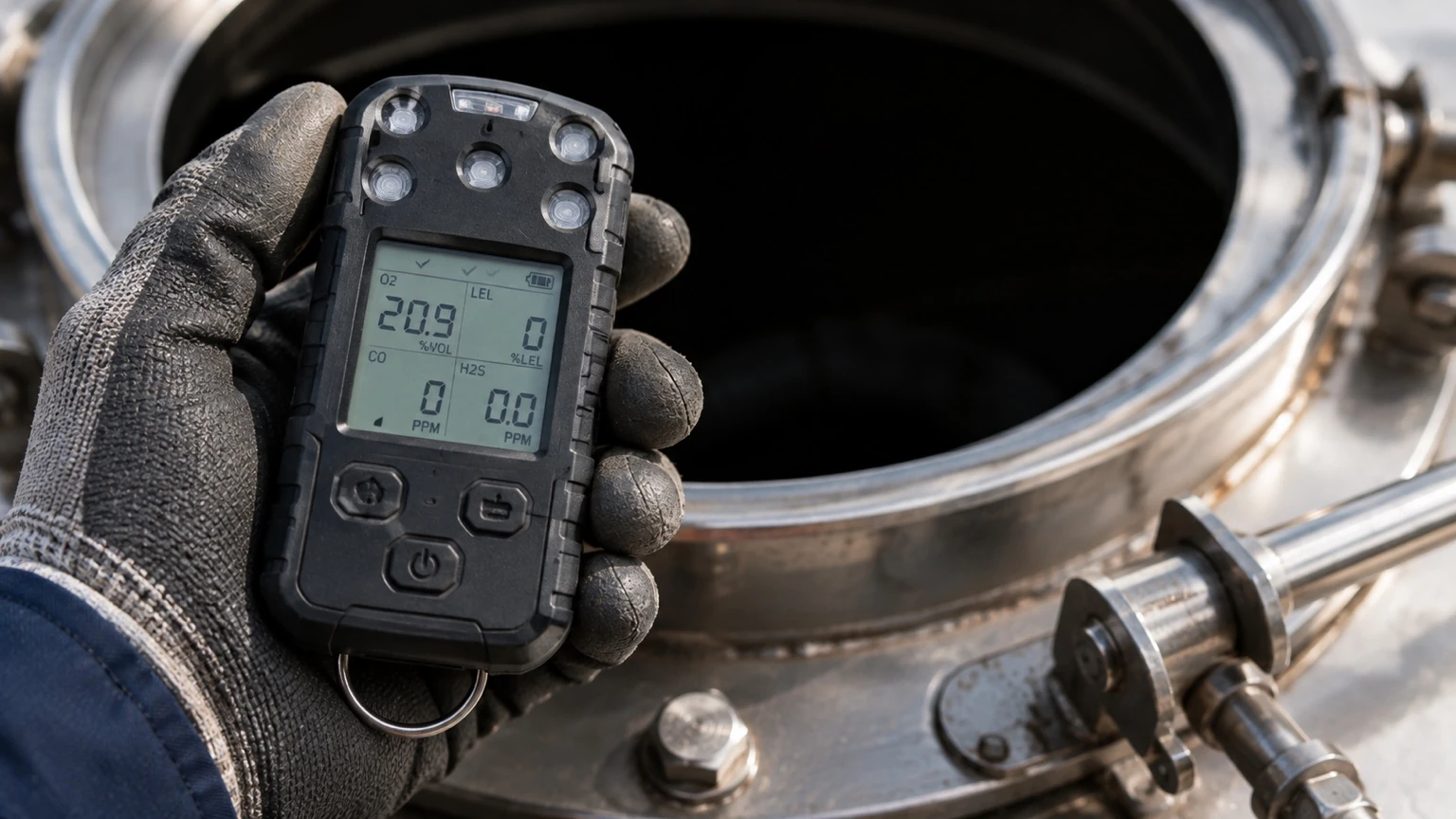
Testing must reflect the actual hazards reasonably expected in that specific space. A standard four-gas meter is often necessary but not always sufficient. If the operation involves a substance the instrument cannot sense, the meter will read "safe" while the space is anything but.
Entry Begins Sooner Than Workers Think
Here is the point that would have changed the FleetPride outcome, and probably dozens of others.
OSHA defines entry as occurring the moment any part of a worker’s body breaks the plane of the opening. Not when they climb all the way in. When their head and shoulders cross the threshold to look, measure, photograph, or grab something, entry has already legally occurred.
This matters because employers and workers routinely treat "just looking inside" as something different from entry. From a hazard standpoint it is worse. Leaning the head through the opening puts your airway into the most concentrated pocket of a hazardous atmosphere, and it positions you so that if you lose consciousness, you fall inward, completing the entry no one authorized.
If your head crosses the plane, you have entered. Full stop.
A Permit Is a Decision, Not a Form
A confined space entry permit exists to force a structured decision before work begins, not to create a record after someone is already inside.
Depending on the space and standard, the permit documents that the following were addressed first:
- The specific space and the purpose of entry
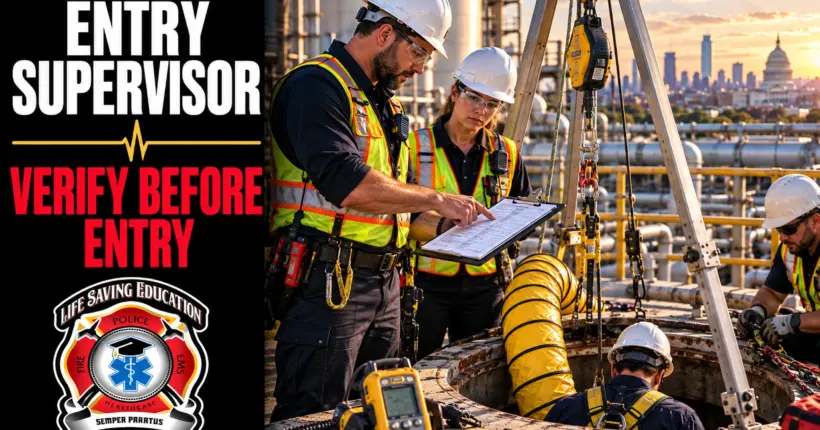
- Authorized entrants, the attendant, and the entry supervisor
- Identified hazards and isolation measures
- Atmospheric test results and ventilation
- Communication systems and required PPE
- Rescue arrangements
- The authorized time window for entry
If the permit is being filled out to justify an entry that has already happened, it is theater. The value is entirely in the pause it creates beforehand.
Ventilation Helps. It Does Not Prove Anything.
Mechanical ventilation can reduce atmospheric hazards. It does not, by itself, prove the space is safe.
A fan can be too small, poorly positioned, or aimed so it recirculates contaminated air. It can miss dead spaces, pull in vehicle exhaust, quit running, or get unplugged mid-job. It can control one hazard while leaving another wide open. Only atmospheric testing confirms whether ventilation is actually producing and holding acceptable conditions.
And ventilation does nothing for the non-atmospheric hazards: electrical energy, moving machinery, stored pressure, engulfment, falls, heat, and restricted egress. Those need their own controls.
Isolation must match the hazard
Before entry, the employer has to determine how the space is isolated from hazardous energy and material. A closed valve is not isolation. Valves leak, get bumped open, or let trapped product seep in.
Real isolation, depending on the equipment, can require lockout or tagout, blanking or blinding, disconnecting piping, double-block-and-bleed, blocking moving components, releasing stored pressure, preventing vehicle movement, securing hatches, and controlling electrical hazards. It is worth noting that OSHA’s citations against FleetPride specifically included electrical hazards alongside the confined space and respiratory findings. These failures cluster. They rarely travel alone.
The Attendant Is a Safety Role, Not a Spare Set of Hands
A permit-space attendant stays outside the space and does one job: protect the entrants.
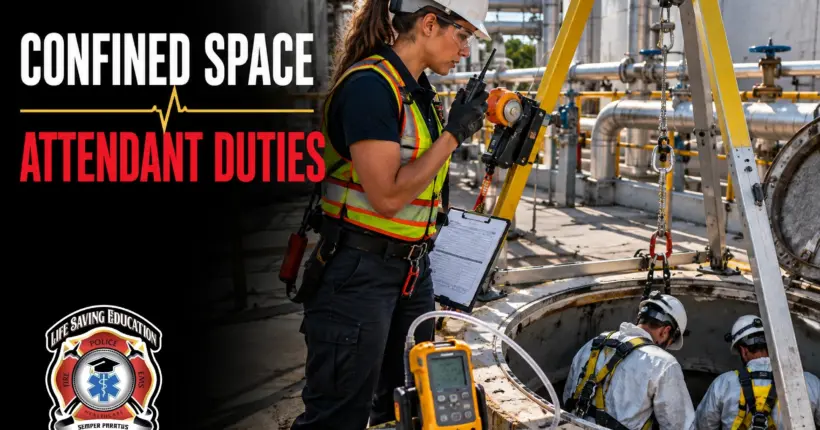
The attendant monitors entrants and conditions, maintains communication, recognizes danger, orders evacuation, summons rescue, and stops unauthorized people from entering. An attendant loaded up with unrelated tasks is not an attendant. They are a bystander with a title.
The attendant is not automatically a rescuer. Entering the space without training, air supply, retrieval gear, and backup is exactly how one victim becomes two. OSHA requires permit-space programs to include procedures for summoning rescue, rescuing entrants, providing emergency services, and preventing untrained people from attempting rescue.
"Call 911" Is Not a Rescue Plan
A rescue plan cannot be the words "call the fire department" written on a permit.
When an outside rescue service is designated, the employer must confirm that service can actually respond in time and perform the specific type of rescue the space demands. The service needs access to plan and practice. OSHA’s own commentary on the standard notes that full compliance is designed to let most permit-space work happen without ever needing a rescue, which is the entire point: rescue is the last layer, not the plan.
Questions that must be answered before entry, not during the emergency:
- Does the rescue service know it has been named?
- Can it arrive fast enough for the hazard involved?
- Does it have the right respiratory protection?
- Can rescuers physically fit through the opening?
- Is rope or mechanical retrieval required?
- Will the patient be suspended vertically?
- Are hazardous materials involved?
- Can the team package and remove an unconscious person?
- Has it practiced in this space or one like it?
A skilled rescue team 40 minutes away is not a meaningful answer to an immediately dangerous atmosphere that kills in minutes.
Plan non-entry rescue whenever you can
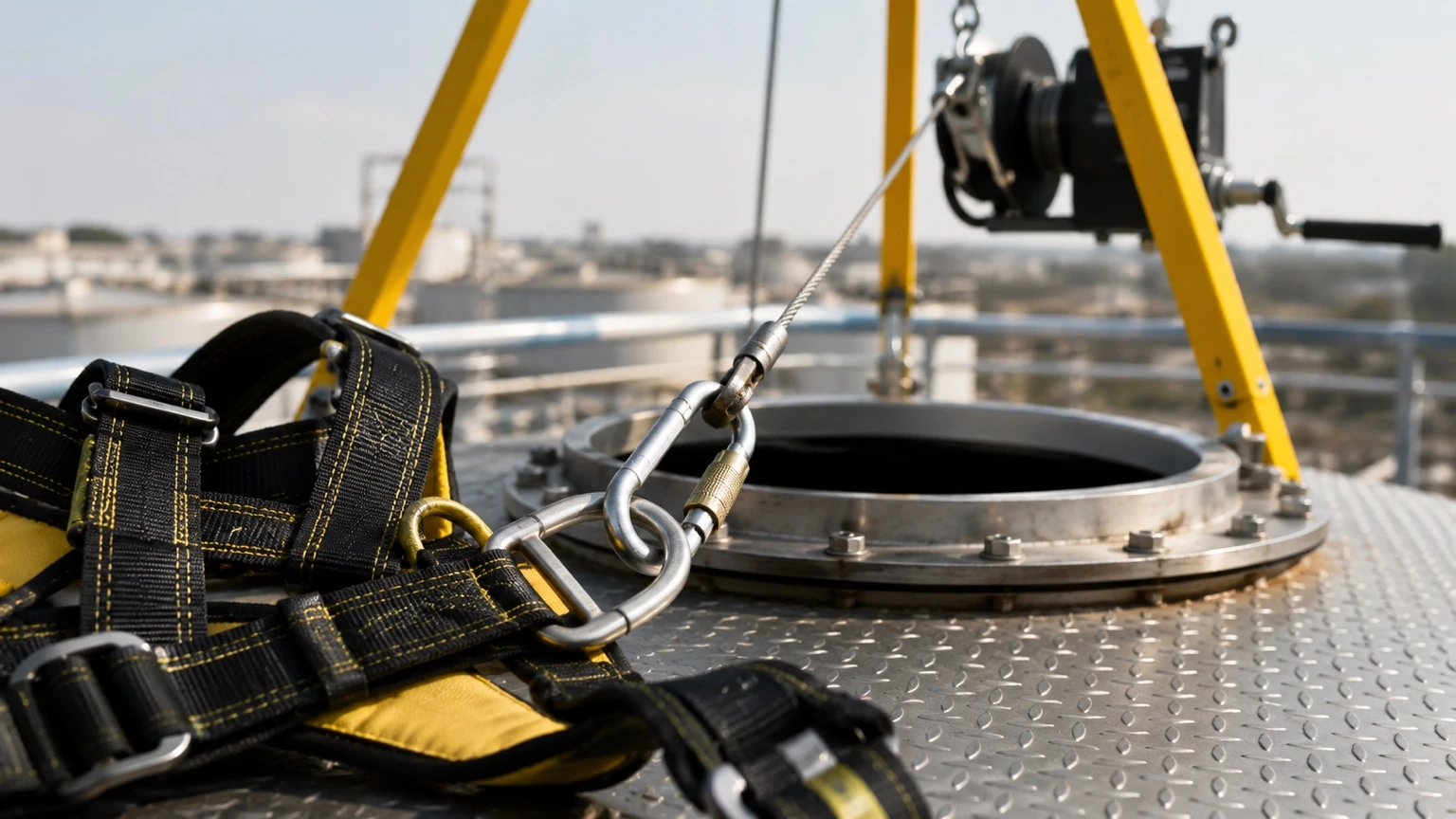
Whenever feasible, a retrieval system lets you pull an entrant out without sending a second person into the hazard. That can mean a full-body harness, a retrieval line, a mechanical winch, and a tripod, davit, or other rated anchorage, arranged so the worker can actually pass back through the opening.
But clipping a rope to a worker does not create a rescue system. The employer has to work out whether the line will snag, whether internal obstructions will trap the body, whether the opening is large enough, whether the anchorage and mechanics are properly rated, and whether the attendant can actually operate it. Retrieval gear has to match the real geometry of the specific space.
Respirators Are Part of a Program, Never a Shortcut
A respirator does not replace identifying and controlling the hazard. OSHA cited FleetPride for deficiencies in its respiratory protection program, and that word, program, is the point.
When respiratory protection is required, the employer generally needs a complete program covering selection, medical evaluation, fit testing, training, inspection, cleaning and storage, cartridge and filter limits, supplied-air requirements, procedures for immediately dangerous atmospheres, and emergency use.
One hard rule saves lives here: air-purifying respirators do not supply oxygen. They filter contaminants from breathable air. In an oxygen-deficient space, or an atmosphere with unknown contaminants or unknown concentration, they offer no protection and a dangerous false sense of one. Oxygen-deficient work requires supplied air.
Why Would-Be Rescuers Die Too
Confined space emergencies create an almost unbearable pull to go in immediately. A coworker sees someone collapse a few feet away and believes the save will take five seconds. They climb in, hit the same atmosphere, and go down beside the first victim.
This is the single most documented pattern in confined space fatalities, and it is why the plan has to exist before the emergency, not be invented during it. A sound response looks like this:
- Recognize the emergency
- Prevent anyone else from entering
- Summon the designated rescue service
- Start non-entry retrieval if feasible
- Ventilate when appropriate
- Monitor the atmosphere
- Ready respiratory protection
- Control hazardous energy
- Establish command and accountability
- Provide patient care immediately after removal
Unplanned entry feels like courage. In a confined space it is how the casualty count doubles.
Confined Space Safety: What This Case Asks of Employers
The FleetPride case reinforces a short list of responsibilities that do not depend on the outcome of the citations.
- Identify your spaces before assigning work. Keep an inventory of confined and permit-required spaces. A worker should never have to classify a space after they have already arrived with a task in hand.
- Evaluate the task, not just the location. Inspection, cleaning, welding, coating, and product removal can each create different hazards in the same space.
- Test for the actual hazards. Base testing on previous contents, chemicals used, the work process, and foreseeable reaction or decomposition products.
- Control entry. Signs, written procedures, permits, supervision, and training should make informal or unauthorized entry impossible, not merely discouraged.
- Verify rescue capability in advance. Method, equipment, response time, and the responsible service all get confirmed before anyone crosses the opening.
- Coordinate on multi-employer sites. When a host and contractors share a space, hazard information and entry procedures must be shared. One employer’s shortcut cannot become another employer’s fatality.
What This Case Asks of Fire and Rescue Teams
If your department could be dispatched to an industrial confined space rescue, you should know which local businesses are quietly counting on you.
Pre-incident planning should capture space locations, entry dimensions, vertical and horizontal access, stored products, atmospheric hazards, lockout points, anchor options, ventilation locations, patient-removal paths, communication limits, required respiratory protection, site contacts, and after-hours access. No crew should be discovering during an active entrapment that they were named as the rescue service for a complex facility they have never set foot in.
And rescue teams have to practice realistic patient removal. Dragging a limp, adult-weight human through a narrow tanker manway is a completely different problem than lowering a light mannequin through a clean training prop.
Key Takeaways
- A confined space is defined by its characteristics, not by how dangerous it looks. A parked tanker trailer qualifies.
- Entry begins the instant any body part crosses the opening. "Just looking inside" is entry, and it puts your airway in the worst spot.
- Atmospheric hazards are invisible. Test for oxygen, then combustibles, then toxics, every time, with the right instrument.
- "Call 911" is not a rescue plan, and the attendant is never the backup rescuer.
- When you cannot prove your program protects the next entrant, stop entering, which is exactly what the company in this case did after the death.
Frequently Asked Questions
Is a tanker trailer really a confined space?
Yes, when it meets OSHA’s three-part test: large enough to bodily enter and work, limited or restricted entry and exit, and not designed for continuous occupancy. A tanker trailer entered for inspection, cleaning, or repair typically meets all three. If it can also hold a hazardous atmosphere or other serious hazard, it becomes a permit-required confined space.
When does OSHA consider that a worker has "entered" a confined space?
As soon as any part of the worker’s body breaks the plane of the opening. A worker leaning their head and shoulders inside to look or measure has already entered under the standard, even if their feet never leave the ground.
Do I need a permit and testing if the worker is only inspecting, not doing repairs?
The task does not exempt you. Inspection still involves entry, and the atmosphere does not care why you came. If the space is permit-required, the pre-entry evaluation, testing, permit, attendant, and rescue arrangements apply regardless of how brief or routine the job seems.
Isn’t running a fan enough to make a confined space safe?
No. Ventilation can reduce atmospheric hazards but cannot prove the space is safe, and it does nothing for non-atmospheric hazards like electrical energy, engulfment, or falls. Only atmospheric testing confirms whether ventilation is actually producing and maintaining acceptable conditions.
Can my crew rescue a coworker who collapses inside a tank?
Not without training, air supply, retrieval equipment, and a plan. Untrained rescue is the leading way a single confined space fatality becomes multiple. The safe response is to prevent further entry, summon your designated rescue service, and use non-entry retrieval whenever it is feasible.
Train Your Team Before the Space Does It for You
Confined space safety is not about responding well after a worker collapses. It is about building a system that keeps the collapse from ever happening: identify the space, evaluate the hazards, test the atmosphere, isolate the energy, control and authorize entry, post a real attendant, verify rescue, and refuse impulsive rescue attempts.
If your people enter tanks, trailers, vaults, pits, or vessels, that system is worth building before an inspector or a coroner builds it for you. Life Saving Education provides confined space and permit-required entry training, respiratory protection guidance, and hazmat and HAZWOPER instruction for employers, crews, and first responders.
Recommended training
- Confined Space Training Hub for awareness, entrant, attendant, supervisor, and non-entry rescue options
- Confined Space Awareness
- Confined Space Authorized Entrant and Attendant
- Confined Space Entrant, Attendant and Entry Supervisor
- Confined Space Non-Entry Rescue
- 40-Hour HAZWOPER Initial Training
- 24-Hour HAZWOPER Initial Training
- 8-Hour HAZWOPER Annual Refresher
- Request onsite group training or a program review
I would rather teach your crew on a Tuesday than help recover one of them on a Wednesday.
Sources
- OSHA news release, “US Department of Labor cites big rig parts distributer for confined space, safety hazards after worker fatality at company’s Corpus Christi facility,” July 15, 2026.
- U.S. Department of Labor newsroom, same release, July 15, 2026.
- 29 CFR 1910.146, Permit-Required Confined Spaces.
- 29 CFR 1910.146, full text with appendices.
- Occupational Health & Safety, “OSHA Cites FleetPride Following Fatal Corpus Christi Incident”, July 16, 2026.
Disclaimer
This article is provided by Life Saving Education for general educational purposes only. It is not legal, medical, or compliance advice, and it is not a substitute for hands-on training or professional guidance. OSHA requirements vary by industry, work activity, jurisdiction, and specific conditions, and citations described here are allegations that the employer has the right to contest. Regulations and clinical guidelines change and vary by state. Verify current requirements for your situation with the applicable federal or state-plan standards and qualified occupational-safety guidance. In an emergency, call 911.