💡 Compliance note: This article is general safety education and does not replace an employer-specific hazard assessment, emergency response plan, or applicable OSHA requirements.
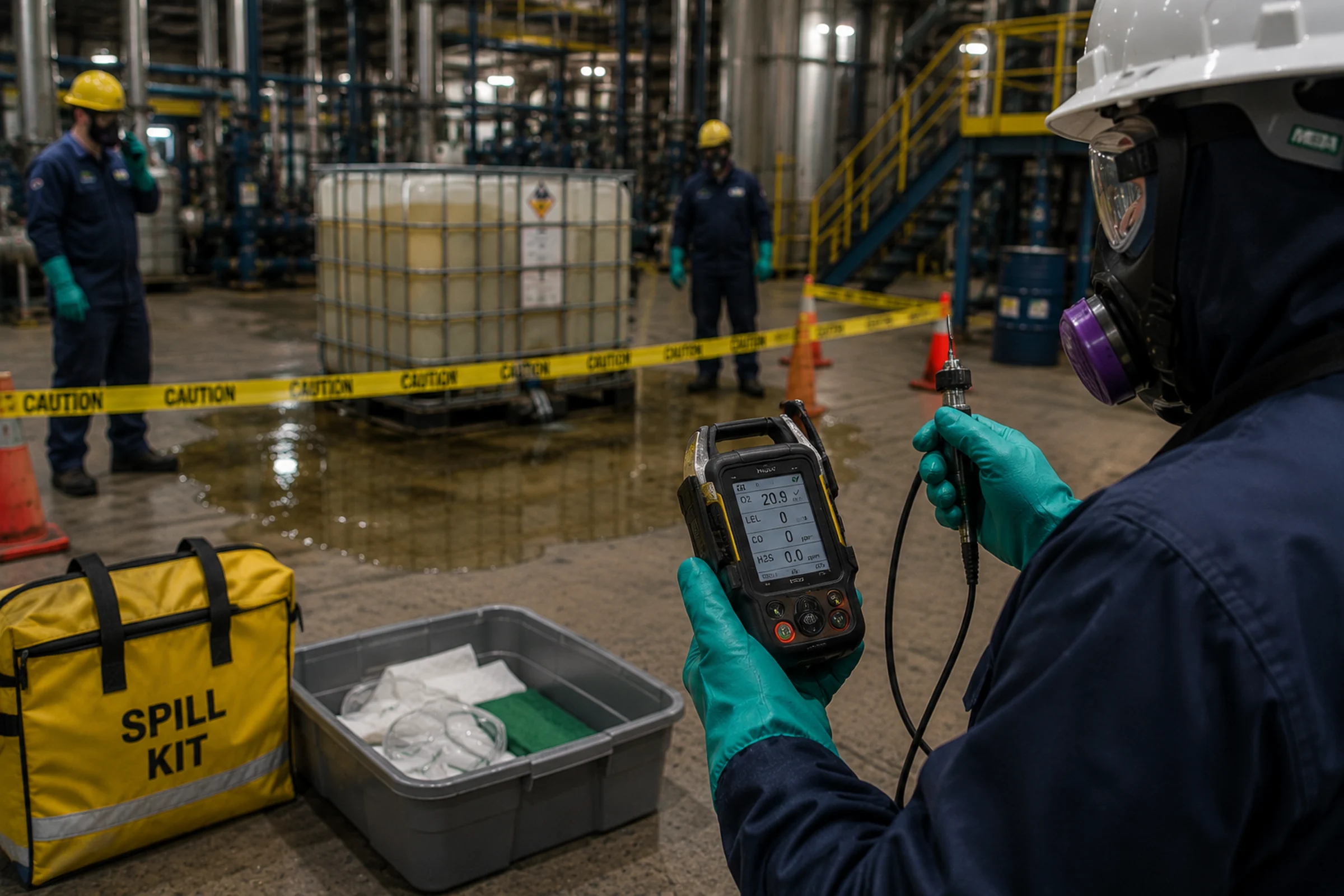
A container falls.
A valve fails.
A hose separates.
A chemical begins leaking onto the floor.
Someone’s first instinct is often:
“Get the spill kit.”
But before anyone reaches for absorbent material, there is a much more important question:
Is this actually a spill employees are supposed to clean up, or has it become an emergency response?
Under OSHA’s Hazardous Waste Operations and Emergency Response standard, commonly called HAZWOPER, that distinction matters.
Getting it wrong can expose employees who expected to perform routine cleanup to an atmosphere or chemical hazard they were never equipped, trained or organized to handle.
Not Every Chemical Spill Is a HAZWOPER Emergency
This is one of the most common misconceptions surrounding 29 CFR 1910.120.
OSHA does not automatically classify every release of a hazardous substance as a HAZWOPER emergency response.
Some releases are considered incidental.
An incidental release is limited enough that it does not pose a significant safety or health hazard to employees in the immediate area or to the employees cleaning it up, and it does not have the potential to rapidly become an emergency.
Employees familiar with the material and its hazards may be able to safely control such a release using the equipment and procedures provided by their employer.
But that definition has an important implication:
You cannot determine whether a release is incidental simply by looking at how much liquid is on the floor.
Quantity Alone Does Not Answer the Question
A small release can create a serious emergency.
A larger release of another material under controlled conditions may present a very different risk.
The important questions include:
- What substance was released?
- How much?
- At what concentration?
- What are its toxicological properties?
- Is it volatile?
- Is it flammable?
- Could it react with water or another material?
- Is the area ventilated?
- Could vapor accumulate?
- Could the atmosphere become oxygen-deficient?
- Could employees be exposed above safe limits?
- Is respiratory protection required?
- Could the release spread?
- Could conditions deteriorate rapidly?
- Do employees actually know what the substance is?
The physical environment and properties of the material matter as much as the visible size of the spill.
The Question OSHA Is Really Asking
A useful way to think about the distinction is:
Can employees in the immediate area safely control this release using the training, PPE and equipment already available to them without entering an emergency condition?
If the answer is yes, the event may qualify as incidental.
If the answer is no, the employer may be dealing with an emergency response covered by HAZWOPER.
OSHA’s enforcement guidance recognizes three broad categories:
- Releases that are clearly incidental.
- Releases that may be incidental or emergency responses depending on circumstances.
- Releases that clearly require emergency response.
That middle category is why a simplistic “spill size” rule can be dangerous.
Context changes everything.
Warning Signs That This May Be an Emergency
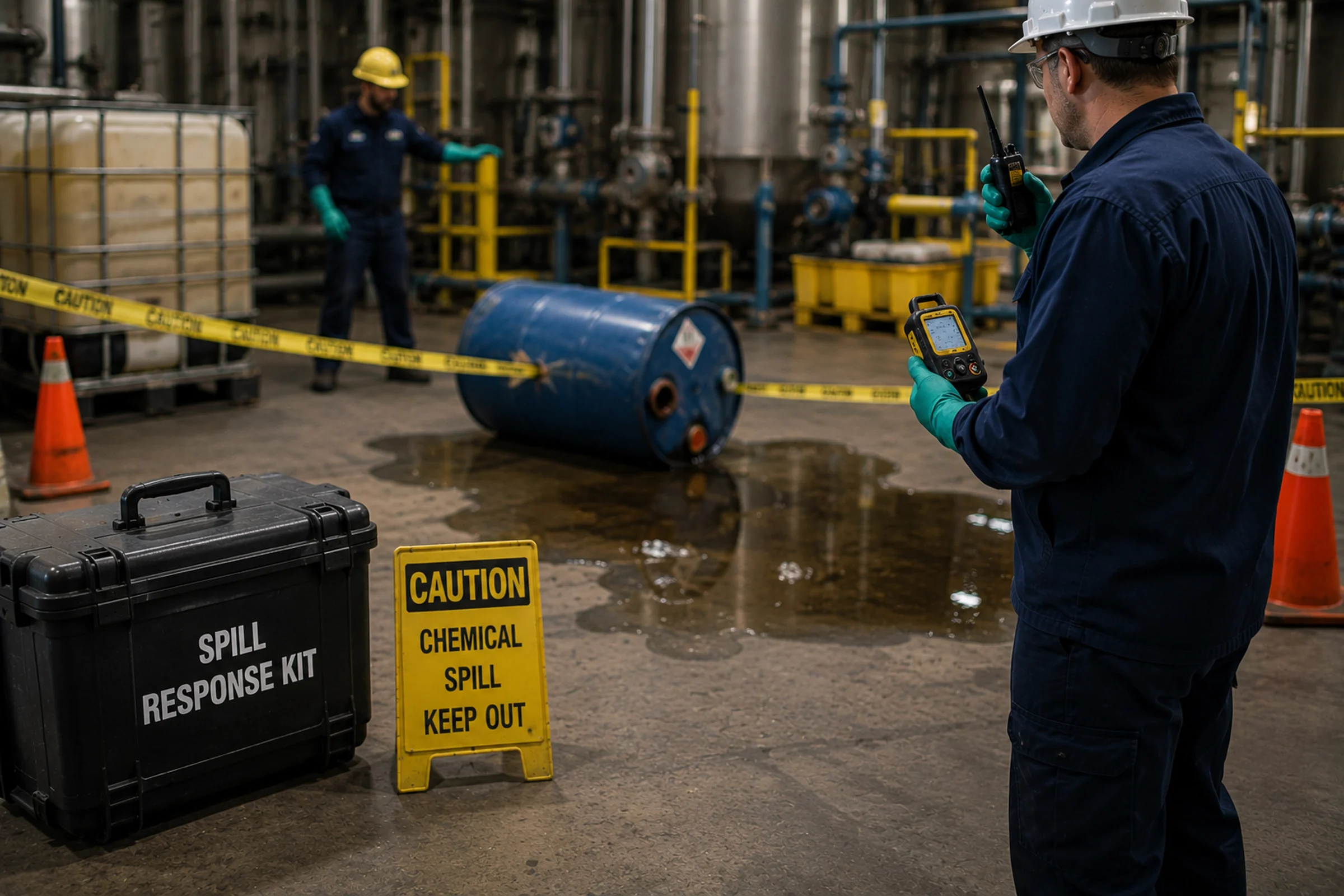
Employees and supervisors should become especially cautious when a release involves conditions such as:
- an unknown substance,
- an unknown concentration,
- significant toxic inhalation potential,
- a potentially oxygen-deficient atmosphere,
- a flammable or explosive atmosphere,
- a rapidly spreading vapor cloud,
- a release requiring evacuation,
- a reaction generating heat or toxic gas,
- a situation requiring specialized chemical protective clothing,
- an IDLH atmosphere or the reasonable potential for one,
- or circumstances beyond the capabilities of employees working in the immediate area.
At that point, the correct action may not be to clean up the spill.
It may be to isolate the area, deny entry, activate the emergency plan and call appropriately trained responders.
The Spill Kit Can Create False Confidence
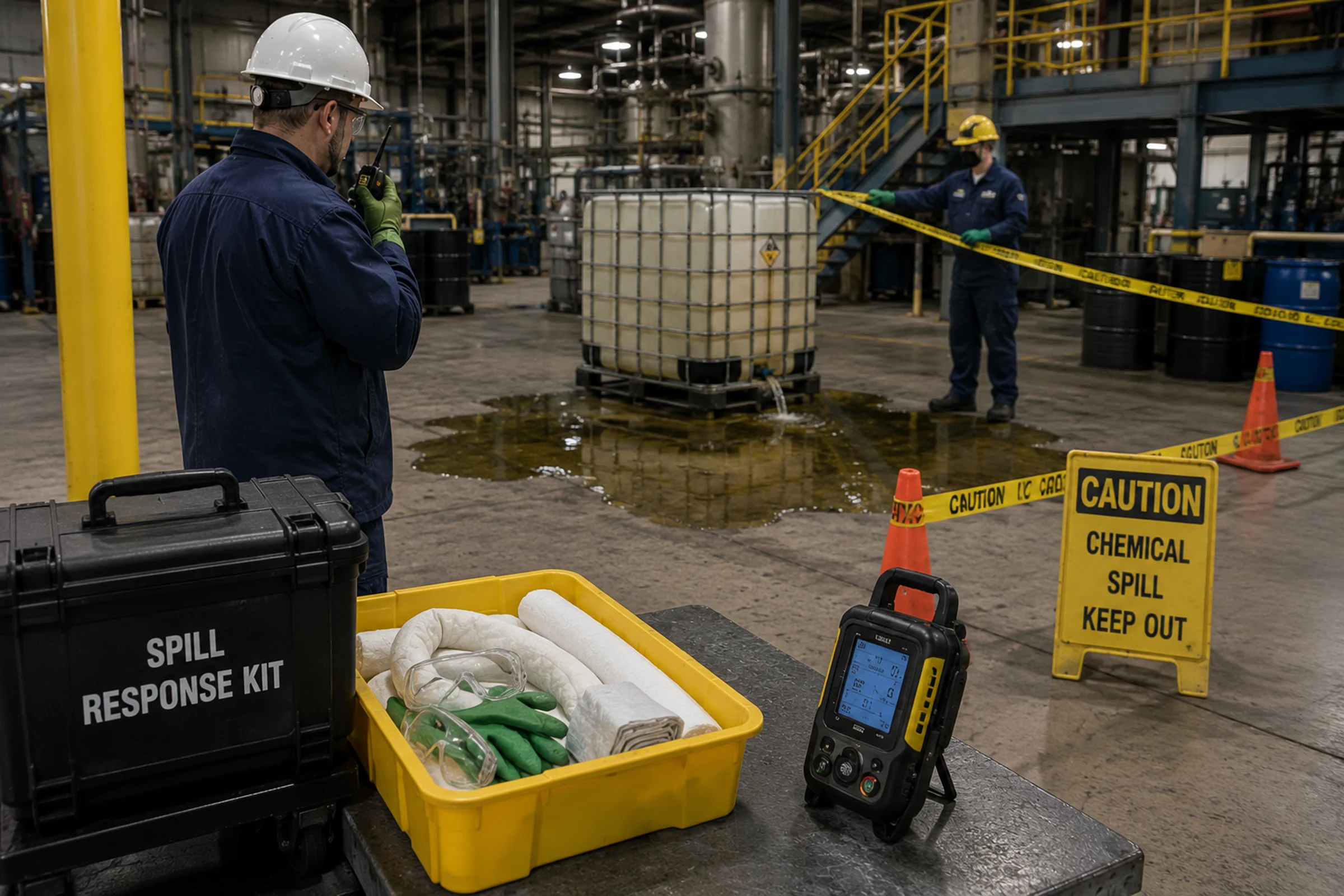
Spill kits are useful tools.
They are not permission to approach every release.
A spill kit may contain absorbent pads, socks, neutralizers, disposal bags, gloves and other equipment.
But none of those items answer the first questions that matter:
- What is the chemical?
- What is the airborne concentration?
- Is the atmosphere flammable?
- Is oxygen adequate?
- Is respiratory protection required?
- Will the gloves in the kit actually protect against this material?
A box labeled “spill kit” can create a psychological shortcut.
Employees see the kit and assume the employer expects them to use it.
That assumption can be dangerous if the release exceeds the employee’s training or PPE.
“Just Put on a Respirator” Is Not a Response Plan
Respiratory protection adds another layer of complexity.
An employee cannot simply put on whatever respirator is available and enter an unknown chemical atmosphere.
Respirator selection depends on the contaminant, concentration, oxygen level and other conditions.
Some atmospheres require supplied-air respiratory protection or self-contained breathing apparatus.
An unknown atmosphere should not be treated as though an air-purifying respirator automatically makes it safe.
If employees need respiratory protection because the release has created an emergency condition, the employer may already be in HAZWOPER emergency-response territory.
Emergency Response Requires an Organized System
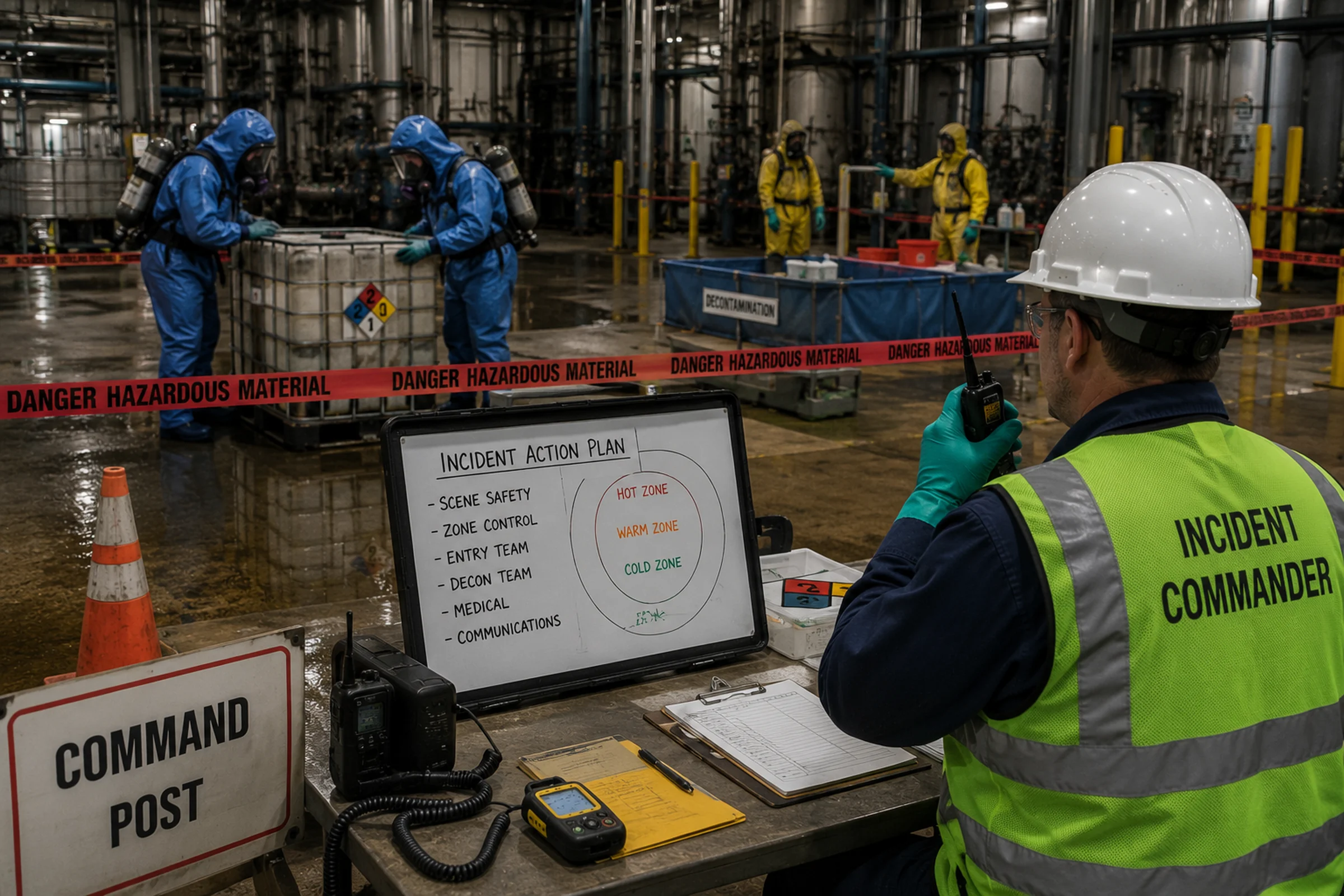
HAZWOPER emergency response is not simply “send someone in wearing more PPE.”
It requires an organized response system.
Depending on the workplace and response plan, that can include:
- an emergency response plan,
- defined responder roles,
- incident command,
- site control,
- hazard evaluation,
- PPE selection,
- air monitoring,
- decontamination,
- medical surveillance,
- emergency medical support,
- and training appropriate to each responder’s function.
That is why a workplace cannot improvise a hazmat team after the release occurs.
The structure has to exist before the emergency.
Awareness Is a Real Job
One of the most important HAZWOPER concepts is that not every employee needs to enter the hazard area.
First Responder Awareness Level personnel are trained to recognize the presence of hazardous substances, protect themselves, initiate the emergency response sequence and make appropriate notifications.
Their role is not to stop the leak.
That distinction can be difficult in workplaces where employees are accustomed to fixing problems.
In a chemical emergency, backing away, isolating the area and calling for trained resources may be exactly the correct professional action.
Emergency Response and Cleanup Are Different Questions
Another frequent source of confusion is what happens after the immediate emergency ends.
The emergency-response provisions of HAZWOPER and post-emergency cleanup requirements are related but not identical questions.
Who can perform cleanup depends on the circumstances, employer’s role, hazards present and applicable OSHA requirements.
Employers should not assume that because the active leak has stopped, any employee can now enter and clean the area.
Residual contamination may still require protective equipment, monitoring, training and controlled work practices.
HazCom Still Matters
Even when a release does not rise to the level of a HAZWOPER emergency response, OSHA’s Hazard Communication requirements may still apply.
Employees need information about the chemicals they work with.
That includes:
- labels,
- safety data sheets,
- hazard information,
- training,
- and appropriate protective measures.
HAZWOPER does not replace Hazard Communication.
And Hazard Communication does not replace the employer’s responsibility to assess workplace hazards and protect employees from them.
“Not HAZWOPER” does not mean “not hazardous.”
What Supervisors Should Ask Before Anyone Cleans Up a Release
Before directing an employee to intervene, a supervisor should be able to answer several basic questions.
- Do we know exactly what was released?
- Do we understand its hazards?
- Can the release be controlled safely with the equipment already available?
- Are the employees expected to perform the task trained for it?
- Is their PPE appropriate for this chemical?
- Could the atmosphere become unsafe?
- Is monitoring necessary?
- Could the situation escalate?
- Is evacuation required?
If those answers are uncertain, uncertainty itself may be a reason to stop and escalate the response.
A Better Training Scenario
Instead of teaching workers:
“If you see a spill, get the spill kit,”
give them a decision-making exercise.
Place a simulated leaking container in a work area.
Provide an SDS.
Give them information about ventilation and quantity.
Then change one variable.
The label is unreadable.
An employee reports dizziness.
The detector alarms.
The product begins reacting.
The leak is moving toward a drain.
The room has limited ventilation.
Ask the employee:
At what point do you stop being the person who cleans this up and become the person who calls for emergency response?
That is the decision HAZWOPER training needs to develop.
The Bottom Line
The most dangerous chemical spill may not be the largest one.
It may be the release that looks manageable enough to encourage an unprotected employee to approach it.
The line between an incidental release and a HAZWOPER emergency is based on hazard, circumstances and response capability, not simply the number of gallons on the floor.
Before employees intervene, they should know:
- what the material is,
- what it can do,
- whether the atmosphere is safe,
- whether their PPE is appropriate,
- whether their training matches the task,
- and when their job is to back away and activate the emergency plan.
The goal of chemical-spill training is not to make every employee a hazmat technician.
It is to make sure employees know the difference between a problem they can safely control and an emergency they should not enter.
✅ Training Takeaway
Before asking, “How do we clean this up?” ask a more important question:
“Are we still dealing with an incidental release?”
That decision point can prevent the first exposure from becoming several.
🧭 Quick Decision Check
- Known material? Confirm the substance and hazards before approaching.
- Atmosphere understood? Consider oxygen, flammability, toxicity, and whether monitoring is needed.
- Employee capability? Training, PPE, and equipment must match the task.
- Potential to escalate? If conditions can rapidly become dangerous, stop and activate the emergency response plan.
❓ Frequently Asked Questions
Does every hazardous chemical spill require HAZWOPER emergency response?
No. OSHA distinguishes incidental releases from emergencies based on the hazard, circumstances, and whether employees can safely control the release with their normal training and equipment.
Can spill size alone determine whether a release is incidental?
No. A small release of a highly toxic, volatile, reactive, or unknown substance can present greater danger than a larger controlled release of another material.
Does having a spill kit mean employees should clean up the release?
No. A spill kit is equipment, not a hazard assessment. Employees still need to know what was released, whether the atmosphere is safe, and whether their PPE and training are appropriate.
What should an awareness-level employee do during a hazardous-materials emergency?
Recognize the hazard, protect themselves, isolate or deny entry when appropriate, initiate the emergency response sequence, and make the required notifications rather than entering the hazard area.
Build the Decision Before the Spill
Employees should know when they can safely control a release and when their job is to isolate, notify, and wait for trained emergency responders.
🔗 Continue Learning with LSE
- HAZWOPER Training for 40-hour, 24-hour, 8-hour refresher, and role-based training guidance.
- HAZWOPER and HazMat Response Guide for responder roles and emergency-response concepts.
- HAZWOPER 40 vs. 24 vs. 8 to understand which training level fits different work assignments.
- 24-Hour HAZWOPER Initial Training and 40-Hour HAZWOPER Initial Training.
- 8-Hour HAZWOPER Annual Refresher for applicable refresher training.
📚 Regulatory References
- 29 CFR 1910.120, Hazardous Waste Operations and Emergency Response.
- 29 CFR 1910.120(q), Emergency Response to Hazardous Substance Releases.
- OSHA guidance concerning incidental releases and emergency response.
Employers should evaluate the standards applicable to their particular industry, substances, workplace and response plan. This article is educational and does not replace an employer-specific hazard assessment or applicable regulatory requirements.