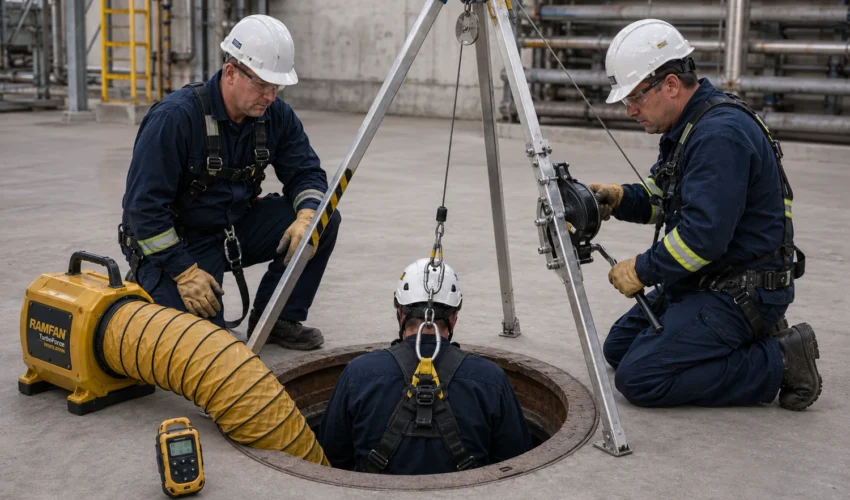
Confined Space Non-Entry Rescue
-
Onsite at your location or a scheduled classroom. Washington DC and East Coast.
Practice tripod, retrieval, communication, packaging, and non-entry rescue procedures in controlled scenarios.
This practical course focuses on non-entry retrieval systems, equipment inspection, setup, communication, patient considerations, and controlled rescue scenarios. It is not a substitute for technical confined-space rescue training where entry rescue may be required.
At a Glance
| Format | Instructor-led practical course |
|---|---|
| Duration | Approximately 8 hours; equipment and scenario complexity may require additional time. |
| Price | $349 — contact us to register |
| Who it is for | Entry teams and designated personnel who may perform non-entry retrieval under an employer’s confined-space program. |
| Prerequisites | Appropriate prior confined-space role training. Employer-provided or course-provided equipment must be compatible with intended operations. |
| Credential | LSE course completion documentation for the training performed. This does not establish a complete technical rescue-team capability. |
| Class size | 6-12 |
What You Will Learn
- Inspect retrieval equipment
- Set up a compatible non-entry retrieval system
- Coordinate entrant, attendant, and retrieval roles
- Perform controlled retrieval scenarios
- Recognize when non-entry rescue is not feasible
Course Outline
Planning and Limitations
When non-entry rescue applies
Equipment
Inspection, compatibility, and setup
Operations
Communication and retrieval procedures
Practical Scenarios
Controlled team exercises
Evaluation
Performance review and documentation
Your Instructors
Life Saving Education courses are taught by a team of experienced instructors. Every LSE instructor is at least a paramedic with teaching experience, and many bring additional firefighter, clinical, technical-rescue, or occupational-safety backgrounds. The assigned instructor may vary by course, location, and specialty.
Important Program Notices
Confined Space Program Notice
Confined space training supports, but does not replace, the employer’s written permit-required confined space program under 29 CFR 1910.146. Employers remain responsible for space evaluation, permits, equipment, rescue arrangements, and site-specific procedures.
Completion Documents
Completion documents are issued by the applicable certifying organization after all attendance, skills, testing, and administrative requirements are met. A generic site certificate is never a substitute for an official course completion card or eCard. The organization imposing your training requirement decides what it will accept; verify the required course and completion document before registering.
Register or Request a Quote
Seats are scheduled directly with our team so we can confirm the right course, format, and date for you. Call 617-840-0113, email Lifesavingedu@gmail.com, or send us a message. Group and onsite training available across the East Coast.
LSE - Training, Education & Editorial Team
Life Saving Education provides practical, real-world training in emergency medicine, fire and rescue services, workplace safety, and occupational health. Our instructor team brings frontline experience from EMS, fire service, nursing, workplace safety, and professional education into every course we teach.
We deliver hands-on and classroom training for healthcare professionals, emergency responders, businesses, organizations, and individuals, with instruction grounded in current standards, evidence-based practices, and real-world application.
Life Saving Education also publishes educational articles, safety updates, training resources, and professional insights designed to help students and working professionals build knowledge, confidence, and skills they can apply when it matters most.
You might be interested in
-
500 Students
-
10 lessons
-
Lifetime
-
600 Students
-
10 lessons
-
Lifetime