Prepared by the LSE Editorial Team. Reviewed by Joseph Andrade, Jr., RN, NRP.
People often ask for an “OSHA 30 certification,” but that wording can create the wrong impression. The course provides broader safety and health education than OSHA 10 and gives instructors more time to address hazard recognition, controls, worker rights, and safety responsibilities. Whether you actually need the card depends on your employer, project, contract, jurisdiction, or other organization setting the requirement.
✅ Key takeaways
- OSHA 30 is an Outreach Training Program course, not an OSHA certification.
- The 30-hour course is generally more appropriate for supervisors and workers with safety responsibility.
- Construction and General Industry are separate Outreach programs with different required topics.
- Federal OSHA does not require Outreach training, although states, municipalities, employers, unions, owners, and contracts may require it.
- OSHA student course completion cards do not have a federal expiration date, but the organization requiring the card can set its own acceptance or renewal rules.
🎓 What OSHA 30 is
OSHA-authorized Outreach trainers deliver 10-hour and 30-hour classes. OSHA describes the 10-hour course as worker hazard awareness and says the 30-hour course is more appropriate for supervisors or workers with some safety responsibility. Students who successfully complete the required class receive an Outreach student course completion card.

🏗️ Construction or General Industry?
The right course depends on the work. OSHA 30 Construction is built around construction hazards and program requirements. OSHA 30 General Industry addresses hazards found across non-construction workplaces. OSHA also has separate Outreach programs for Maritime and Disaster Site Worker training.
| Course | Best fit | Important point |
|---|---|---|
| OSHA 30 Construction | Construction work and construction safety responsibilities | Uses the Construction Outreach topic framework. |
| OSHA 30 General Industry | Non-construction workplaces covered by the General Industry program | Uses a different topic framework matched to that sector. |
🚫 What OSHA 30 is not
- It is not a certification or license. OSHA’s Outreach FAQ specifically says an OSHA card is not considered a certification or license.
- It is not a substitute for required standard-specific training. Outreach provides broad safety and health information and does not fulfill an employer’s duty to train employees under specific OSHA standards.
- It does not make the student an OSHA-authorized trainer. Trainer authorization requires separate prerequisites and OSHA trainer courses through an OTI Education Center.

🦺 What does OSHA 30 cover?
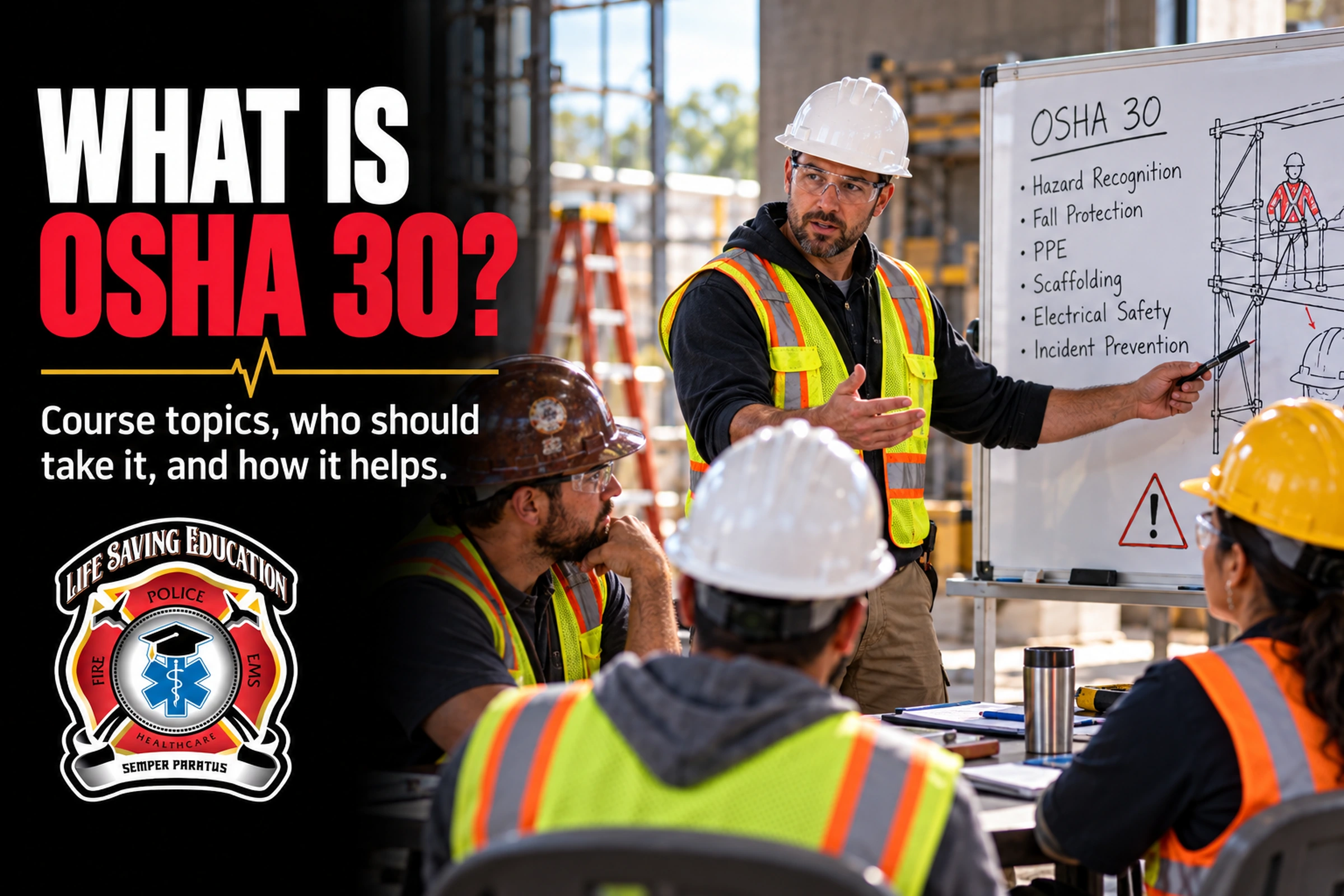
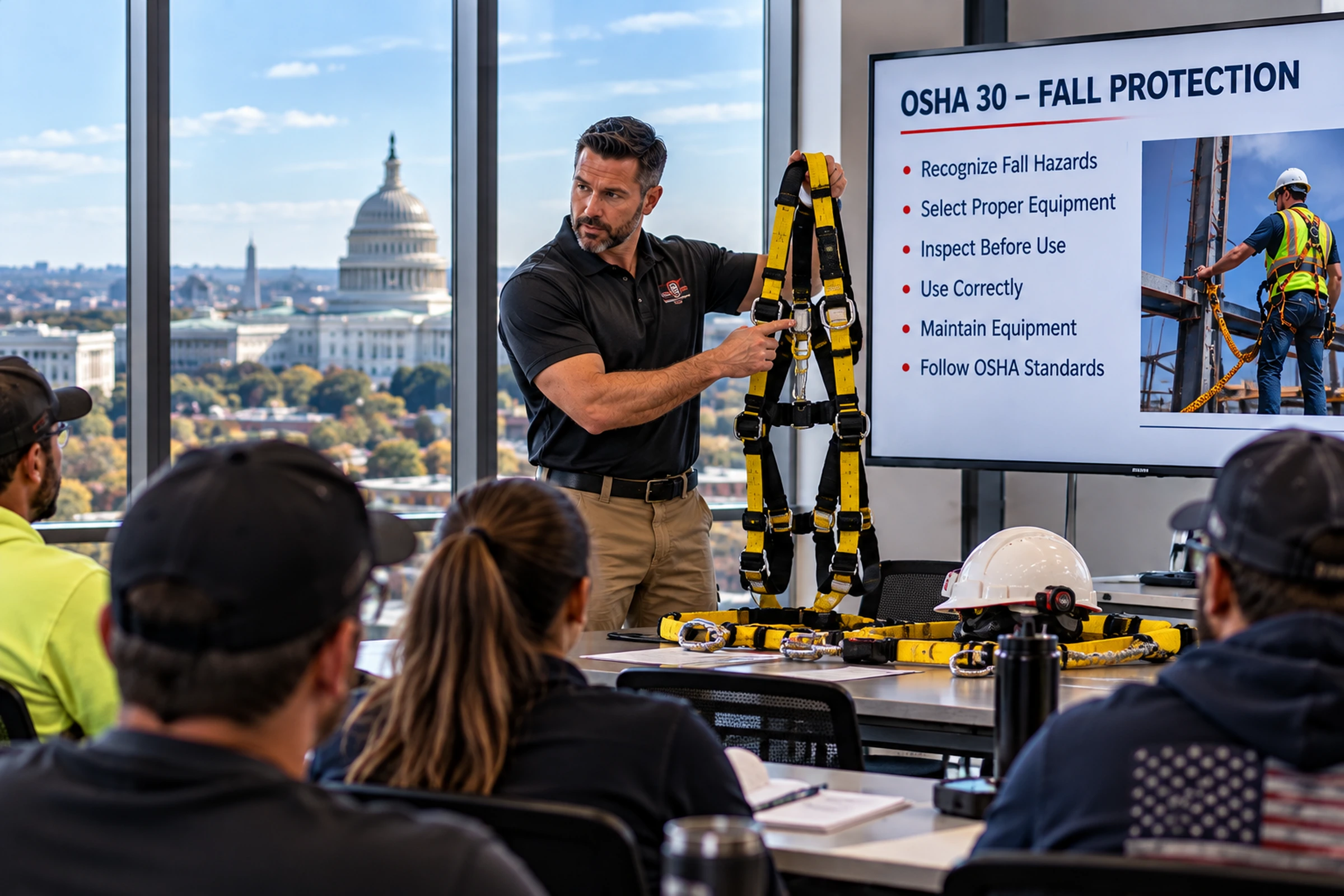
OSHA establishes mandatory and elective topic requirements, while authorized trainers can tailor portions of the course to the audience. Construction training commonly addresses worker rights and employer responsibilities, managing safety and health, fall hazards, electrocution, struck-by and caught-in/between hazards, PPE, health hazards, and other construction topics. General Industry uses a different topic framework matched to that sector.
The additional class time gives instructors more room to connect hazard recognition with controls, work practices, and supervisory decisions. That makes the 30-hour format useful for people who have responsibility for more than their own individual tasks.
👷 Who actually needs an OSHA 30 card?
Federal OSHA describes Outreach as voluntary. Requirements commonly come from an employer or general contractor, a public or private contract, a union or owner policy, or state and local law.
New York City, for example, has its own Site Safety Training system for covered construction work. Workers should confirm the exact OSHA card and SST requirements that apply to their role rather than assuming any OSHA 30 card will satisfy the requirement.
If you are deciding between course levels, see what to expect at an OSHA 10 class.
🪪 Does an OSHA 30 card expire?
OSHA states that student course completion cards in Construction, General Industry, Maritime, and Disaster Site do not have a federal expiration date. Because Outreach is voluntary at the federal level, the employer or organization mandating the training determines what it will accept. A state, municipality, project owner, employer, or union can impose a more recent-training requirement.
🔄 What if you lose your OSHA 30 card?
Contact the trainer or online provider that delivered the course. OSHA does not maintain the class records needed to replace the card. OSHA says a replacement can only be issued when the class was completed within the previous five years, and only one replacement card may be issued per student per class.
🔎 How to avoid fake or invalid cards
For classroom Outreach, verify that the instructor is currently authorized for the applicable industry. For online training, use an OSHA-accepted online provider. OSHA notes that authorized trainers are independent service providers, not OSHA employees.
A legitimate card documents completion of a legitimate Outreach class. It should never be marketed as a shortcut around required contact hours or course requirements. For a real-world example of why verification matters, read our coverage of fake OSHA and SST cards and the workers caught in the middle.
❓ Frequently asked questions
Is OSHA 30 required by OSHA?
No. Federal OSHA’s Outreach Training Program is voluntary. Other authorities and organizations can require an Outreach card.
Is OSHA 30 a certification?
No. OSHA says the student course completion card is not a certification or license.
Is OSHA 30 better than OSHA 10?
They serve different audiences. OSHA describes the 10-hour class as hazard awareness for workers, while the 30-hour course is more appropriate for supervisors and workers with safety responsibility.
Can OSHA 30 replace confined space, HAZWOPER, lockout/tagout, or other required training?
No. Outreach training does not fulfill an employer’s training obligations under specific OSHA standards. Required task and hazard-specific training still applies.
Can I take OSHA 30 online?
Yes, through an OSHA-accepted online Outreach provider. Students should verify the provider against OSHA’s current accepted-provider information before enrolling.
🎯 Choosing the right training
Start with the requirement driving the card: your job, project, jurisdiction, employer, or contract. Then choose the correct industry and delivery option. LSE provides OSHA 30-Hour training, OSHA 10-Hour training, and employer-focused safety training.
Need OSHA training for your team?
Life Saving Education can help employers select the appropriate OSHA Outreach course and coordinate group training. Start with OSHA 30-Hour Training or compare it with OSHA 10-Hour Training.
📚 Sources and further reading
- OSHA Outreach Training Program
- OSHA Outreach Training Program FAQs
- What to Expect at Your First OSHA 10 Class
- When Online Safety Training Is Not Enough
- Fake OSHA and SST Cards in NYC
Educational note: Outreach program requirements and local mandates can change. Confirm the current requirement for your employer, project, and jurisdiction.