Prepared by the LSE Editorial Team. Reviewed by Joseph Andrade, Jr., RN, NRP.
Life Saving Education. Practical safety education built around real hazards, real decisions, and skills people can use when seconds count.
There is a version of refresher training everyone has experienced.
A clock starts. Slides move. People wait for eight hours to pass. A certificate appears.
That may satisfy someone’s administrative checklist, but it misses the point of HAZWOPER refresher training.
OSHA’s HAZWOPER standard requires annual refresher training for several categories of covered workers. For general site workers covered by 29 CFR 1910.120(e), the refresher is at least eight hours annually. Certain treatment, storage, and disposal facility employees also receive eight hours annually. Emergency-response refresher requirements depend on the employee’s HAZWOPER role and competency provisions.
The rule tells us the minimum time. It does not say the course should be forgettable.
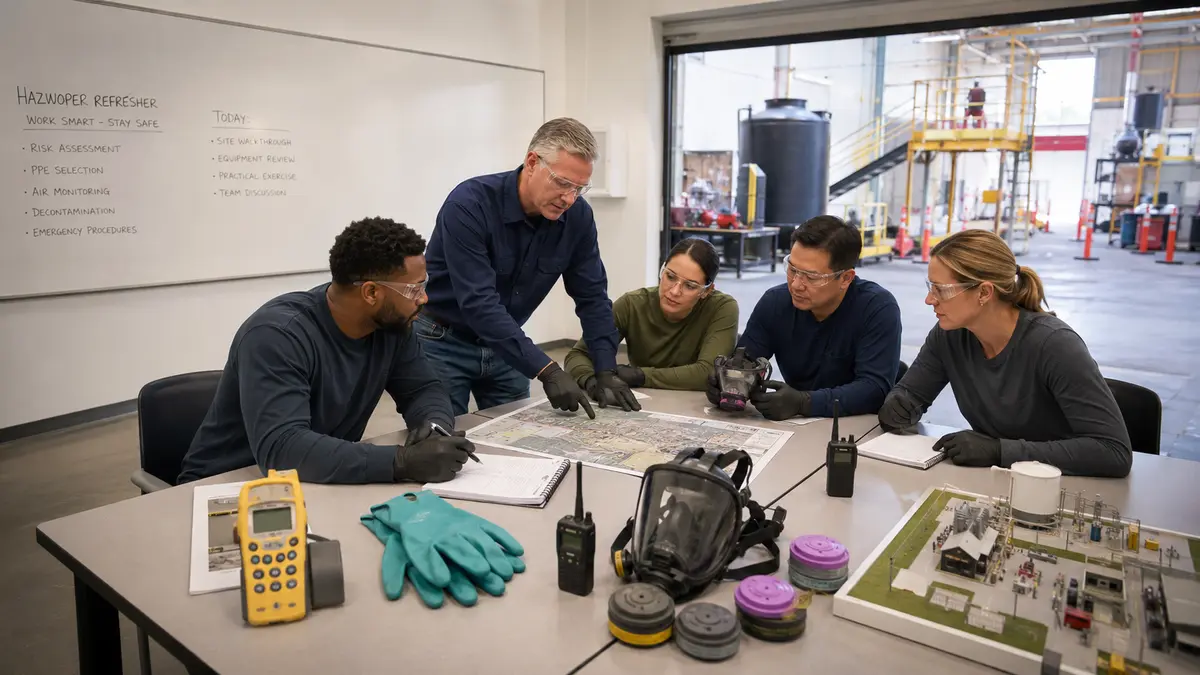
🧭 A useful refresher should reconnect the regulation to the hazards, equipment, decisions, and incidents your employees actually face.
⏱️ HAZWOPER Refresher Training: What OSHA Actually Requires
For covered cleanup-site employees under paragraph (e), OSHA requires eight hours of refresher training annually on the topics specified in the standard, relevant critiques of incidents that have occurred in the past year, and other relevant topics.
OSHA’s own HAZWOPER FAQ says the required eight hours may be delivered in segments as long as the employee completes the full requirement by the anniversary date.
That flexibility can be useful for employers who build refresher learning around real safety meetings, drills, site lessons, and formal instruction, provided the training actually covers the required content and is documented appropriately.
8-Hour HAZWOPER Annual Refresher
40-Hour HAZWOPER Initial Training
📅 Does "Annual" Mean Exactly Every 12 Months?
OSHA has addressed this directly.
Its interpretation letters explain that the agency’s intent is for employees to complete refresher training within twelve months of the initial course or previous refresher.
If a worker misses the anniversary because of unavoidable circumstances, OSHA has said the employee should attend the next available refresher course.
That is not the same as saying the due date does not matter.
Some OSHA-approved State Plans may apply stricter timing, and employers should verify state-specific requirements. An employer also has to decide whether a long gap has eroded the worker’s knowledge enough to require additional training before returning to covered duties.
What if the refresher is very late?
OSHA’s historical interpretations do not create a universal automatic rule that a worker must always repeat the entire 24-hour or 40-hour initial course just because the annual date was missed.
But the employer remains responsible for ensuring the worker is properly trained and capable of performing assigned duties safely.
If the gap is long, the person’s work history has changed, or competence is questionable, simply taking an eight-hour online course may not be the right corrective action.
🧪 Start by Matching the Course to the Work
"HAZWOPER refresher" is not one audience.
A contaminated-site worker, environmental technician, hazardous-waste TSD employee, emergency responder, supervisor, and industrial cleanup worker can need different emphasis.
Before selecting a course, identify:
- which paragraph of 1910.120 applies
- the employee’s work assignment
- anticipated chemical and physical hazards
- PPE and respiratory-protection use
- monitoring equipment
- decontamination procedures
- site-control responsibilities
- emergency-response role
- changes in procedures or hazards since the last course
A course that never resembles the employee’s job is a weak refresher even if the timer reaches eight hours.
🧠 What Should a Strong Refresher Revisit?
OSHA gives employers latitude to design refresher training around their needs.
Hazard recognition
Workers should reconnect hazard classes, exposure routes, toxicology, physical hazards, and site-specific warning signs to real tasks.
PPE selection and limitations
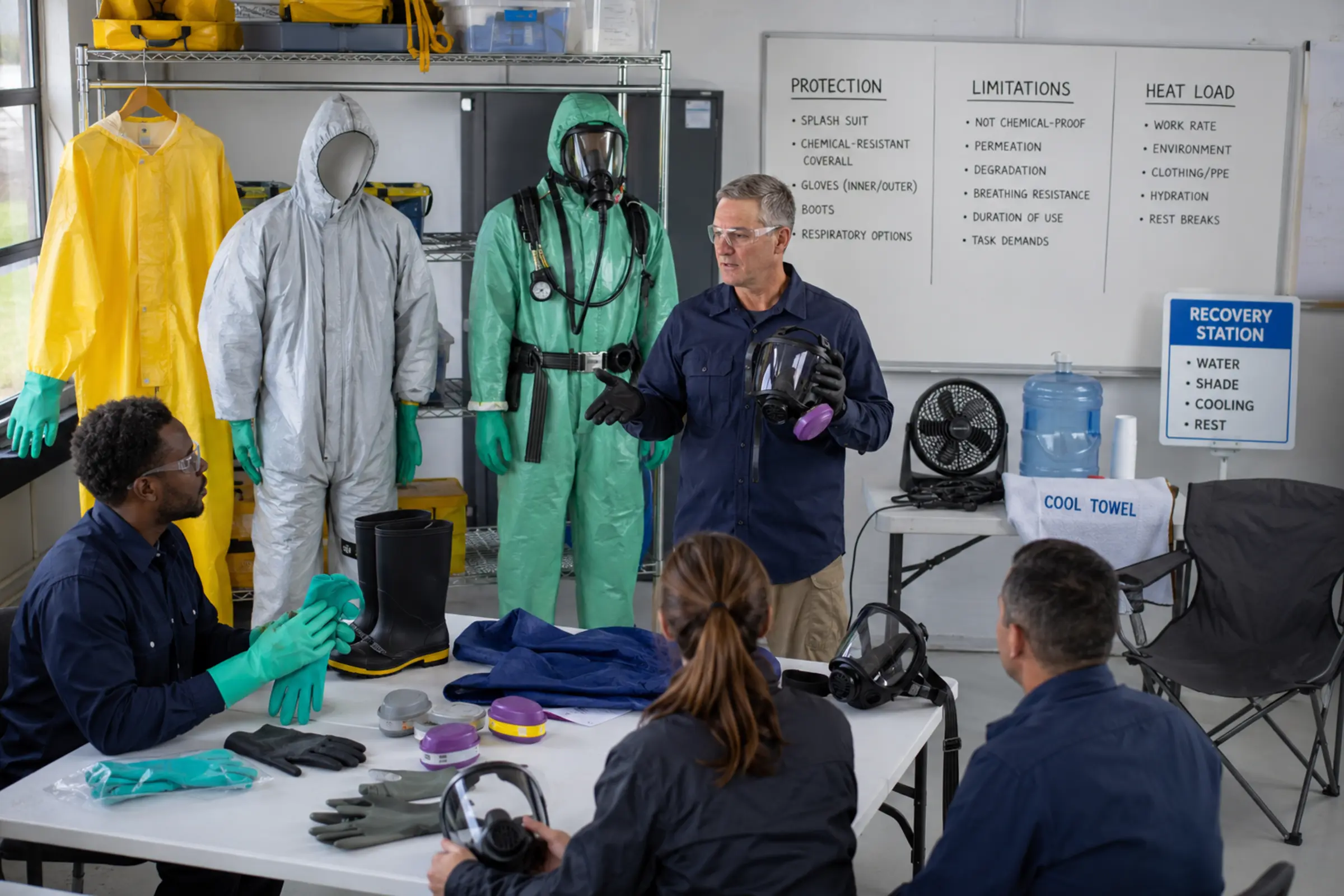
This should include what the equipment protects against and what it does not protect against. Heat stress, mobility, vision, communication, breakthrough, cartridge limitations, and compatibility matter.
Respiratory protection
Where respirators are used, refresher content should reinforce the employer’s respiratory-protection program, selection, limitations, inspections, donning, and emergency procedures. Separate OSHA respiratory-protection training and fit-testing requirements may apply.
Air monitoring
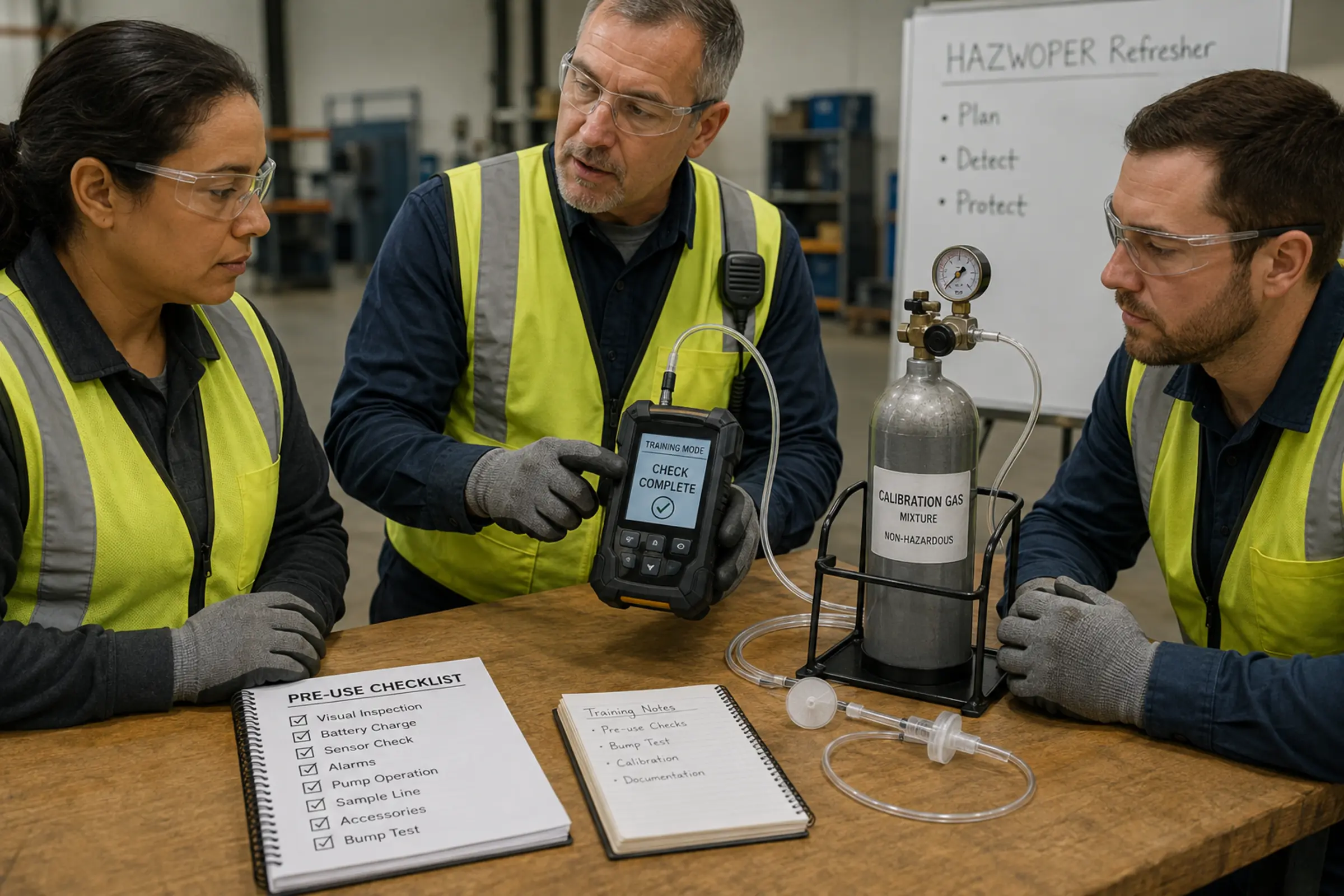
Workers should understand the purpose and limitations of the instruments they use. A meter reading is not useful if the operator does not understand sensor limitations, calibration, response factors, or sampling strategy.
Site control and decontamination
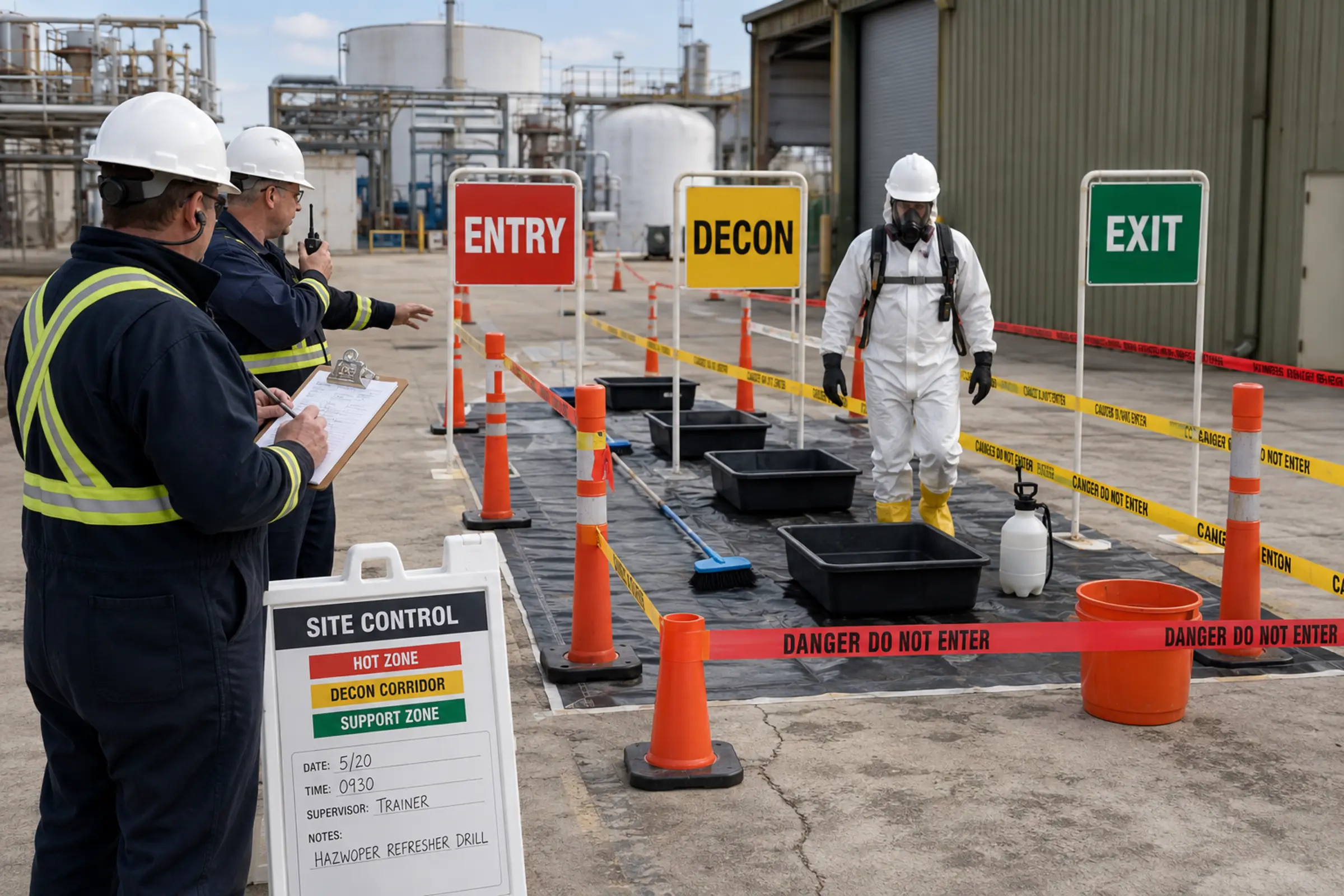
Review work zones, buddy systems, contamination reduction, decon sequences, waste handling, and prevention of cross-contamination.
Emergency procedures
Revisit alarms, communications, medical response, evacuation, rescue limitations, and incident command when applicable.
Lessons from the last year
OSHA’s refresher language specifically allows and expects relevant critique of incidents from the past year.
- near misses
- PPE failures
- monitoring problems
- heat illness
- decontamination mistakes
- spills
- changing chemical inventories
- lessons from industry incidents
This is where the refresher stops being generic.
🧑🏫 How to Evaluate the Instructor or Provider
OSHA does not approve or endorse individual HAZWOPER training providers.
That is an important point for buyers.
A provider should not imply that OSHA has certified its course unless there is a specific credential or relationship that can be accurately explained.
Instead, evaluate whether the training program can show:
- a curriculum mapped to the applicable HAZWOPER requirements
- instructors with subject-matter knowledge and competent instructional skills
- practical examples that fit the worker’s role
- accurate, current regulatory references
- meaningful evaluation of learning
- clear completion records and certificates
- employer customization where site-specific information is required
Online can be useful, but it is not magic
Computer-based instruction can be part of a HAZWOPER training program, but employers still have to make sure workers receive the knowledge, skills, and site-specific information needed for their actual roles.
A worker who cannot inspect PPE, use the monitor, follow decon, or explain the emergency plan is not rescued by a digital certificate.
🛠️ The Best Refresher Is Connected to the Employer’s Program
Outside training providers can teach the regulatory and technical foundation.
The employer still owns the workplace.
A strong employer supplement can include:
- current site hazards
- employer-specific PPE
- current emergency contacts
- medical-surveillance process
- site maps and work zones
- monitoring equipment actually used
- recent near misses
- updated SOPs
- contractor interfaces
- weather and heat controls
request customized HAZWOPER and HazMat training
Life Saving Education HAZWOPER training
🚩 Red Flags When Shopping for a Refresher
- promises "OSHA certification" without explaining what that means
- treats 8 hours of elapsed time as the only quality measure
- never identifies which HAZWOPER employee category it addresses
- uses outdated regulatory references
- has no meaningful knowledge check
- implies the course replaces employer-specific training
- claims one certificate automatically satisfies DOT, EPA, OSHA, and every state requirement
- provides no way to document what was actually taught
📋 HAZWOPER Refresher Selection Checklist
- Confirm the employee is actually covered by HAZWOPER.
- Identify the applicable role and paragraph of 1910.120.
- Verify the annual due date and State Plan rules.
- Confirm at least eight hours where the applicable HAZWOPER provision requires eight hours.
- Review the curriculum before enrollment.
- Make sure PPE, monitoring, decon, and emergency topics fit the employee’s work.
- Incorporate relevant incidents and changes from the past year.
- Verify instructor qualifications and training documentation.
- Add employer and site-specific content where needed.
- Confirm workers can apply the material, not merely complete it.
🔗 Related Life Saving Education Guides
- 8-Hour HAZWOPER Annual Refresher
- HAZWOPER 40 vs 24 vs 8
- HAZWOPER training hub
- Current course schedule
✅ Key Takeaways
- HAZWOPER refresher training is generally eight hours annually for covered cleanup-site and certain TSD employees.
- OSHA’s intent is completion within twelve months, with the next available refresher used when unavoidable circumstances cause a missed anniversary.
- OSHA does not approve individual HAZWOPER course providers.
- The right refresher depends on the employee’s role, hazards, equipment, and employer program.
- A strong refresher should include lessons from the past year and changes in real operations, not just repeat the initial course.
❓ Frequently Asked Questions
Is the HAZWOPER refresher always eight hours?
The 8-hour annual requirement applies to several HAZWOPER categories, including covered cleanup-site workers and certain TSD employees. Emergency-response refresher requirements are role and competency based, so employers should identify which paragraph applies.
What happens if I miss my HAZWOPER refresher anniversary?
OSHA has said workers should complete refresher training within twelve months and attend the next available refresher if unavoidable circumstances cause a missed anniversary. State Plans can be stricter, and the employer must still ensure the worker remains competent.
Does missing one refresher mean I automatically need to retake 40-hour HAZWOPER?
Not automatically under federal OSHA guidance. The employer must evaluate the circumstances and the worker’s retained knowledge and skills. A long lapse or lack of competence may justify more extensive retraining.
Does OSHA certify online HAZWOPER refresher courses?
OSHA does not approve or endorse individual HAZWOPER training programs or trainers. Employers are responsible for providing training that meets the standard and prepares workers for their duties.
Can the refresher be split into shorter sessions?
OSHA’s HAZWOPER FAQ says refresher training may be given in segments as long as the required eight hours are completed by the anniversary date.
🎯 Make the Eight Hours Worth Having
A refresher should make the worker more capable at the end of the day than at the beginning.
Life Saving Education’s HAZWOPER training approach focuses on practical hazard recognition, PPE, monitoring, decontamination, site control, and emergency decision-making rather than treating the annual course as a timer.
8-Hour HAZWOPER Annual Refresher
request customized HAZWOPER and HazMat training
Training You Can Count On. When Seconds Count.
📚 Sources and Further Reading
- OSHA, 29 CFR 1910.120 HAZWOPER
- OSHA, HAZWOPER FAQ
- OSHA, Initial and Annual Refresher HAZWOPER Training Interpretation
- OSHA, Hazardous Waste Operations Interpretation, March 12, 1993
- OSHA, Combination Course and HAZWOPER Refresher Interpretation
⚖️ Educational Disclaimer
This article is provided by Life Saving Education for general educational purposes only. It is not medical, legal, or compliance advice, and it is not a substitute for hands-on training or professional guidance. Regulations and clinical guidelines change and vary by state, jurisdiction, job function, and operation. Verify current requirements for your situation. In an emergency, call 911.