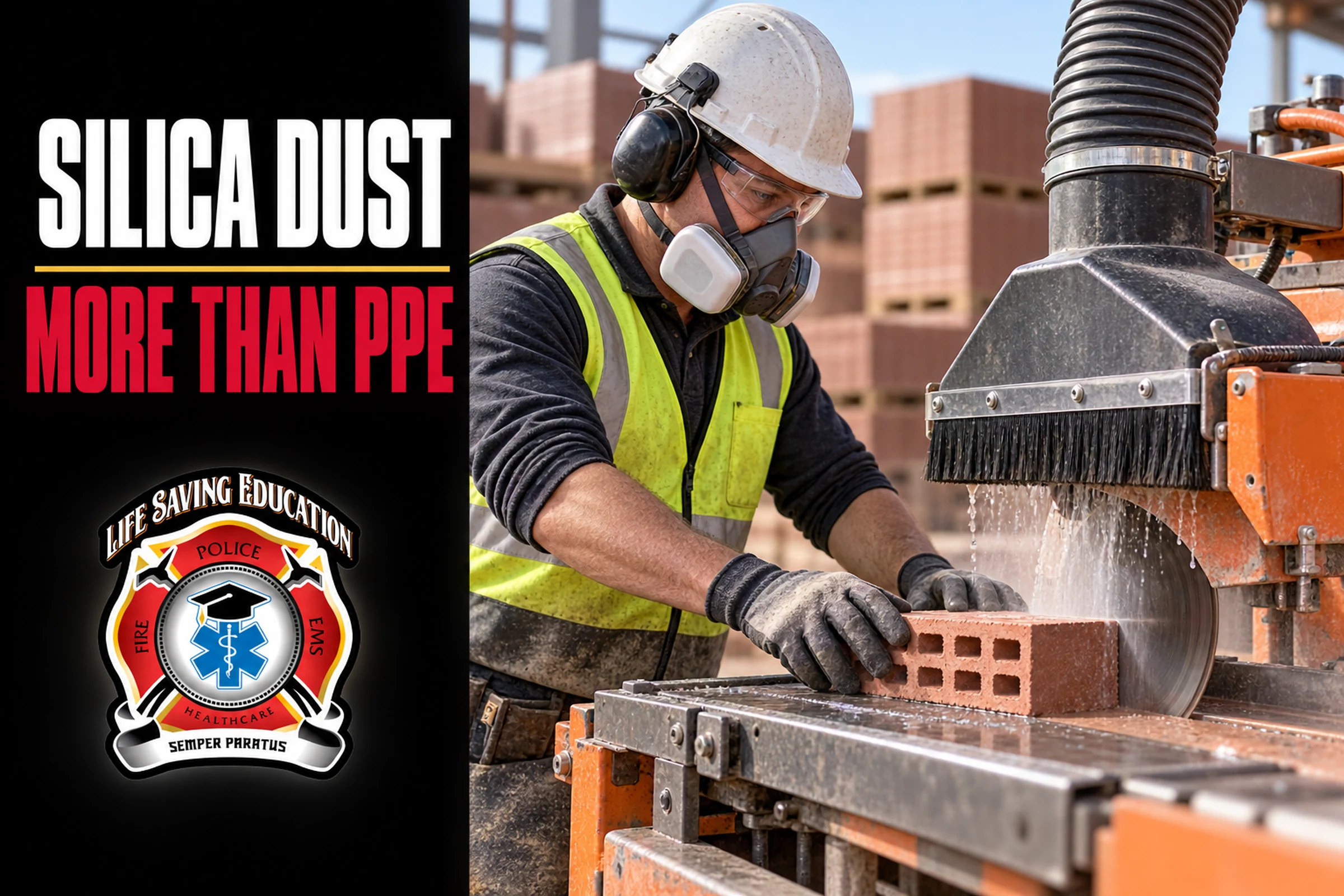
By Joseph Andrade, Firefighter, Paramedic, Emergency Department and Vascular Access RN, OSHA Outreach Instructor, and Safety Officer. Founder and lead instructor at Life Saving Education.
Joseph is an active firefighter, paramedic, and registered nurse working in emergency and vascular access care, as well as an OSHA Outreach instructor and safety officer. He has spent his career on the response side of emergencies, from the fireground to the ambulance to the hospital bedside, and now trains civilians, workplaces, and first responders in the skills that save lives.
A Pennsylvania enforcement case shows how exposure assessment, engineering controls, regulated areas, respiratory protection, fit testing, medical surveillance, and training must function as one system.
✅ Key Takeaways
- OSHA proposed $496,528 in penalties against a Pennsylvania brick manufacturer after alleging workers were knowingly exposed to excessive respirable crystalline silica.
- OSHA cited issues involving exposure levels, respirator use, annual fit testing, regulated areas, exposure assessment, and medical surveillance.
- A respirator is not a substitute for a complete silica-control program.
- OSHA’s general-industry silica permissible exposure limit is 50 micrograms per cubic meter as an 8-hour time-weighted average, while the action level is 25 micrograms per cubic meter.
- Tight-fitting respirators used as required protection generally require medical evaluation before required use and fit testing before initial use and at least annually thereafter.
- The penalties are proposed. The employer may contest the citations.
😷 Silica Exposure Is More Than a Respirator Problem
Silica hazards are easy to oversimplify. A worker is surrounded by dust, someone notices, and management orders respirators. It can feel like the problem has been handled.
A recent OSHA enforcement action in Pennsylvania shows how much more a working silica-control program has to cover.
On August 26, 2026, the U.S. Department of Labor announced that OSHA had cited General Shale Brick Inc., doing business as Watsontown Brick Company, following a February inspection of its Watsontown, Pennsylvania operation. OSHA said employees in one plant were exposed to respirable crystalline silica above allowable levels and alleged that the employer knew about the exposure but failed to adequately correct it or require affected employees to wear respirators.
OSHA issued three willful, four serious, one repeat, and one other-than-serious citation, with proposed penalties totaling $496,528. OSHA also cited deficiencies involving annual respirator fit testing, regulated areas, exposure assessment across silica-related jobs, and medical examinations.
The company has the right to contest OSHA’s citations, so these remain allegations rather than final adjudicated findings.
For training purposes, the case is still useful because OSHA’s allegations reach well beyond respirator use. Exposure assessment, controls, regulated areas, fit testing, and medical requirements all appear in the same enforcement action.
▸ What is respirable crystalline silica?
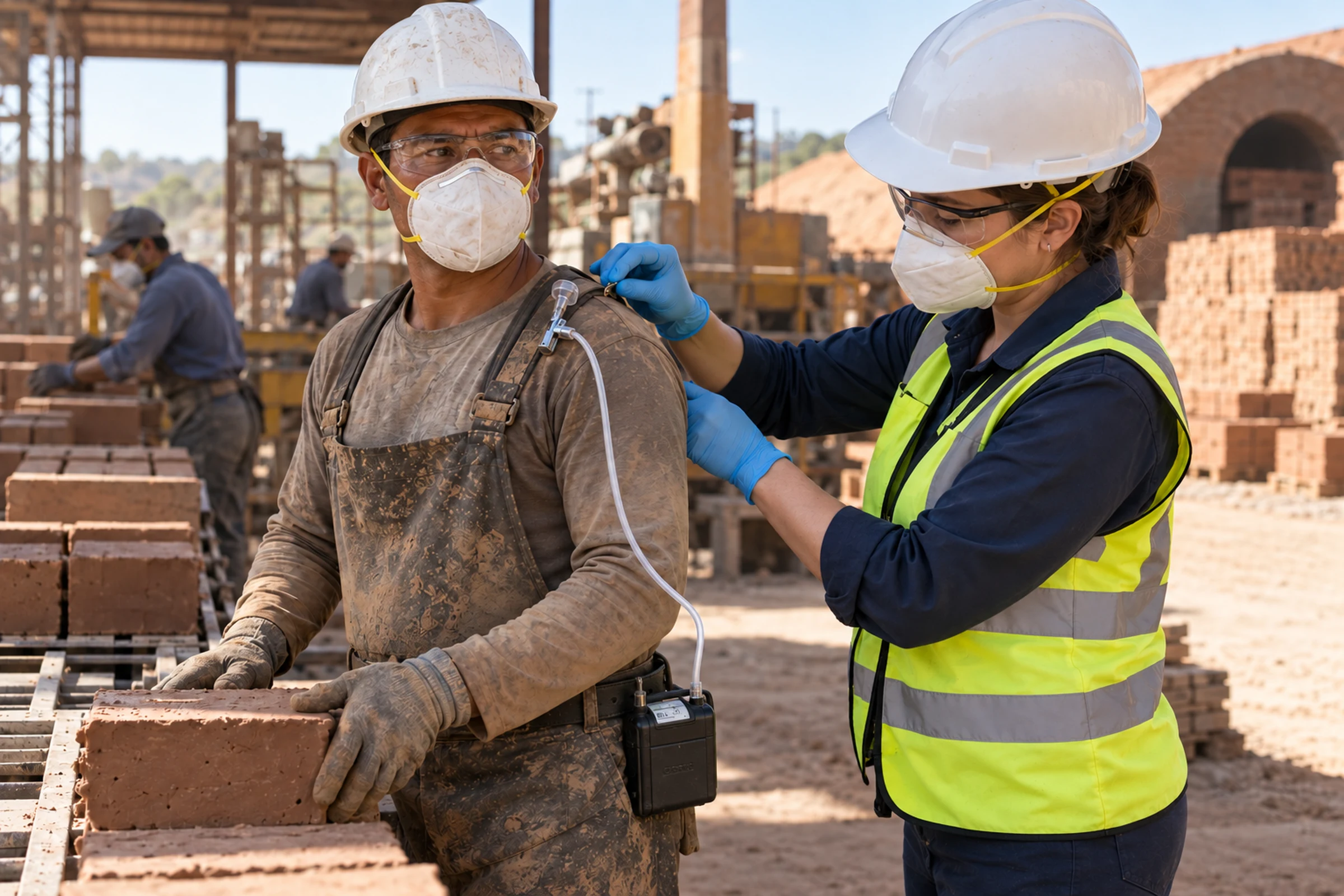
Crystalline silica is found in common materials such as sand, stone, concrete, mortar, brick, ceramics, and many manufactured products.
The occupational hazard develops when work processes create particles small enough to reach deep portions of the respiratory system. Cutting, sawing, grinding, drilling, crushing, abrasive blasting, brick manufacturing, and similar high-energy processes can generate respirable crystalline silica.
The particles that matter most are often too small to judge by sight. A visibly dusty workplace may have a serious exposure problem, but a cleaner-looking space can still contain respirable particles.
Visible dust can warn you that controls are failing. It cannot tell you the airborne concentration.
▸ Why silica exposure matters
Respirable crystalline silica is associated with serious occupational disease, including silicosis, lung cancer, chronic obstructive pulmonary disease, and kidney disease.
Silicosis results from lung injury and scarring after inhalation of crystalline silica particles. The disease may develop over years, although very high exposures can produce more rapid disease.
That delay creates a dangerous false sense of security. A worker may feel well today even though the exposure occurring today is creating long-term risk.
The absence of immediate symptoms is not evidence that the exposure is acceptable.
So an effective program has to control the exposure before disease becomes the indicator that the program failed.
🏗️ What OSHA says went wrong in Pennsylvania
OSHA inspected the Watsontown facility under its Site-Specific Targeting program and its silica National Emphasis Program.
According to OSHA, investigators found that employees making molded brick were breathing silica above safe limits. OSHA alleged that the employer was aware of the exposure but failed to adequately correct the condition or require appropriate respiratory protection.
The enforcement findings did not stop with the respirator.
OSHA also alleged that the employer failed to annually fit test certain respirator users, failed to establish required regulated areas, failed to assess exposure for all silica-related jobs, and failed to provide required medical examinations to qualifying employees.
Taken together, those allegations show how OSHA can evaluate the whole exposure-control system instead of treating the respirator as a stand-alone fix.
▸ Layer 1: Know the exposure
For general industry, OSHA’s respirable crystalline silica standard establishes a permissible exposure limit of 50 micrograms per cubic meter as an 8-hour time-weighted average.
The standard also uses an action level of 25 micrograms per cubic meter as an 8-hour time-weighted average.
Where employees are or may reasonably be expected to be exposed at or above the action level, employers must use an exposure-assessment approach permitted by the standard.
That means employers need answers to practical questions:
- Which tasks generate respirable silica?
- Which workers perform them?
- How long are they exposed?
- What engineering controls are operating?
- What does representative exposure information show?
- Have materials, production rates, tasks, equipment, or controls changed?
- Are maintenance and cleanup workers exposed even though they are not part of the primary production process?
A hazard that has not been adequately characterized is difficult to control reliably.
“It doesn’t look dusty” is not an exposure assessment
Visual observation can identify obvious control failures.
It cannot tell an employer the airborne concentration of respirable crystalline silica.
The correct question is not, “Does it look dusty?”
It is, “What exposure are employees actually experiencing?”
⚠️ Layer 2: Control the hazard before relying on the worker
Respirators are important protective equipment, but an exposure-control strategy generally should not begin with the assumption that PPE alone will solve the problem.
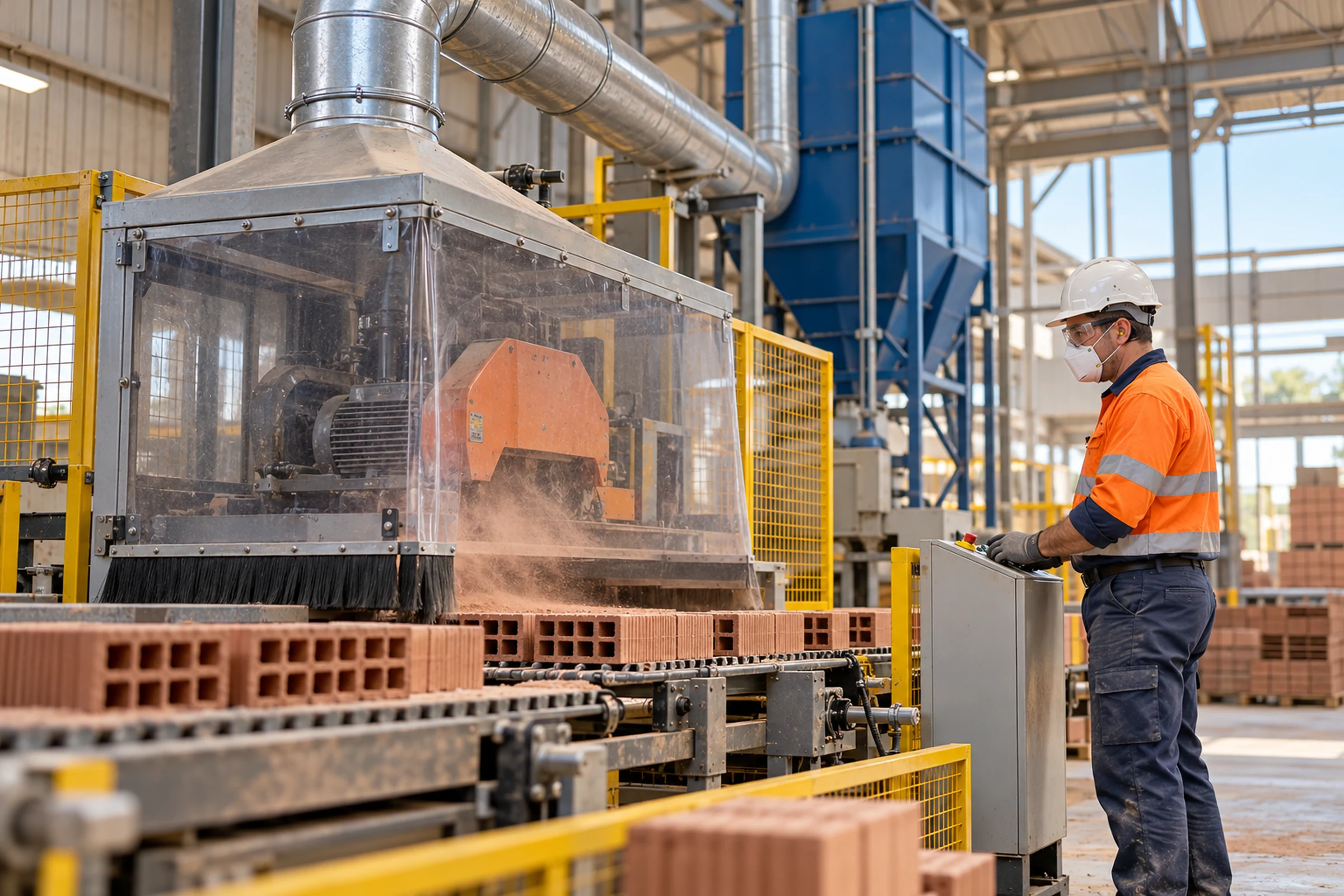
An effective silica program examines controls such as:
- process modification,
- local exhaust ventilation,
- enclosed systems,
- wet methods where appropriate,
- dust collection,
- maintenance of controls,
- housekeeping methods that do not unnecessarily aerosolize dust,
- and work practices that reduce airborne generation.
Respiratory protection is then integrated where required.
That matters because PPE is highly dependent on human performance. A respirator can fail to protect because of poor selection, poor fit, facial hair across the sealing surface, incorrect use, damage, poor maintenance, incorrect filter selection, or simply not being worn when required.
Controlling the hazard at the source is generally more reliable than asking each worker to personally overcome an uncontrolled atmosphere.
▸ Layer 3: Regulated areas are part of exposure control
Under OSHA’s general-industry silica rule, a regulated area is an area where employee exposure exceeds, or can reasonably be expected to exceed, the permissible exposure limit.
This is not just a sign on a door.
A regulated-area system helps determine:
- who may enter,
- what protection is required,
- how exposure zones are communicated,
- and whether workers who are not directly operating the dusty process are still being exposed.
Silica does not stop at departmental boundaries.
If dust migrates from one process into a nearby area, workers outside the primary task may still require protection.
A useful audit question is simple:
If a supervisor walked the facility today, could that person immediately identify where elevated silica exposure is expected and what controls apply there?
If the answer is no, the program deserves another look.
😷 Layer 4: A respirator must actually fit
Buying the correct respirator is only one step.
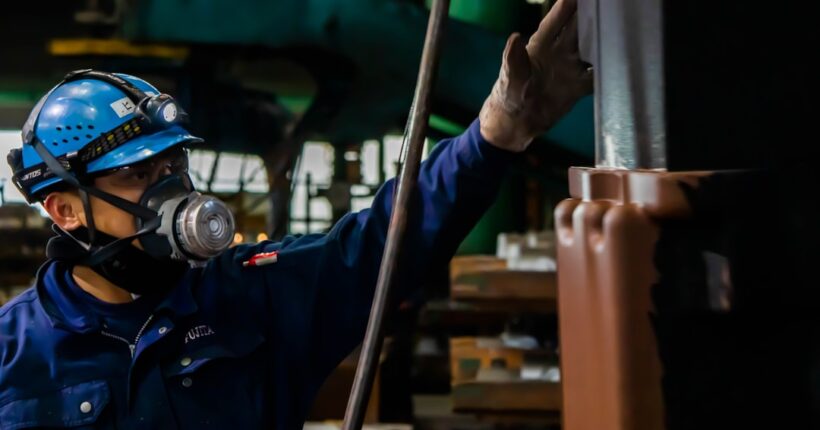
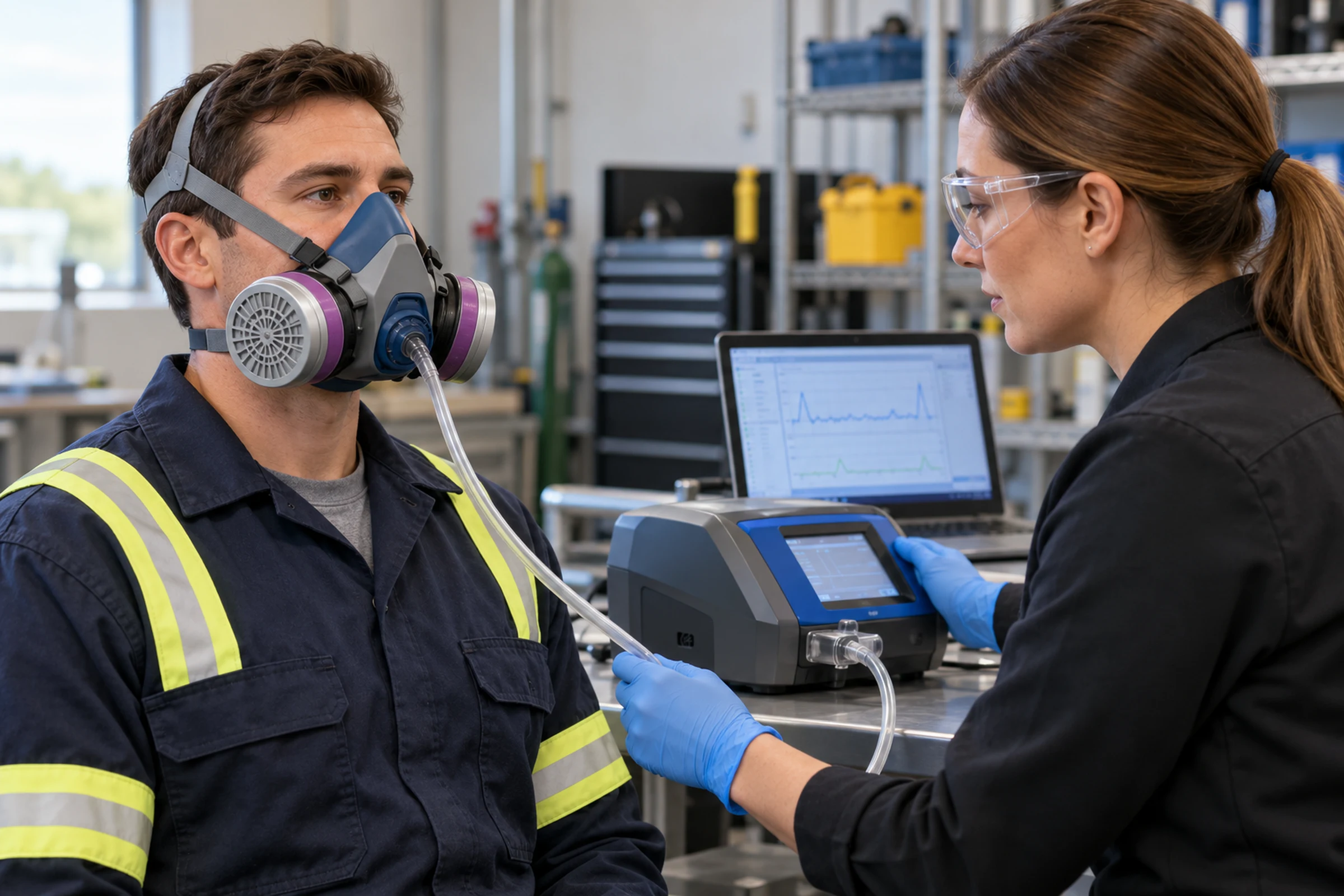
For employees who are required to use tight-fitting respirators, OSHA requires appropriate fit testing before initial required use, whenever a different make, model, style, or size is used, and at least annually thereafter.
The fit test answers a very specific question:
Does this exact respirator adequately fit this exact worker?
A worker cannot simply be handed whichever half-mask happens to be available.
The respiratory-protection program also needs to address facial hair. Facial hair that lies between the sealing surface of a tight-fitting facepiece and the face can interfere with the seal.
A strong program therefore does not treat fit testing as paperwork. It treats the fit test as evidence that the selected facepiece can form the seal the worker is relying on.
▸ Layer 5: Medical evaluation is different from fit testing
These requirements are often confused.
Medical evaluation asks whether the employee can safely wear the respirator.
Fit testing asks whether the selected tight-fitting respirator adequately fits the employee’s face.
Under OSHA’s respiratory-protection standard, required respirator users generally receive medical evaluation before fit testing or required respirator use.
Medical evaluation is not simply an annual certificate. Additional evaluation is driven by the standard’s criteria, such as signs or symptoms, recommendations from the healthcare professional or program administrator, information indicating a need for reevaluation, or changes in workplace conditions that increase physiological burden.
That differs from the annual fit-testing requirement.
Silica also has separate medical-surveillance provisions for qualifying workers.
Employers need to know which requirement they are addressing instead of treating every “medical” requirement as the same checkbox.
▸ Layer 6: Medical surveillance is part of prevention
Medical surveillance is not a substitute for controlling exposure.
A chest image is not ventilation.
A pulmonary-function test does not reduce airborne dust.
The purpose of medical surveillance is to help identify occupational health effects and provide appropriate medical follow-up for workers who meet the standard’s criteria.
OSHA’s Pennsylvania announcement specifically identified medical-examination deficiencies among its allegations.
That should remind employers to verify that the workers who qualify for silica medical surveillance are actually included in the program.
🎓 Layer 7: Training must explain the whole system
Good silica training should go far beyond:
Wear this respirator.
A worker should be able to answer:
- Why is this task hazardous?
- Which control is supposed to be operating?
- What does the control look and sound like when functioning?
- When is respiratory protection required?
- Where are regulated areas?
- What should I do if ventilation fails?
- What does fit testing prove?
- Why does facial hair matter?
- What is medical surveillance for?
- Who do I notify if a control is not functioning?
That is the difference between giving workers information and giving them usable safety knowledge.
▸ The hierarchy of controls still matters
One of the most useful ways to teach silica is through the hierarchy of controls.
Elimination and substitution may not always be practical for a brick-manufacturing process, but that does not mean the hierarchy disappears.
Engineering controls can capture or suppress dust.
Administrative controls can reduce unnecessary exposure and define safe work practices.
PPE provides another layer when exposure cannot otherwise be adequately controlled.
Respirators matter, but they should not be expected to compensate for an uncontrolled process by themselves.
🏢 What employers should audit now
The Pennsylvania case does not prove that other employers have the same deficiencies. It does provide a useful checklist.
1. Identify every silica-producing task
Include production, maintenance, cleanup, repair, and occasional tasks.
2. Review exposure data
Determine whether existing data still represents current conditions.
3. Verify engineering controls
Do not simply confirm that ventilation equipment exists. Confirm that it is functioning.
4. Review regulated areas
Confirm that boundaries reflect actual exposure conditions.
5. Audit respirator selection
Make sure the respirator and filter are appropriate for the hazard and exposure.
6. Verify medical evaluation
Confirm that employees required to use respirators have been medically evaluated as required.
7. Check annual fit-test dates
Do not rely on a spreadsheet nobody reviews.
8. Examine facial-hair practices
Written rules should match field practice.
9. Review silica medical surveillance
Identify which workers meet the applicable criteria.
10. Talk to the workers
Ask whether the controls work during real production conditions.
The last step often produces information no spreadsheet contains.
🏗️ OSHA 10 or OSHA 30 is not a silica-control program
This distinction matters for employers and for students.
OSHA Outreach Training provides broad safety and health education. It does not replace employer-specific hazard training, silica training, respiratory-protection requirements, industrial-hygiene evaluation, or other standard-specific obligations.
This Pennsylvania case is useful in OSHA 10 and OSHA 30 instruction because it shows how several programs can converge around one hazard:
industrial hygiene + engineering controls + silica standard + respiratory protection + medical surveillance + training.
That is much closer to how workplace safety functions in the field.
✅ What to remember
The lesson from OSHA’s Pennsylvania silica case is not that employers need to buy better respirators.
It is that respiratory protection is only one part of controlling respirable crystalline silica.
A credible program begins by identifying the hazard and understanding exposure.
It then controls that exposure as effectively as possible, defines hazardous areas, selects appropriate respiratory protection where required, medically evaluates respirator users, verifies fit, provides applicable medical surveillance, trains employees, and periodically checks whether the system works.
If one piece is missing, another piece may eventually be asked to carry more of the burden.
When the hazard can cause irreversible disease, that is not a system employers should leave to chance.
❓ Frequently Asked Questions
Is wearing a respirator enough to comply with the silica standard?
Not by itself. Respiratory protection may be required in certain circumstances, but silica compliance also depends on exposure assessment, engineering and work-practice controls, regulated areas where applicable, housekeeping, training, medical surveillance, and the respiratory-protection program. The exact obligations depend on the standard and work being performed.
What is the OSHA permissible exposure limit for respirable crystalline silica in general industry?
The PEL is 50 micrograms per cubic meter of air as an 8-hour time-weighted average. The general-industry standard also uses an action level of 25 micrograms per cubic meter as an 8-hour TWA.
Does a dusty-looking workplace automatically mean employees are over the PEL?
No. Visible dust can identify an obvious control problem, but it cannot establish the concentration of respirable crystalline silica. Exposure assessment requires the methods and information allowed by the applicable OSHA standard.
Is respirator medical evaluation required every year?
OSHA’s respiratory-protection rule does not simply require an automatic annual medical evaluation for every respirator user. Medical reevaluation is required under the circumstances identified by 29 CFR 1910.134. Annual fit testing is a separate requirement for required use of tight-fitting respirators.
Why does facial hair matter?
Facial hair that lies between the sealing surface of a tight-fitting respirator and the face can interfere with the seal. A worker may have the correct cartridge and a current fit test but still lose protection if the sealing surface is compromised.
Are OSHA 10 and OSHA 30 courses substitutes for employer silica training?
No. OSHA Outreach courses provide broad safety and health education. They do not replace employer-specific training or the requirements of standards such as respirable crystalline silica and respiratory protection.
🎓 Instructor Note
This case works well as a scenario-based OSHA lesson. Give students a fictional brick facility with exposure data, a ventilation problem, workers wearing half-mask respirators, expired fit tests, and unclear regulated areas. Ask them to identify which failures are exposure-control failures, which are respiratory-program failures, and which require additional information. That approach reinforces that silica compliance is an integrated system rather than a single PPE decision.
🦺 LSE Training Connection
Life Saving Education provides OSHA 10- and OSHA 30-Hour training for Construction and General Industry. OSHA Outreach education does not replace employer-specific silica or respiratory-protection programs, but it can help employees and supervisors better understand how workplace hazards are identified and controlled.
Request training for your organization or browse LSE courses.
Training You Can Count On. When Seconds Count.
Images are AI-generated educational illustrations, not photographs of the cited incidents or study participants. Displayed screens and documents are illustrative.
📚 Authoritative Sources
- U.S. Department of Labor, OSHA. Pennsylvania brick manufacturer enforcement announcement, August 26, 2026.
https://www.osha.gov/news/newsreleases/philadelphia/20260826 - OSHA. 29 CFR 1910.1053, Respirable Crystalline Silica.
https://www.osha.gov/laws-regs/regulations/standardnumber/1910/1910.1053 - OSHA. 29 CFR 1910.134, Respiratory Protection.
https://www.osha.gov/laws-regs/regulations/standardnumber/1910/1910.134 - OSHA. Silica health effects.
https://www.osha.gov/silica-crystalline/health-effects