Prepared by the LSE Editorial Team. Reviewed by Joseph Andrade, Jr., RN, NRP.
Joseph is an active firefighter, paramedic, and registered nurse working in emergency and vascular access care, as well as an OSHA Outreach instructor and safety officer. He has spent his career on the response side of emergencies, from the fireground to the ambulance to the hospital bedside, and now trains civilians, workplaces, and first responders in the skills that save lives.
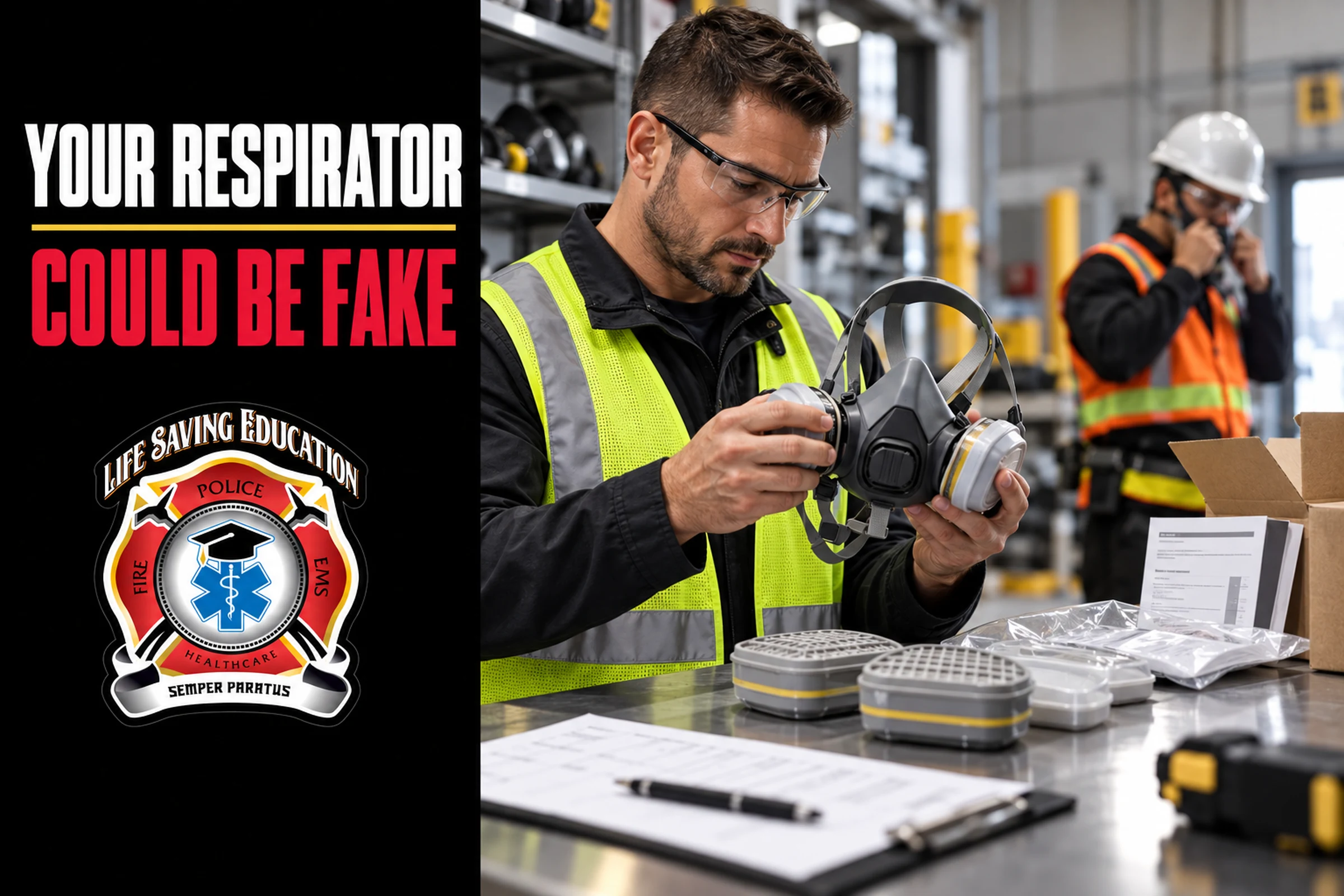
A respirator can look authentic, fit correctly, and still fail to provide the protection a worker expects. NIOSH testing of fraudulent filters and cartridges shows why procurement belongs inside the respiratory-protection program.
✅ Key Takeaways
- NIOSH tested fraudulent P100 filters, chemical cartridges, and combination cartridges that closely resembled genuine products.
- In the pilot project, 220 of 240 fraudulent P100 filters, 124 of 124 fraudulent combination cartridges, and 8 of 8 fraudulent chemical cartridges failed required NIOSH performance tests.
- NIOSH approves complete respirator configurations, not random individual components marketed as “compatible.”
- Using components that are not listed as part of an approved configuration can void NIOSH approval.
- Employers should verify approval-holder information, part numbers, approval labels, and Certified Equipment List information rather than relying on marketplace descriptions.
- Fit testing does not prove that a fraudulent filter or cartridge provides the promised filtration or chemical protection.
😷 The respirator looks real. Is that enough?
A worker can enter a contaminated area with an elastomeric respirator that fits well, has a current fit test, and carries a cartridge that looks exactly like last year’s stock. The package may even say P100 and list the expected model.
If the cartridge is fraudulent, none of those visual checks proves that it will perform as expected. NIOSH has documented that problem in products sold through online marketplaces.
Some counterfeit components copy genuine part numbers, colors, markings, and even the word “NIOSH.”
Some fraudulent parts are visually close to genuine products even though their performance is not.
🔎 What NIOSH tested
NIOSH’s National Personal Protective Technology Laboratory conducted a pilot project comparing fraudulent respirator components with genuine components from NIOSH Approved configurations.
The project evaluated:
- P100 filters,
- organic-vapor chemical cartridges,
- and combination chemical/particulate cartridges.
Testing examined filtration, chemical service life, and breathing resistance using NIOSH standard testing procedures.
The failure rates were high.
NIOSH reported that:
- 220 of 240 fraudulent P100 filters failed,
- 124 of 124 fraudulent combination cartridges failed,
- 8 of 8 fraudulent chemical cartridges failed.
The report concluded that nearly all fraudulent components tested failed to meet all required NIOSH performance tests.
For a worker, the consequence is inadequate protection from the contaminant the cartridge or filter was supposed to control.
▸ Some fraudulent products looked almost identical
One of the most useful findings is that appearance was not a reliable guarantee.
NIOSH found fraudulent combination and chemical cartridges that were nearly identical in appearance to genuine products.
Some used the same part numbers associated with authentic components.
Some displayed “NIOSH” or P100 markings.
Small differences in labeling or color sometimes existed, but the counterfeit products were designed to look legitimate.
Many workplace PPE inspections are mainly visual, which makes those similarities easy to miss.
A supervisor may check:
- Is the correct color cartridge installed?
- Is the part number familiar?
- Does it say P100?
- Does it fit the facepiece?
Those questions are not enough when the supply chain itself is compromised.
🔎 NIOSH approves configurations, not random components
This point should become part of respiratory-protection training.
NIOSH does not simply approve a filter in isolation and then allow it to be mixed with any facepiece that physically accepts it.
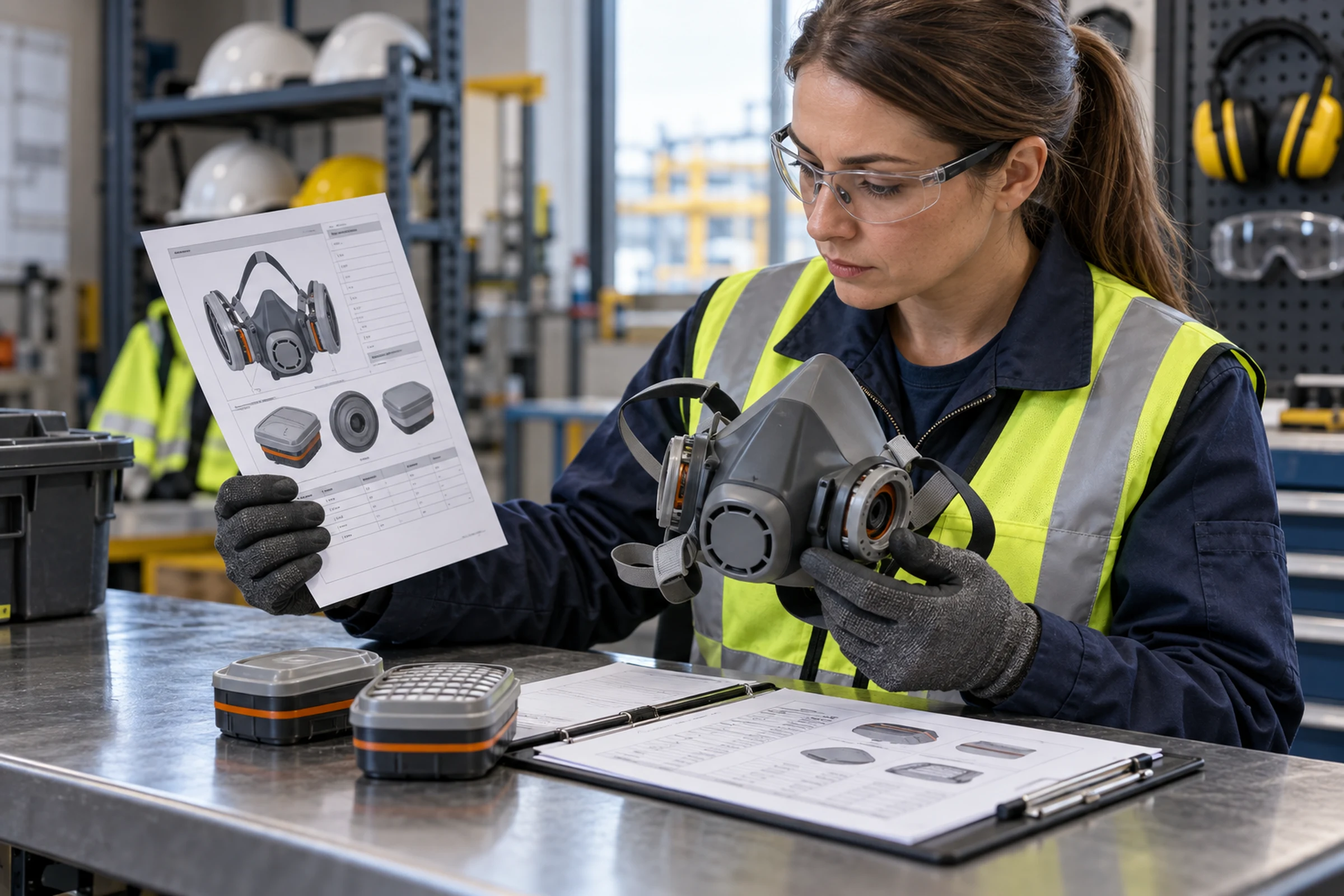
NIOSH approvals apply to complete respirator configurations.
The approval label identifies the facepiece, filters, cartridges, replacement parts, and other components that make up the approved configuration.
If a worker uses a filter or cartridge that is not part of that approved configuration, the respirator is no longer being used as the NIOSH Approved configuration.
A component may physically attach and still not be an approved combination.
“Fits” and “approved” are not the same word.
▸ “Compatible with” can be misleading
Online marketplace listings often use language such as:
- compatible with,
- replacement for,
- equivalent to,
- meets NIOSH,
- P100 style,
- or fits model X.
Those phrases can create confidence without establishing approval.
NIOSH specifically warns that manufacturers or sellers who are not NIOSH approval holders may market filters as compatible with approved facepieces.
Using such components can void the NIOSH approval.
For employers, procurement needs to ask a different question:
Is this exact component part of the approved respirator configuration we are using?
▸ Fit testing cannot detect a bad filter
This distinction is essential.
A quantitative or qualitative fit test evaluates how well a tight-fitting facepiece seals to the user.
It does not prove that a filter achieves P100 filtration performance.
It does not prove an organic-vapor cartridge has adequate service life.
It does not prove the component came from an approved manufacturer.
A worker can pass a fit test while wearing a facepiece that later receives a fraudulent cartridge.
The seal may be excellent.
The protection can still fail.
That means a mature respiratory-protection program must address both:
facepiece fit and component authenticity.
▸ The P100 failures
NIOSH evaluated fraudulent P100 filters against the applicable filtration-performance requirement.
Of the 240 fraudulent P100 filters tested, 220 failed.
That means 11 of the 12 fraudulent P100 products in the pilot had filters exceeding the allowed penetration limit.
Some failed immediately.
Some demonstrated much greater particulate penetration than the P100 requirement allows.
The genuine comparison filters passed.
The data do not show that every unfamiliar filter will fail. They do show why a P100 label should be verified when the source or product history is uncertain.
▸ The chemical-cartridge failures may be even more alarming
Particulate filters and chemical cartridges protect against different hazards.
A chemical cartridge is expected to adsorb or otherwise capture specified gases or vapors for a defined service period under testing conditions.
NIOSH found that all fraudulent organic-vapor chemical cartridges tested for service life failed.
The report states that fraudulent chemical cartridges experienced chemical breakthrough in less than five minutes in the service-life tests, while the genuine controls met the minimum requirement.
For combination cartridges, all 12 fraudulent pairs evaluated for service life failed the minimum requirement.
Some experienced breakthrough in less than one minute.
That is a dramatic reminder that a worker cannot judge chemical-cartridge performance by breathing comfort or smell alone.
Some hazardous substances have poor warning properties.
Some can cause harm before odor is detected.
Cartridge selection and authenticity have to be correct before exposure occurs.
▸ Why counterfeit PPE appears
Counterfeit products thrive where several conditions overlap:
- high demand,
- online purchasing,
- price pressure,
- decentralized procurement,
- complicated part numbers,
- familiar brand appearance,
- and buyers who know what the product should look like but do not verify approval.
The COVID-era respirator shortages made counterfeit N95 products widely visible to the public.
But the occupational problem extends beyond disposable filtering facepieces.
NIOSH now highlights fraudulent higher-protection filters and chemical cartridges as well.
For HAZWOPER, industrial hygiene, construction, healthcare, emergency response, and maintenance work, the consequences can be serious.
🔎 What a NIOSH approval means
NIOSH’s Respirator Approval Program evaluates respirators under 42 CFR Part 84.
Approved respirators and components must match approved configurations.
For filtering facepiece respirators, required markings can include:
- approval-holder name,
- part or model number,
- filter series and efficiency,
- NIOSH markings,
- and the applicable approval number.
For elastomeric respirators and cartridges, the approval label and Certified Equipment List provide the more complete configuration information.
Employers should teach procurement personnel how to use those resources.
▸ The Certified Equipment List belongs in procurement
A workplace respiratory-protection program often focuses on the user:
- medical evaluation,
- fit testing,
- training,
- seal checks,
- cleaning,
- storage.
Those are essential.
But someone also decides what gets purchased.
That means procurement is part of the protective system.
Before purchasing unfamiliar respirators or replacement components, employers should verify:
- The approval holder
- The model and part number
- The NIOSH approval number or TC number where applicable
- The approval label
- The component’s presence in the approved configuration
- The seller and supply chain
- Whether labeling and packaging match official information
If the price appears too good to be true, that should trigger verification, not celebration.
▸ What workers can check
Workers should not carry the entire burden of counterfeit detection, but they can provide an additional safety layer.
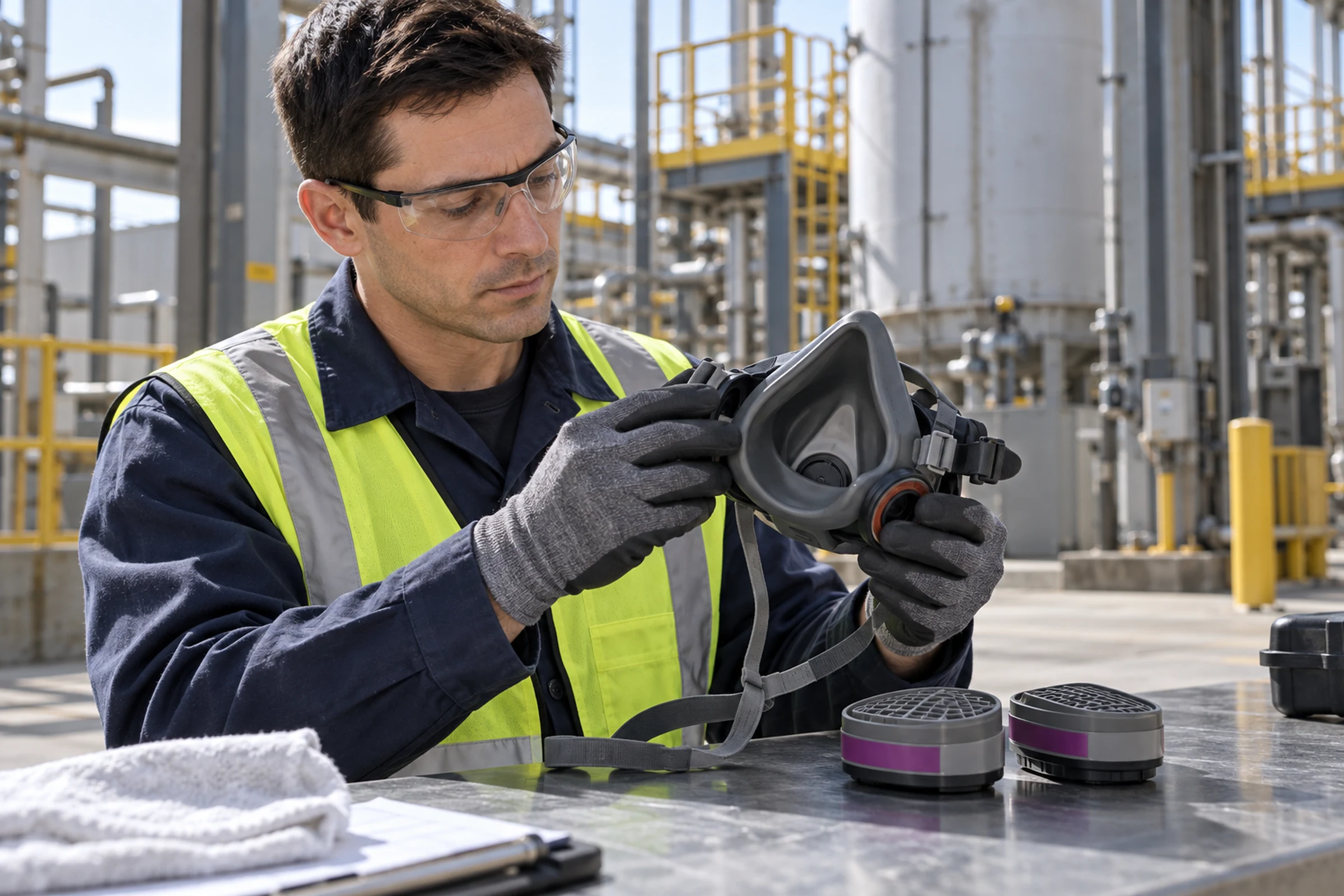
Teach users to look for:
- missing manufacturer information,
- misspelled NIOSH markings,
- unusual part numbers,
- inconsistent packaging,
- unexpected color or construction differences,
- unfamiliar sellers,
- damaged seals,
- and components that differ from what the program normally issues.
Workers should know who to contact when something looks wrong.
A culture that punishes workers for questioning PPE makes counterfeit detection less likely.
😷 What respiratory-program administrators should do now
Inventory current components
Record the facepieces, filters, cartridges, and approval information actually in use.
Verify approved configurations
Do not assume every physically compatible component is approved.
Review purchasing sources
Identify where PPE is purchased and who is authorized to buy it.
Centralize high-risk purchases
For critical respiratory protection, uncontrolled marketplace purchasing should be avoided.
Train procurement staff
The buyer may never wear the respirator, but the buying decision can determine whether the worker is protected.
Add authenticity checks to inspections
Include labeling and approval verification in periodic program review.
Quarantine questionable products
Do not “use them up” while someone investigates.
Report suspected counterfeit products
NIOSH provides a process for reporting counterfeit or misrepresented respirators.
▸ HAZWOPER implications
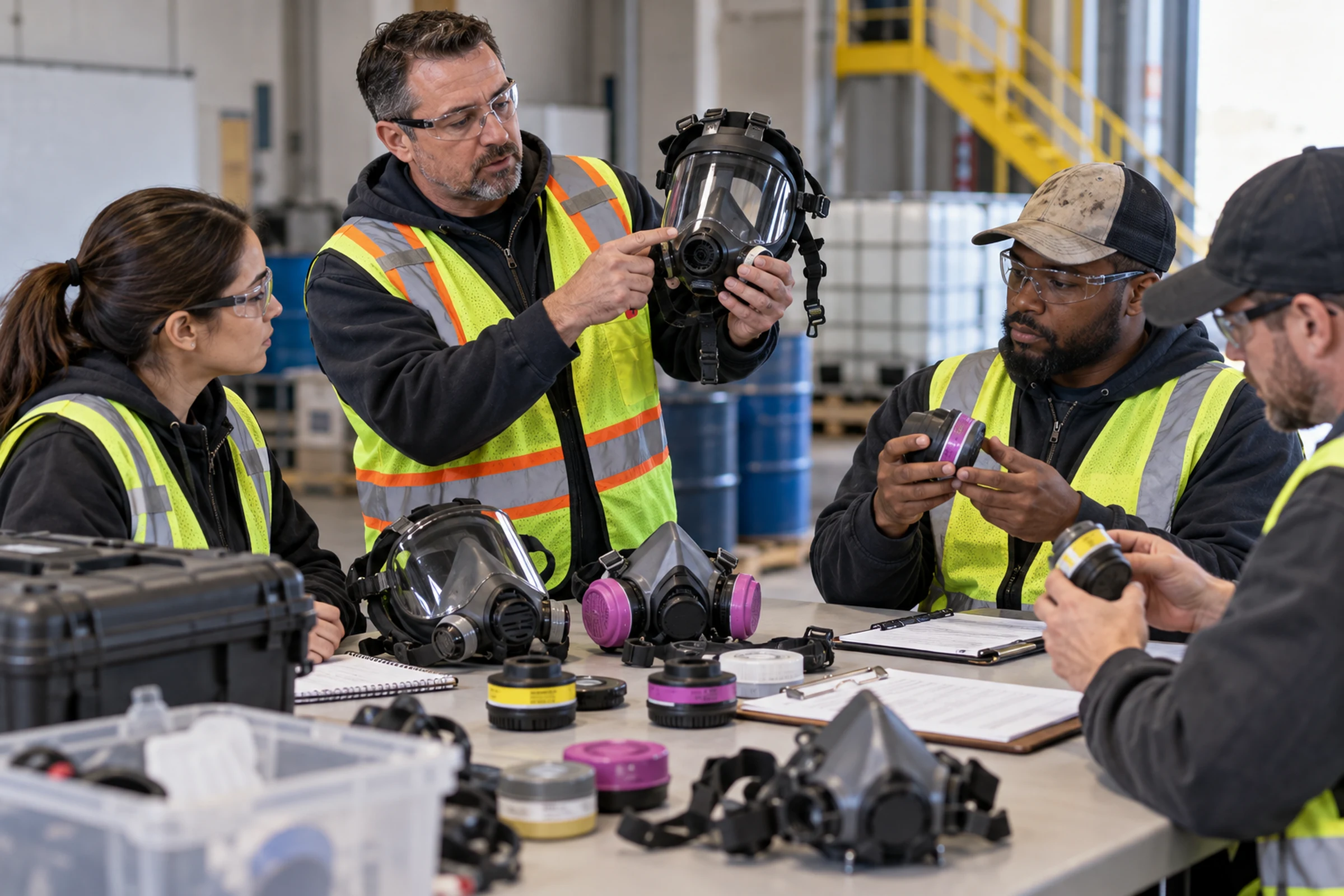
HAZWOPER training often emphasizes selecting PPE based on:
- contaminant,
- concentration,
- route of exposure,
- oxygen level,
- IDLH conditions,
- breakthrough characteristics,
- and protection factor.
All of that assumes the respirator performs as specified.
A fraudulent component breaks that assumption.
A worker can select the correct cartridge category on paper and still be inadequately protected if the cartridge is not genuine or not part of an approved configuration.
That makes counterfeit-component awareness relevant to:
- site safety plans,
- respiratory programs,
- equipment inspection,
- decontamination,
- procurement,
- and pre-entry checks.
▸ Healthcare and EMS implications
Healthcare workers may associate counterfeit respiratory protection primarily with disposable N95s.
The same verification principle applies.
The presence of familiar markings does not automatically prove NIOSH approval.
EMS agencies, hospitals, emergency-response teams, and stockpiles should maintain controlled procurement and verify products before deployment.
During shortages, organizations may be especially vulnerable to unfamiliar vendors and urgent purchasing.
That is exactly when verification becomes more important.
🏗️ OSHA compliance and NIOSH approval
OSHA’s respiratory-protection standard requires NIOSH-certified respirators when respirators are necessary to protect employee health.
The respirator must be used in compliance with the conditions of its certification.
Using nonapproved replacement components can therefore create both a protection problem and a compliance problem.
That is why counterfeit-component education belongs inside the respiratory-protection program rather than being treated as a consumer-fraud topic.
✅ What to remember
A respirator can fit.
It can look authentic.
It can display familiar markings.
And it can still fail.
NIOSH’s pilot testing found widespread performance failures among fraudulent P100 filters and chemical and combination cartridges.
The main lesson:
Respiratory protection begins before the worker puts on the respirator.
It begins with purchasing the right approved equipment from a trustworthy source.
Employers should verify complete NIOSH Approved configurations, control purchasing, train procurement personnel, educate workers, and investigate questionable products.
Fit testing proves the facepiece can fit the worker.
It does not prove that a counterfeit cartridge can protect the worker.
❓ Frequently Asked Questions
Does NIOSH approve individual filters and cartridges by themselves?
NIOSH approves respirator configurations. The approval label identifies the components that make up that approved configuration. A replacement component that physically fits is not automatically part of the approval.
Can a counterfeit cartridge still pass a fit test?
Yes. Fit testing evaluates the seal of a tight-fitting facepiece on the user. It does not verify the filtration efficiency or chemical service life of a filter or cartridge.
What did NIOSH find in the fraudulent-component pilot project?
NIOSH reported failures in 220 of 240 fraudulent P100 filters, 124 of 124 fraudulent combination cartridges, and 8 of 8 fraudulent chemical cartridges across required performance testing.
Can I trust a marketplace listing that says “compatible with” an approved respirator?
Compatibility language does not prove that the component is part of a NIOSH Approved configuration. Verify the approval label and Certified Equipment List rather than relying only on a seller’s description.
Is a TC number enough to prove a product is genuine?
A TC number is an important verification tool, but the number and the complete product/configuration information should be checked against official NIOSH records. Counterfeit products may copy familiar markings.
What should an employer do with questionable filters or cartridges?
Remove them from service or quarantine them while the approval and supply source are verified. Do not keep using a questionable product merely because it was already purchased.
Why is this relevant to HAZWOPER?
HAZWOPER respiratory protection depends on selecting equipment that actually provides the expected protection against the identified hazard. A fraudulent component can defeat an otherwise correct PPE selection process.
🧰 Procurement Checklist for Respiratory Protection
Before approving a purchase:
- Identify the NIOSH approval holder.
- Confirm the facepiece model.
- Confirm the exact filter or cartridge part number.
- Review the NIOSH approval label.
- Verify the configuration through NIOSH resources or the Certified Equipment List.
- Purchase through a controlled, reputable supply chain.
- Compare received packaging and markings with official product information.
- Quarantine unusual or inconsistent components.
- Keep purchasing records and lot information where practical.
- Train users to report anything that looks different from normal stock.
🎓 Instructor Note
A useful training exercise is to place several mock marketplace listings in front of students. Some can use phrases like “compatible with,” “P100 style,” or “meets NIOSH.” Ask learners which information actually establishes an approved configuration. Then provide an approval label and require them to match the facepiece and components. This transforms a procurement issue into an applied respiratory-protection skill.
🦺 LSE Training Connection
Respiratory protection, HAZWOPER, OSHA, and emergency-response education should teach workers not only how to wear PPE, but how to recognize whether the equipment being relied on is actually approved for the job.
Request training for your organization or browse LSE courses.
Training You Can Count On. When Seconds Count.
Images are AI-generated educational illustrations, not photographs of the cited incidents or study participants. Displayed screens and documents are illustrative.
📚 Authoritative Sources
- NIOSH. Performance Testing of Fraudulent Respirator P100 Filters, Organic Vapor Chemical Cartridges, and Combination Cartridges. PPE CASE Report.
https://www.cdc.gov/niosh/media/pdfs/2025/09/NPPTL_CaseReport_P2025_0101.pdf - NIOSH. Counterfeit/Misrepresented Respirators.
https://www.cdc.gov/niosh/ppe/counterfeit_respirators/index.html - NIOSH. Identifying NIOSH Approved Respirators.
https://www.cdc.gov/niosh/ppe/niosh-approved-respirators/index.html - NIOSH. Respirator Approval Program.
https://www.cdc.gov/niosh/rap/ - OSHA. 29 CFR 1910.134, Respiratory Protection.
https://www.osha.gov/laws-regs/regulations/standardnumber/1910/1910.134