Prepared by the LSE Editorial Team. Reviewed by Joseph Andrade, Jr., RN, NRP.
Life Saving Education turns current enforcement cases, standards, and incident lessons into practical safety training that workers and supervisors can use on the job.
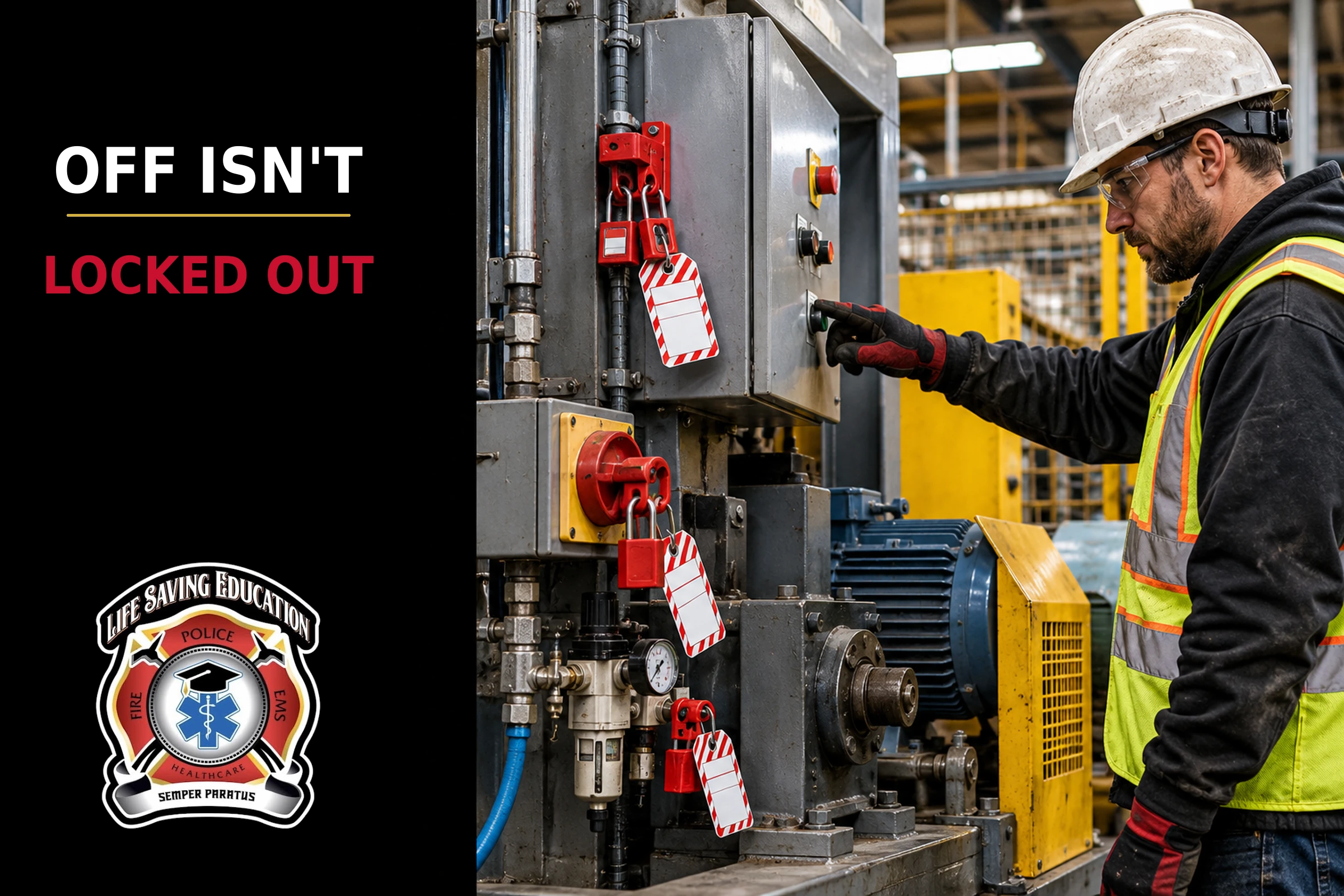
The machine is quiet.
The motor stopped. The controls are dark. Nobody hears anything moving.
That is exactly when maintenance can feel safe.
OSHA’s new New Jersey enforcement case is a reminder that stopped and isolated are two different conditions.
On September 23, OSHA announced proposed penalties totaling $446,864 against a multi-location car wash operator in Sicklerville, New Jersey. The agency alleges workers performed maintenance without required lockout, without adequate energy-control procedures, and without sufficient lockout/tagout training. OSHA also cited noise-program deficiencies.
The dollar amount will get attention. The better training question is simpler:
Before someone puts a hand, tool, or body part into a machine, how do we know every dangerous source of energy is actually controlled?
⚙️ “Off” Is a Control Position. Lockout Is an Energy-Control Process.
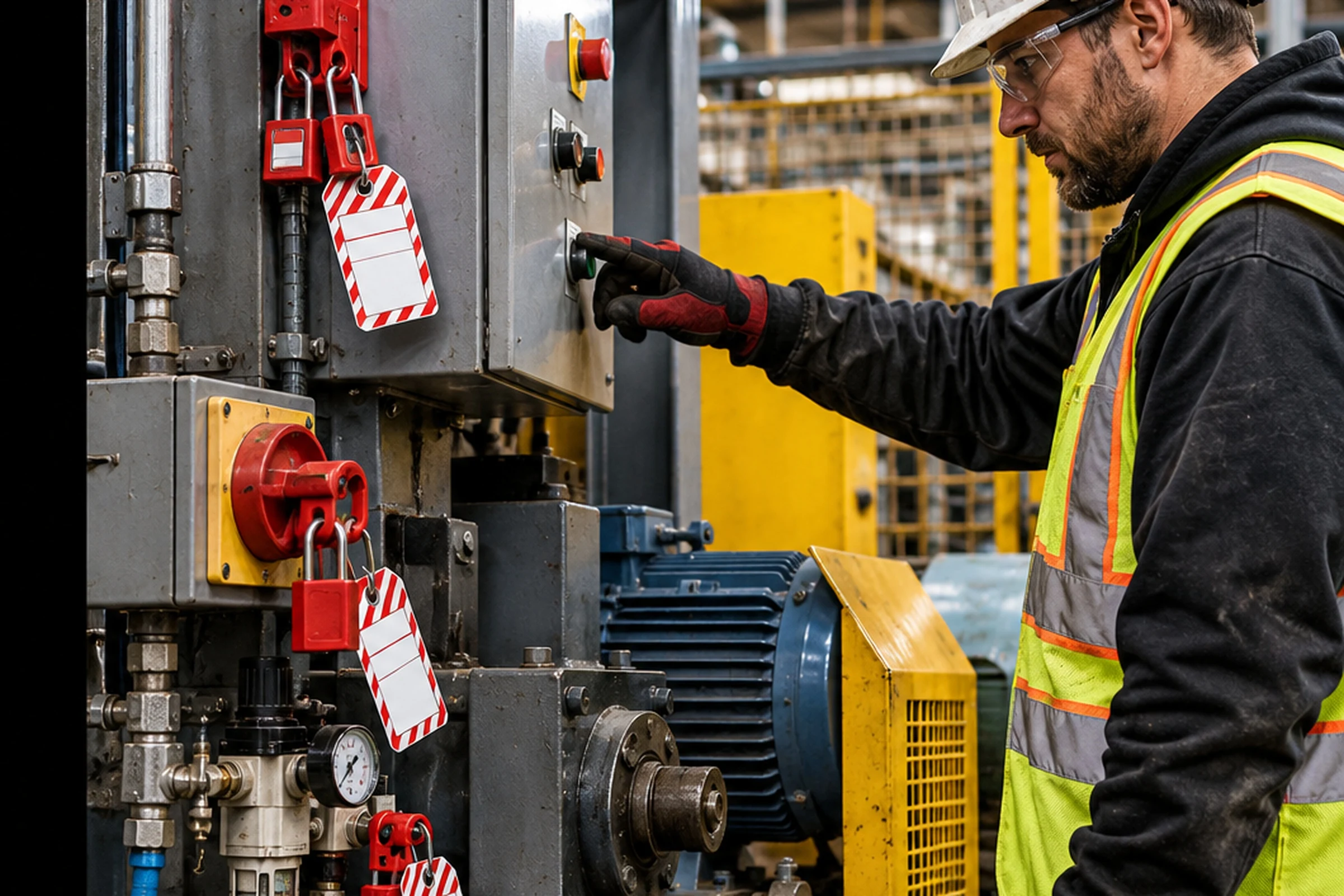
Pressing a stop button can halt normal operation without physically separating the equipment from its energy sources.
A motor may still be connected to electrical power. A pneumatic line can remain pressurized. A hydraulic cylinder can hold energy. A raised component can fall under gravity. A spring can stay compressed. A hot system can retain thermal energy. A conveyor can move when stored tension is released.
OSHA’s general-industry lockout/tagout standard, 29 CFR 1910.147, is built around that problem. When servicing or maintenance exposes an employee to unexpected energization, startup, or release of stored energy, the equipment must be isolated and rendered inoperative under an energy-control program.
The program is more than a bucket of locks. OSHA requires energy-control procedures, employee training, and periodic inspections.
🔌 Start by Finding Every Energy Source
Lockout fails when the procedure controls the obvious energy source and misses the one that can still hurt somebody.
NIOSH’s new September 2026 Lockout / Tagout / Tryout Toolbox Talk tells workers to identify the energy sources that need control before maintenance. It specifically calls out:
- electrical energy,
- mechanical energy,
- gravitational energy,
- thermal energy,
- hydraulic energy,
- pneumatic energy,
- and chemical energy.
That list is useful because many real machines combine several of them.
A car wash is a good example. Conveyors, pumps, rotating brushes, doors, compressors, electrical panels, tensioned components, and pressurized systems can all create different isolation points. A generic instruction that says “shut machine off and apply lock” may leave the worker guessing which devices actually control the hazard.
🧾 Why Machine-Specific Procedures Matter
OSHA says an energy-control procedure must clearly and specifically explain the scope, purpose, authorization, rules, and techniques used to control hazardous energy.
For a complex machine, useful instructions answer practical questions:
Identify the machine and the normal stopping sequence.
List each disconnect, valve, breaker, blocking point, or other energy-isolating device.
Explain how pressure, motion, heat, gravity, or mechanical tension will be relieved, restrained, blocked, or otherwise made safe.
Describe the tryout, test, meter check, gauge check, visual confirmation, or other verification appropriate to the equipment.
Clear procedures reduce improvisation. They also make training and annual inspection much more meaningful because the auditor can compare what employees actually do with a defined process.
🧨 Stored Energy Is Where “Off” Becomes Dangerous
After locks and tags are applied, OSHA requires potentially hazardous stored or residual energy to be relieved, disconnected, restrained, or otherwise rendered safe.
This is where crews can get hurt even when the main disconnect is locked.
Examples include:
- a hydraulic cylinder held in the raised position,
- compressed air trapped between closed valves,
- springs or belts under tension,
- flywheels or rotating parts that have not fully stopped,
- electrical components capable of storing charge,
- and material or machine parts that can shift under gravity.
If stored energy can reaccumulate to a hazardous level, OSHA requires continued verification until the servicing is complete or the possibility of reaccumulation no longer exists.
✅ Lockout / Tagout / Tryout
The word tryout is useful because it forces the crew to ask whether the machine is truly unable to operate.
NIOSH’s new toolbox talk tells workers to release or block stored energy and then try out and visually check the system to confirm all energy sources are de-energized.
OSHA’s standard makes the same core point in regulatory language: before work begins, the authorized employee must verify that isolation and de-energization have been accomplished.
Verification should be appropriate to the equipment. A start-button try alone does not prove that every form of stored energy has been controlled.
👷 Authorized, Affected, and Other Employees Have Different Training Needs
One reason lockout programs become weak is that everybody gets the same short presentation.
OSHA divides training by the employee’s relationship to the energy-control process.
Authorized employees apply lockout or tagout devices for servicing and maintenance. They need training in recognizing hazardous energy, understanding the type and magnitude of the energy, and knowing the methods used to isolate and control it.
Affected employees operate or use the machine, or work in the area where servicing occurs. They need to understand the purpose and use of the energy-control procedure.
Other employees who may work around a lockout area need to understand the procedure and the prohibition on restarting or reenergizing locked or tagged equipment.
That distinction matters in a busy operation. The maintenance technician, equipment operator, cleaner, supervisor, and nearby coworker may all interact with the same lockout, but their responsibilities are different.
🔐 Group Lockout Cannot Become “One Lock for the Crew”
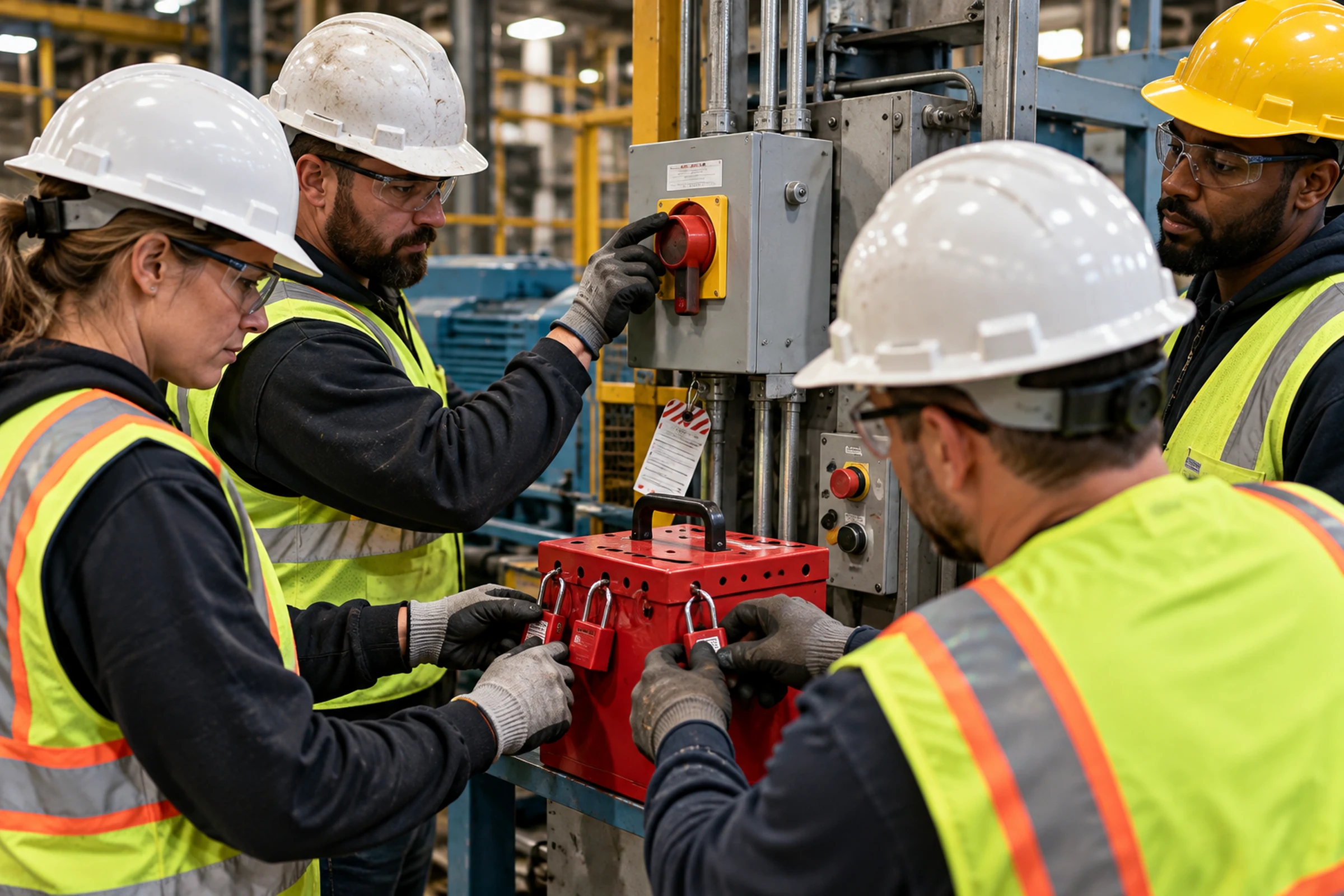
Large maintenance jobs often involve several workers, departments, or contractors.
OSHA allows group lockout systems, but the system must provide protection equivalent to personal lockout. The standard assigns responsibility for coordinating the group and requires each authorized employee to affix a personal lockout or tagout device to the group lockout device, lockbox, or comparable mechanism when that employee begins work.
That personal connection matters. A worker should never have to rely on the assumption that the person holding the key remembers who is still inside the hazard zone.
🔍 The Annual Inspection Is Supposed to Find Weak Procedures
OSHA requires periodic inspection of the energy-control procedure at least annually.
The inspection is not a paperwork exercise. It is supposed to identify deviations and inadequacies, verify that employees understand their responsibilities, and trigger correction and retraining when needed.
For a useful annual review, pick real equipment and watch the procedure happen.
Ask:
- Did the employee identify every energy source?
- Did the written procedure match the actual machine?
- Were all required locks and tags applied?
- Was stored energy controlled?
- Did the employee verify isolation?
- Would the procedure still work during a shift change or multi-crew job?
If the procedure only works because one experienced mechanic knows the machine from memory, the written program is not doing enough work.
🔊 The Noise Citations Matter Too
The New Jersey case was not limited to hazardous energy.
OSHA also cited alleged failures involving noise monitoring, baseline audiograms, and training for employees exposed above 85 decibels.
That makes the case a useful reminder about how safety systems fail. A workplace can have visible hazards and chronic exposure hazards at the same time. The maintenance event may create the immediate injury risk, while repeated noise exposure quietly damages hearing over years.
NIOSH also released a new Noise and Hearing Protection Toolbox Talk in September 2026. For employers reviewing this case, it is worth pairing the lockout audit with a quick look at hearing-conservation obligations and current exposure data.
🛠️ What Employers Should Check This Week
✅ Key Takeaways
- OSHA proposed $446,864 in penalties against a New Jersey car wash operator after alleging hazardous-energy and noise violations. The employer may contest the findings.
- Turning a machine off is not the same as isolating it from hazardous energy.
- Lockout/tagout programs must address every applicable energy source, including stored and residual energy.
- Authorized employees must verify isolation and de-energization before maintenance begins.
- Machine-specific procedures are much stronger than generic lockout instructions.
- OSHA requires role-appropriate employee training and at least annual periodic inspection of energy-control procedures.
- NIOSH’s new September 2026 Lockout / Tagout / Tryout Toolbox Talk is a useful short training resource.
❓ Frequently Asked Questions
Is pressing the stop button enough for lockout/tagout?
No. Normal controls may stop operation without isolating the machine from its energy sources. Covered servicing and maintenance requires the applicable energy-isolating devices and energy-control procedure.
Does every machine need a written energy-control procedure?
OSHA generally requires documented procedures, with a narrow exception when all conditions listed in 1910.147(c)(4)(i) are met. Employers should not assume the exception applies without checking every condition.
How often are lockout/tagout procedures inspected?
OSHA requires periodic inspection at least annually to confirm that procedures and the requirements of the standard are being followed.
What is the difference between an authorized and affected employee?
An authorized employee performs covered servicing or maintenance and applies the energy-control devices. An affected employee operates or uses the equipment, or works in the area where servicing is being performed.
Does OSHA 10 or OSHA 30 replace employer-specific lockout training?
No. OSHA Outreach courses provide broad hazard-awareness education. They do not replace the employer’s training duties under specific standards such as 29 CFR 1910.147.
Train Beyond the Lock
A safe energy-control program depends on people who can identify the sources, apply the procedure, control stored energy, and verify zero energy before the work starts. LSE provides OSHA Outreach and custom workplace-safety training for organizations across its service areas.
📚 Sources and Further Reading
- OSHA: New Jersey car wash hazardous-energy and noise enforcement announcement, September 23, 2026
- OSHA: 29 CFR 1910.147, The Control of Hazardous Energy (Lockout/Tagout)
- NIOSH: Lockout / Tagout / Tryout Toolbox Talk, DHHS (NIOSH) Publication 2026-120
- NIOSH: Noise and Hearing Protection Toolbox Talk, DHHS (NIOSH) Publication 2026-118
- Life Saving Education: OSHA 30-Hour Training
This article is educational and does not replace employer-specific procedures, a workplace hazard assessment, legal advice, regulatory interpretation, or required employee training.