Prepared by the LSE Editorial Team. Reviewed by Joseph Andrade, Jr., RN, NRP.
Life Saving Education uses real incidents and current enforcement cases to teach workers and supervisors how ordinary maintenance tasks can become life-threatening when energy and line-of-fire hazards are missed.
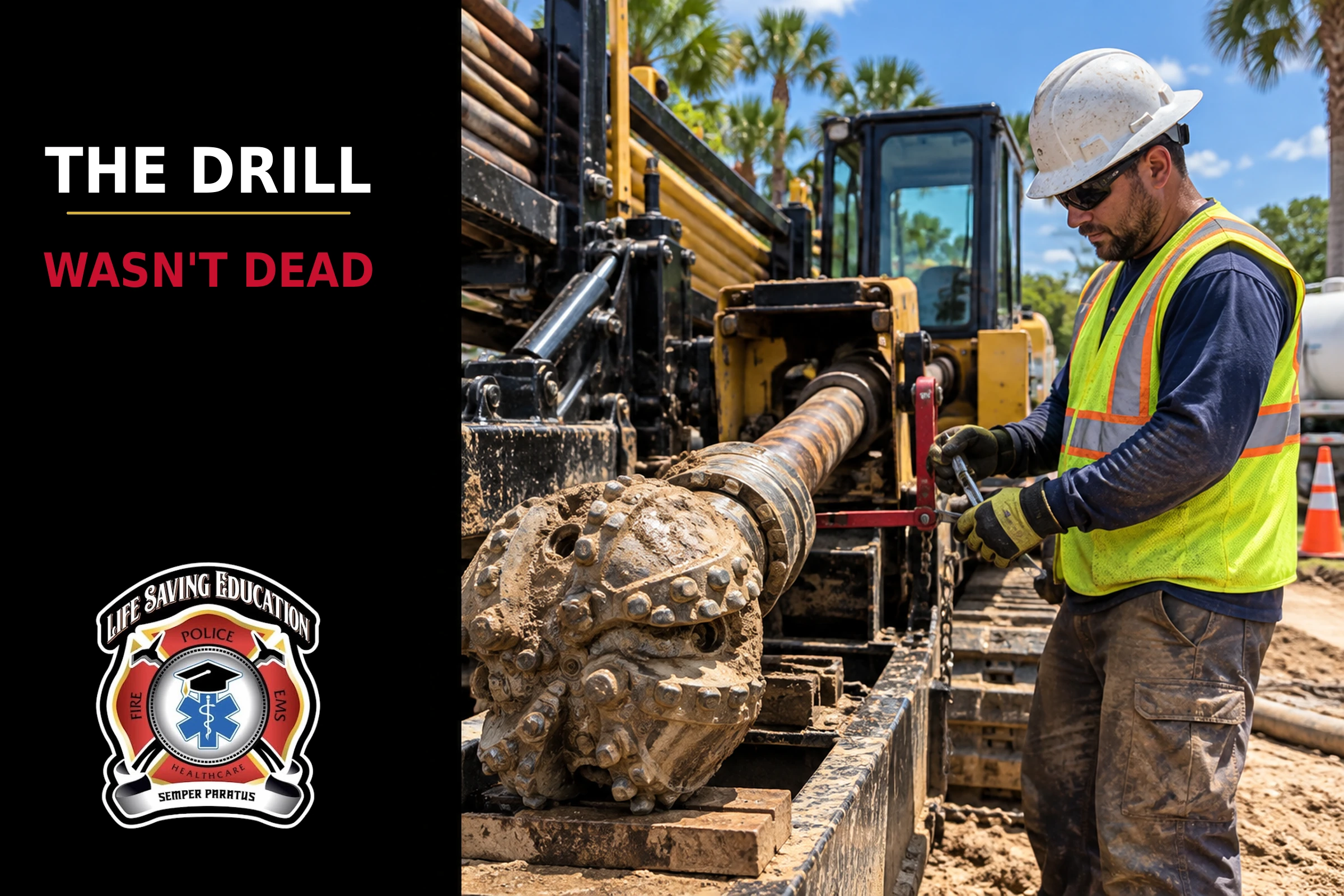
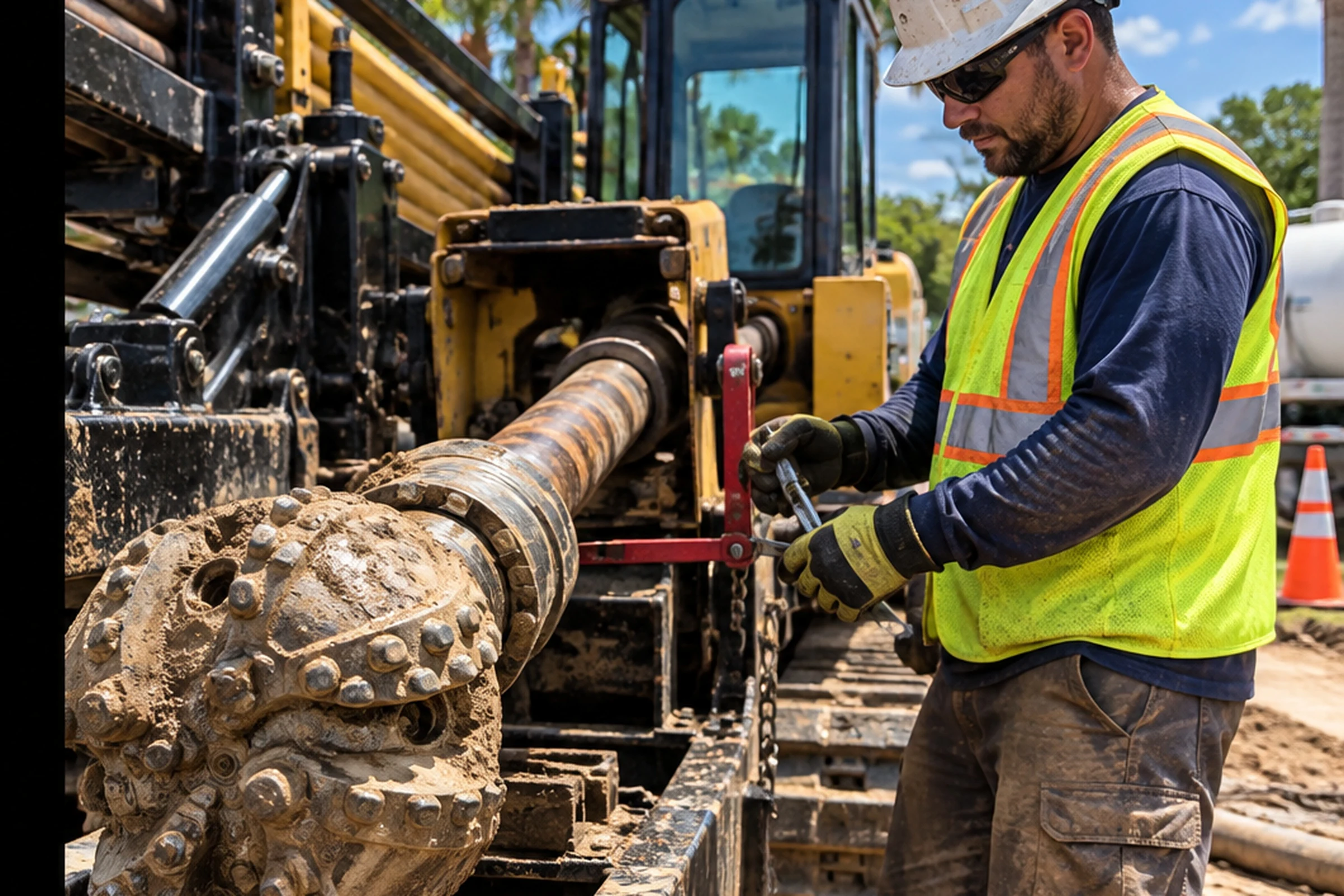
The crew was changing a drill bit.
That sounds like maintenance, not an emergency.
According to OSHA, employees at a New Smyrna Beach, Florida worksite were replacing a bit on a horizontal directional drilling machine on March 17, 2026 when the pipe stem began to rotate. A worker was fatally struck.
OSHA later cited the Orlando-area pipeline contractor for a willful struck-by violation and proposed a penalty of $165,514.
The case is a sharp reminder that heavy equipment does not have to be traveling across a jobsite to create a struck-by hazard. A shaft, pipe, drill string, auger, coupling, attachment, or tool can create lethal movement in a very small area.
⚙️ Maintenance Changes the Hazard
Workers usually operate equipment from positions chosen by the manufacturer. Guards are in place. Controls are designed around normal use. People stand where the machine expects them to stand.
Maintenance changes that geometry.
Someone moves closer to the mechanism. Hands reach toward components. Guards may be opened or removed. A person may kneel beside a shaft, work near a pinch point, or place part of the body where normal operation would never allow it.
That means a small amount of unexpected movement can have a much larger consequence.
🌀 Rotational Energy Creates a Line of Fire
When most people hear struck-by hazard, they picture a truck, crane load, falling object, or piece of flying material.
Rotating machinery deserves the same attention.
A drill stem can sweep through space with enough force to strike, crush, catch clothing, pull a worker into equipment, or throw a tool. Even slow rotation can be dangerous when a worker is close to the shaft.
The safest question before maintenance is not simply, “Is the drill stopped?”
Ask:
📍 Line-of-Fire Thinking Has to Be Specific
“Stay out of the line of fire” is useful advice only when workers can identify the line.
On horizontal drilling equipment, potential danger zones can include:
- the rotational path of the drill stem or tool,
- the area around couplings and threaded connections,
- pinch and crush points near clamps and vises,
- the space between moving equipment and fixed objects,
- areas where stored pressure or tension could release,
- and the path a component could travel if it breaks free.
A pre-task briefing should identify those zones before anybody starts loosening, replacing, cleaning, or adjusting equipment.
🔒 Stop, Secure, and Verify Before Hands Go In
The specific energy-control method depends on the machine, the work being performed, the applicable standard, and the manufacturer’s instructions.
The general safety logic is consistent:
- Stop the equipment using the proper shutdown process.
- Prevent unexpected movement or startup. Use the required isolation, blocking, restraint, lockout, control, or other method that applies to the equipment and task.
- Control stored energy. Pressure, hydraulic force, gravity, torsion, tension, and rotating components may remain hazardous after normal shutdown.
- Verify the condition. Before a worker enters the danger zone, confirm that the component cannot move in the way that could injure the worker.
A switch in the “off” position is a clue. Verification is what tells the crew the hazard is actually controlled.
🧭 The Operator and the Mechanic Need the Same Picture
Maintenance incidents often involve more than one person.
One worker may be at the controls. Another may be near the bit or drill stem. A third may be giving directions.
If those people do not share the same understanding of machine status, a routine adjustment can turn into an unexpected movement event.
A good procedure answers basic communication questions:
- Who is in charge of the maintenance evolution?
- Who controls the operating station?
- How does the worker at the tool confirm the machine is secure?
- What signal authorizes movement?
- What signal stops all movement?
- How is control transferred during a shift or personnel change?
Hand signals and radios help only when everyone agrees on what they mean before the task begins.
🧰 Maintenance Should Have Its Own Procedure
Operating instructions are not automatically maintenance instructions.
The normal production process may tell a worker how to advance the drill, add a rod, or steer the bore. Replacing a bit or servicing a component may require a different sequence and different safeguards.
For high-risk tasks, employers should consider a written procedure that identifies:
- the specific machine and task,
- the required shutdown and isolation steps,
- the parts that can move, rotate, or release energy,
- the worker positions that must remain clear,
- required blocking, restraint, tools, or controls,
- verification before work begins,
- and the process for returning the equipment to service.
That procedure should match the actual equipment on site, not a generic machine from a binder.
👷 A Supervisor’s Five-Minute Pre-Maintenance Check
⚖️ What the OSHA Case Does and Does Not Tell Us
OSHA’s public announcement is brief.
It tells us the incident date, the employer, the maintenance activity, the unexpected rotation, the fatal outcome, the willful struck-by citation, and the proposed penalty.
It does not provide every detail of the company’s procedure, the machine’s control state, the exact mechanical sequence, or the final outcome of any contest.
Training should stay within those limits.
The useful lesson is not to reconstruct facts that have not been published. The useful lesson is to recognize the hazard pattern: a worker entered a maintenance position near a component capable of rotation, and the component moved.
✅ Key Takeaways
- OSHA says a worker was fatally struck when a pipe stem began rotating during drill-bit replacement at a Florida worksite.
- The agency cited the employer for a willful struck-by violation and proposed a $165,514 penalty. The employer may contest the findings.
- Maintenance puts workers closer to moving components and often removes the separation that exists during normal operation.
- Rotational energy creates a line-of-fire hazard even when the overall machine is stationary.
- Crews should identify what can move, who can cause movement, how the hazard will be controlled, and how zero movement will be verified before work begins.
- Machine-specific maintenance procedures and clear operator-to-worker communication reduce reliance on assumptions.
❓ Frequently Asked Questions
What is horizontal directional drilling?
Horizontal directional drilling is a trenchless method used to install underground pipe, conduit, and utilities by drilling a generally horizontal bore from the surface. Equipment configurations and procedures vary by machine and project.
Why is drill maintenance a struck-by hazard?
Drill stems, tools, clamps, attachments, and other components can rotate, swing, release, or move into a worker’s position. A person standing beside the equipment can be in the path even when the machine is not traveling.
Does this case prove the employer violated the law?
No. OSHA issued a citation and proposed penalty. The employer has the right to contest the findings before the Occupational Safety and Health Review Commission.
Can OSHA 10 or OSHA 30 replace machine-specific maintenance training?
No. OSHA Outreach courses provide broad hazard-awareness education. Employers still need to provide training and procedures required for the actual equipment, hazards, tasks, and standards that apply to their employees.
Put the Maintenance Task Into the Training
Safety training works better when workers practice the hazards they actually face. LSE provides OSHA Outreach and customized workplace-safety training that can use real equipment, task examples, and supervisor scenarios.
📚 Sources and Further Reading
- U.S. Department of Labor / OSHA: Florida pipeline installation contractor cited after March 2026 fatality, September 23, 2026
- OSHA: Avoiding Underground Utilities during Horizontal Directional Drilling Operations
- Life Saving Education: OSHA 30-Hour Training
This article is educational and does not replace manufacturer instructions, employer procedures, a job hazard analysis, applicable OSHA requirements, engineering controls, or task-specific training.