Joseph Andrade, Firefighter, Paramedic, RN, OSHA Outreach Instructor, Lead Instructor
Life Saving Education. Practical safety education built around real hazards, real decisions, and skills people can use when seconds count.
When a train derails with hazardous materials, the scene is bigger than the fire you can see.
Responders need to know what is in the cars, where those cars are, how the containers are behaving, what the wind and terrain are doing, what protective actions are needed, and which technical experts can be trusted for the next decision.
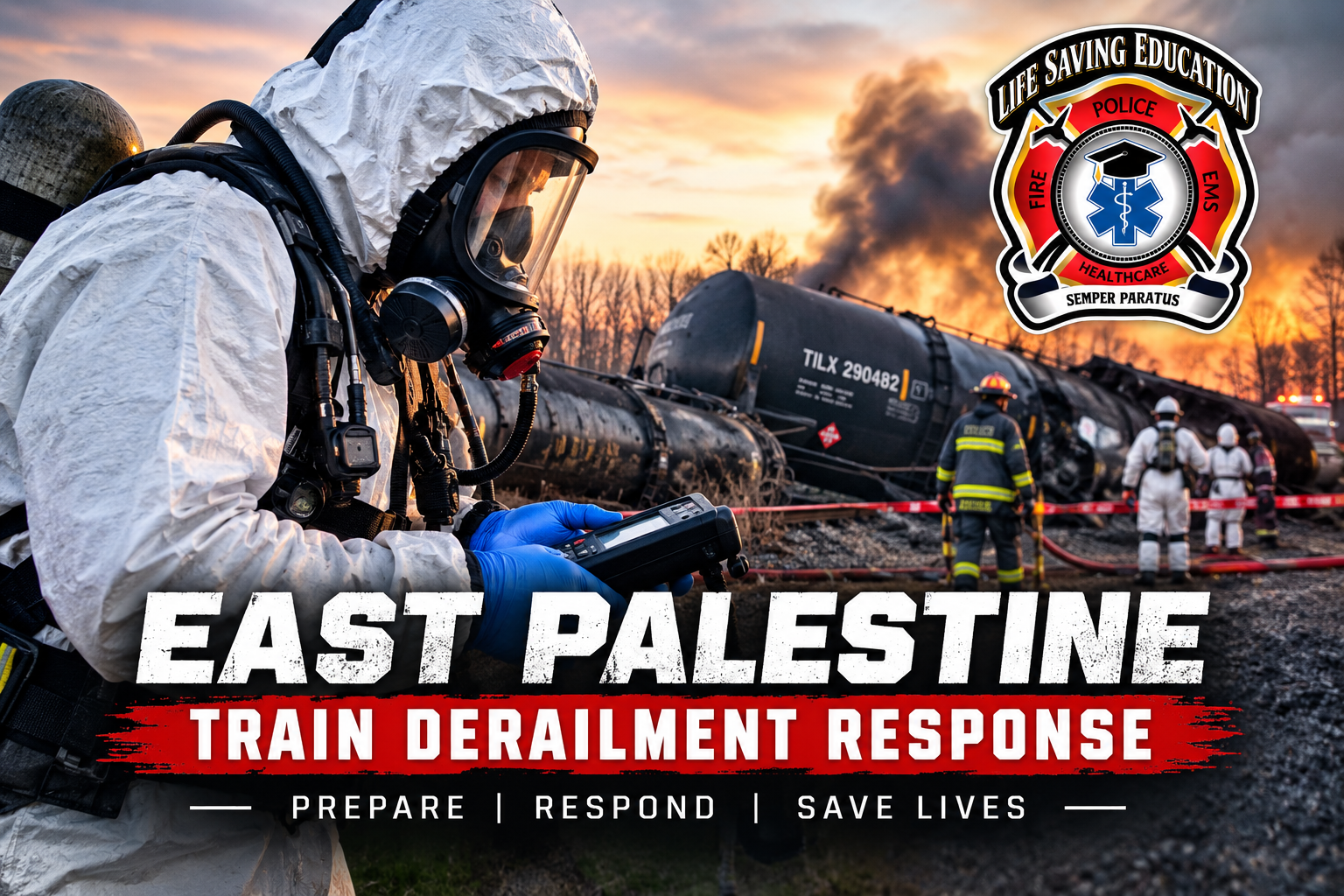
The February 3, 2023 Norfolk Southern derailment in East Palestine, Ohio became one of the most closely examined hazardous-materials transportation incidents in recent U.S. history.
Three years later, the value of studying it is not in replaying the images.
It is in asking what the investigation changed.
The strongest East Palestine train derailment lessons are about information, decision quality, container behavior, responder preparedness, and the discipline to keep reassessing the incident as better evidence arrives.
🚂 Incident snapshot: NTSB found that an overheated wheel bearing caused an axle to separate, leading to the derailment of 38 railcars. The derailed equipment included 11 tank cars carrying hazardous materials. Emergency responders established a 1-mile evacuation zone affecting about 2,000 residents.
🔍 East Palestine Train Derailment Lessons Begin Before the Derailment
NTSB determined that the accident began with a failed wheel bearing on a hopper car.
A hot-bearing detector in Salem, Ohio measured the bearing at 103°F above ambient and generated a non-critical alert. The train crew did not receive that alert. Less than 40 minutes later, a detector at East Palestine measured the bearing at 253°F above ambient and transmitted a critical alarm.
The crew began slowing, but the axle failed and the train derailed.
For emergency responders, this may sound like a railroad maintenance problem outside our lane.
It is not.
Major HazMat events often begin with a mechanical failure, process failure, transportation failure, or human-system failure before the hazardous material is ever released.
Understanding that chain improves prevention, pre-planning, and post-incident investigation.
🧾 Lesson 1: Responders Need the Train Consist Immediately
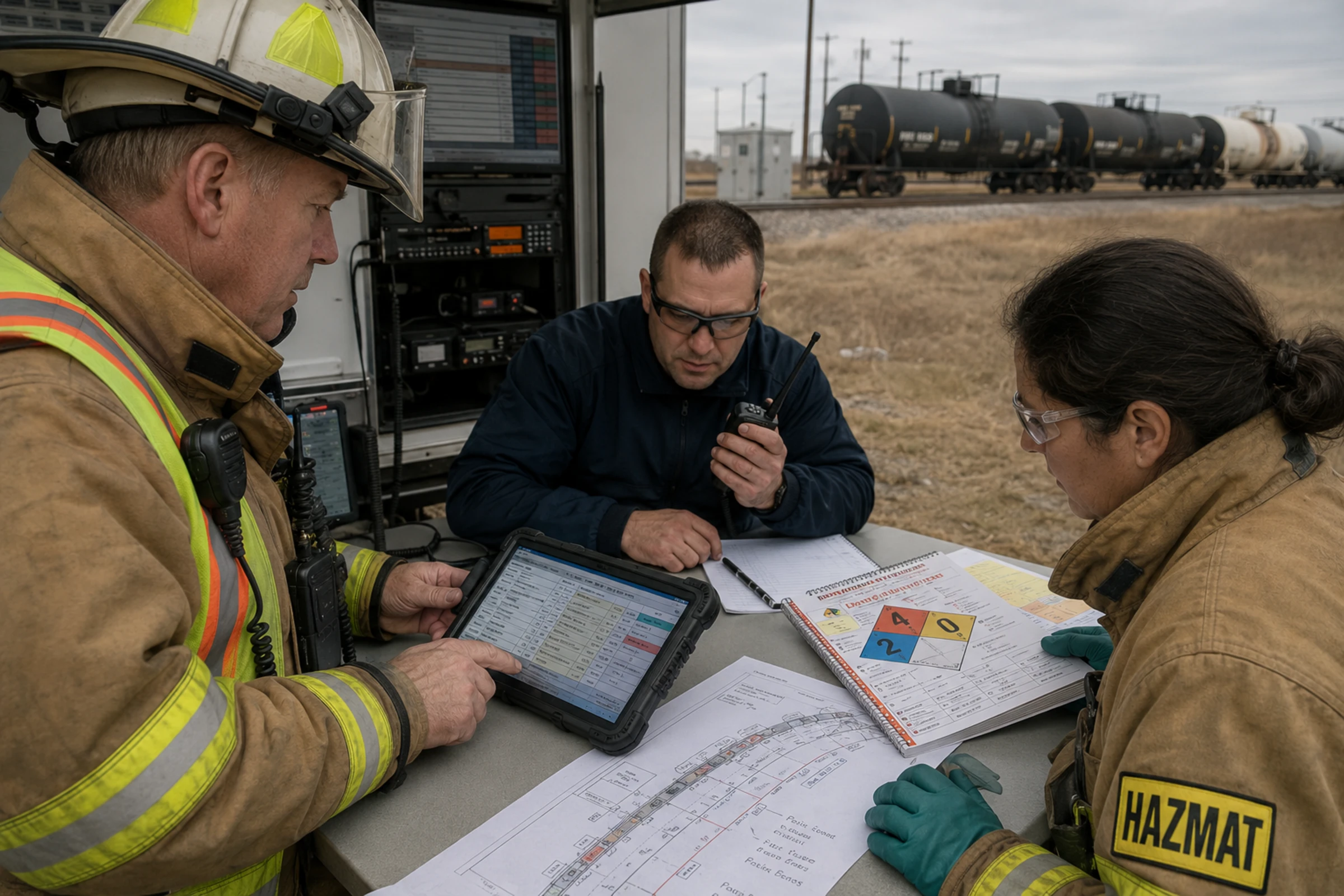
One of the clearest emergency-response lessons was information access.
A train consist tells responders what is in the train and where it is located.
At a rail HazMat incident, that information can affect:
- isolation and evacuation decisions
- ERG lookup
- monitoring priorities
- PPE selection
- fire-control strategy
- identification of tank cars
- requests for technical specialists
NTSB recommended stronger requirements for immediate communication of train-consist information to emergency responders.
PHMSA subsequently issued its real-time train-consist information final rule. USFA explains that railroads must proactively provide real-time electronic hazardous-materials shipment information to the primary public safety answering point when the railroad becomes aware of an accident or incident involving hazardous materials.
That is a major operational improvement.
📱 The training implication
Departments need more than access to an app.
Dispatchers, officers, HazMat teams, and emergency managers should know:
- who receives the information
- how it is pushed to the incident command post
- how AskRail or another authorized system is used
- how railcar positions are reconciled with the actual wreck
- how the ERG supports initial protective actions
- when to request railroad and shipper technical assistance
Life Saving Education HAZWOPER training
🧯 Lesson 2: Container Behavior Matters More Than Visual Drama
One of the most important findings from NTSB involved the five tank cars carrying vinyl chloride monomer.
The cars were not mechanically breached in the initial derailment. They were exposed to fire and pressure-relief devices released material.
Three days after the derailment, responders conducted a vent-and-burn operation.
NTSB later concluded that the vent and burn was not necessary to prevent a tank-car failure and that the incident commander had been given incomplete and misleading information by Norfolk Southern officials and contractors about the risk of a dangerous chemical reaction.
This is a difficult lesson because emergency decisions are made under uncertainty.
The takeaway should not be that incident commanders must personally become polymer chemists.
The takeaway is that high-consequence decisions require:
- reliable product-specific technical information
- independent technical expertise when possible
- clear separation between fact, forecast, and worst-case possibility
- repeated reassessment as temperatures, pressures, monitoring data, and container behavior change
🧠 Command question: What do we know, what are we assuming, and what evidence would change the plan?
That question belongs in every complex HazMat incident.
🛢️ Lesson 3: Tank Car Design Changes Consequences
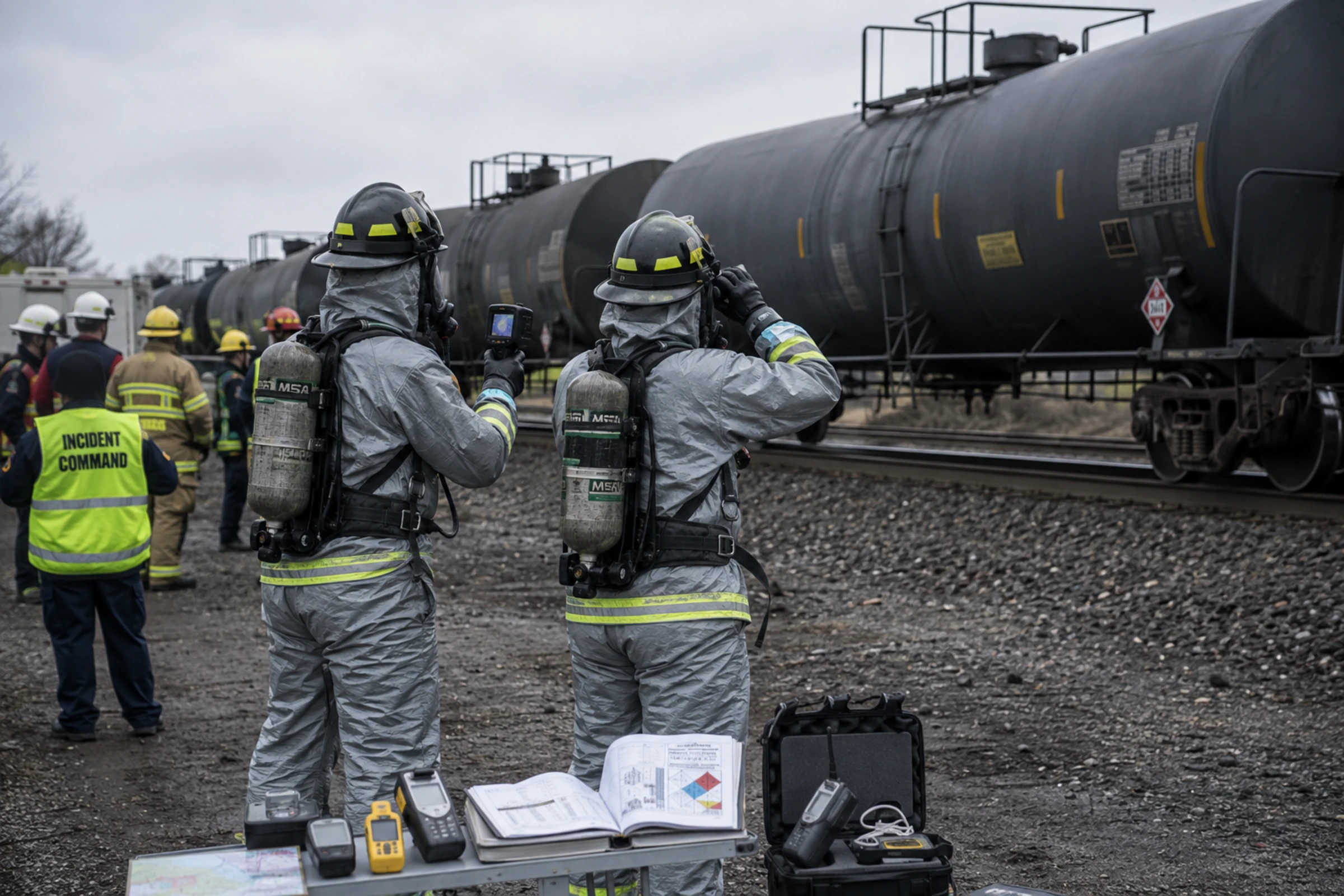
NTSB found that three DOT-111 tank cars were mechanically breached during the derailment, releasing flammable and combustible liquids that ignited.
The agency identified continued use of DOT-111 tank cars for hazardous materials as contributing to the severity of the release and recommended expanding and accelerating their phaseout from certain hazardous-materials service.
For responders, tank-car specification is not trivia.
Container construction can affect:
- mechanical damage vulnerability
- thermal exposure
- pressure relief
- product release
- fire involvement
- evacuation and isolation decisions
HazMat training should include enough container recognition to help responders understand why two railcars carrying hazardous materials may behave very differently in the same wreck.
🔥 Lesson 4: Placards and Markings Have to Survive the Incident
Placards are useful only if responders can see and interpret them.
NTSB recommended that PHMSA require hazardous-material placards to be able to survive accidents and fires.
That recommendation reflects a basic emergency-response reality.
The incident itself may destroy the information system you expected to use.
Strong response plans therefore use redundant identification:
- train-consist information
- placards and markings
- shipping information
- AskRail or authorized electronic data
- railroad representatives
- shipper or manufacturer technical assistance
- air monitoring and product behavior
Do not make one damaged placard carry the entire identification problem.
🧑🚒 Lesson 5: Local Departments Need Rail-Specific HazMat Preparation
East Palestine involved a small community, but the rail line carried mixed freight and hazardous materials through the center of town.
That is not unique.
Many communities with limited HazMat resources have rail corridors, highways, pipelines, industrial facilities, or distribution centers moving dangerous goods through their response area.
USFA and PHMSA have emphasized rail-HazMat preparedness, and PHMSA’s HazMat Roundtable has supported updates to regional rail-response training for rural departments.
Pre-incident planning should include:
- rail access points
- crossings and alternate routes
- water supply limitations
- evacuation and shelter-in-place considerations
- railroad emergency contacts
- mutual-aid HazMat resources
- public-warning systems
- hospitals and EMS transport considerations
- monitoring capability
- decontamination capability
- responder rehabilitation
- unified command procedures
A derailment is a terrible time to learn which side of the tracks your mutual-aid team cannot reach.
🌬️ Lesson 6: Monitoring Is a Decision Tool, Not Just a Number
HazMat incidents evolve.
Air monitoring, environmental sampling, weather information, container temperatures, and visual observations should feed decision-making continuously.
The question is not merely, "What number did the meter show?"
- what instrument was used?
- what does it detect?
- what are its limitations?
- where was the sample taken?
- when was it taken?
- what changed since the last sample?
- how does the result change the protective action?
This is the same philosophy we teach in HAZWOPER and HazMat training.
Monitoring without interpretation is just data.
🏘️ Lesson 7: The Emergency Phase Ends Before the Community Impact Does
EPA’s response continued long after the fire was out and the track was reopened.
By January 2026, EPA reported that site-wide cleanup and restoration were complete and the response had moved into monitoring, maintenance, and reporting, including quarterly groundwater, surface-water, and drinking-water sampling.
That long tail matters.
For emergency services, the incident may transition away from 911 command relatively quickly. For residents, environmental agencies, public health systems, and local government, the event can continue for years.
Public communication should recognize that difference.
- consistency of information
- clarity about uncertainty
- transparency about monitoring
- explanation of what is known and not yet known
- visible coordination among agencies
This is another reason to separate verified facts from assumptions during the initial response.
🎛️ What I Would Put Into a Rail HazMat Drill
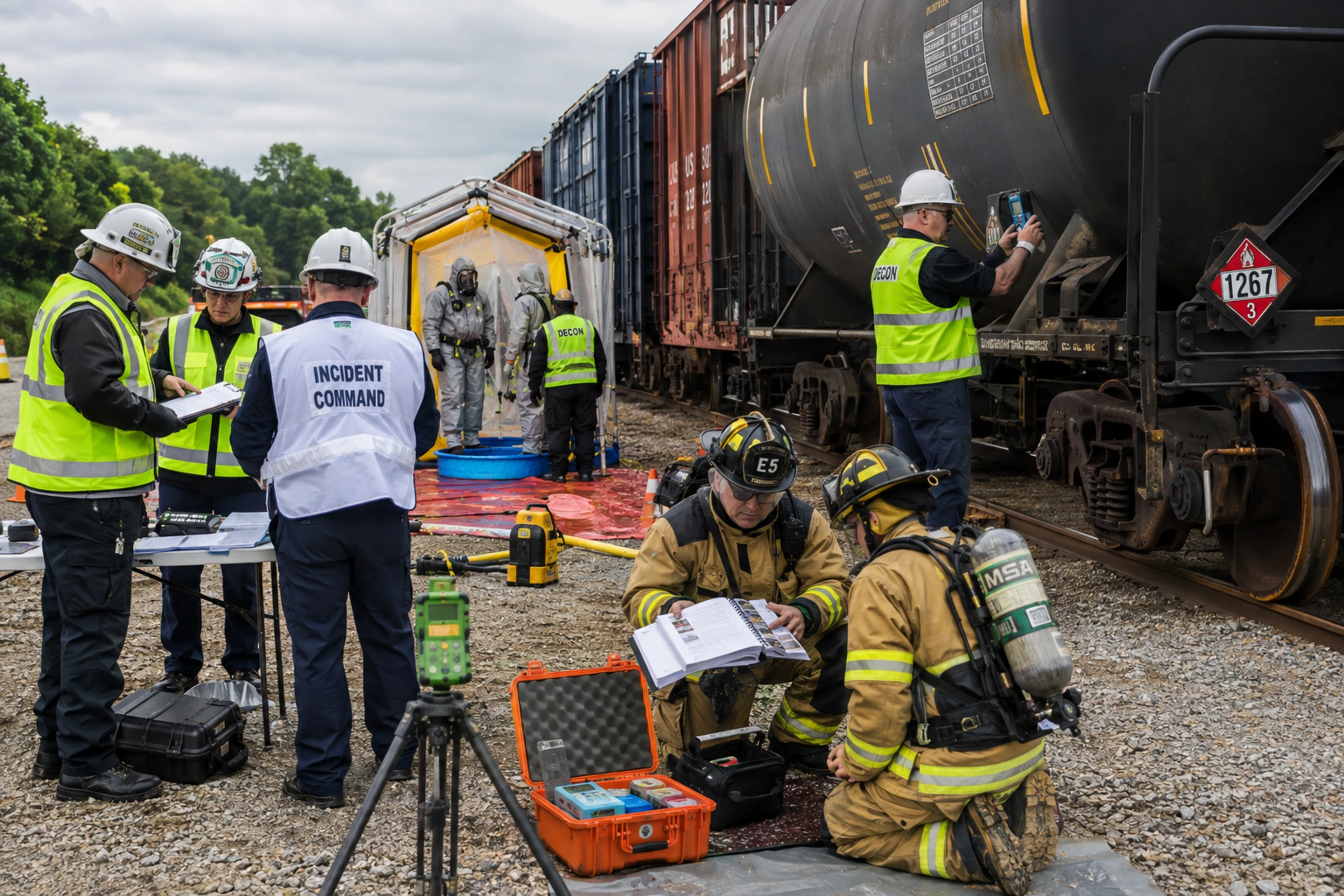
If I were building a training evolution around the lessons, I would not start with a giant fireball.
I would start with incomplete information.
Phase 1: Initial dispatch
A mixed-freight train has derailed. There is fire and an unknown number of hazardous-materials cars.
Students must establish command, position uphill and upwind where appropriate, request the consist, use the ERG, isolate the area, and identify immediate life-safety priorities.
Phase 2: New information arrives
The consist identifies several hazardous materials, but some placards are obscured.
Students must map car positions, identify monitoring priorities, and request technical resources.
Phase 3: Conflicting technical advice
Two sources provide different predictions about container behavior.
Now the exercise becomes command decision-making.
Students must identify what is fact, what is assumption, what data is missing, and what would justify escalation or de-escalation.
Phase 4: Long-duration operations
The release is stabilized, but evacuation, monitoring, public information, responder rehab, decon, and environmental coordination continue.
That is where realism lives.
request customized HAZWOPER and HazMat training
🔗 Related Life Saving Education Guides
- HAZWOPER and HazMat response guide
- When a chemical spill becomes a HAZWOPER emergency response
- Chemical emergency family preparedness
- Customized group safety training
✅ Key Takeaways
- East Palestine was caused by an overheated wheel bearing that led to an axle separation and derailment.
- Real-time train-consist information is a critical responder tool, and federal rules were strengthened after the incident.
- NTSB concluded the vinyl-chloride vent-and-burn decision was unnecessary to prevent tank-car failure and was made using incomplete and misleading technical information.
- Container specification, placard survivability, monitoring, and redundant product identification all affect responder decision-making.
- The best training exercises force leaders to manage uncertainty, not just identify placards.
- HazMat incidents can remain environmental and community-health events long after the emergency-response phase ends.
❓ Frequently Asked Questions
What caused the East Palestine derailment?
NTSB determined that a wheel bearing on a hopper car overheated and caused an axle to separate, resulting in the derailment.
How many railcars derailed?
NTSB reported that 38 mixed-freight railcars derailed. The derailed equipment included 11 tank cars carrying hazardous materials.
Was the vinyl chloride vent and burn necessary?
NTSB concluded that the vent-and-burn operation was not necessary to prevent a tank-car failure and that the incident commander had received incomplete and misleading information about the chemical reaction risk.
What changed for first responders after East Palestine?
One major change was PHMSA’s rule requiring railroads to proactively provide real-time electronic train-consist information to the primary public safety answering point after a hazardous-materials rail incident.
What should fire departments train on for rail HazMat incidents?
Departments should train on command, railcar and product identification, train-consist access, ERG use, isolation and protective actions, monitoring, technical-resource requests, PPE, decon, evacuation coordination, public information, and long-duration operations.
🎯 Train for the Information Problem
A HazMat team’s equipment matters.
So do its meters, suits, reference guides, and decontamination systems.
But the East Palestine investigation is a reminder that one of the most important tools on scene is the ability to turn incomplete information into disciplined decisions.
Life Saving Education provides HazMat, HAZWOPER, OSHA, and emergency-response education grounded in realistic operational decision-making.
Life Saving Education HAZWOPER training
Onsite Group Training
Training You Can Count On. When Seconds Count.
📚 Sources and Further Reading
- NTSB, Norfolk Southern Railway Derailment and Hazardous Materials Release, East Palestine, Ohio
- NTSB, Failed Wheel Bearing Caused Norfolk Southern Train Derailment
- NTSB, Rail Safety Testimony and East Palestine Recommendations
- USFA, 2023 East Palestine Train Derailment and HazMat Release
- EPA, East Palestine Train Derailment Response
- EPA, East Palestine Operational Updates
⚖️ Educational Disclaimer
This article is provided by Life Saving Education for general educational purposes only. It is not medical, legal, or compliance advice, and it is not a substitute for hands-on training or professional guidance. Regulations and clinical guidance change and may vary by state, jurisdiction, employer, operation, or mode of transportation. Verify the current requirements that apply to your situation. In an emergency, call 911.