Prepared by the LSE Editorial Team. Reviewed by Joseph Andrade, Jr., RN, NRP.
Joseph works across emergency response, healthcare, and workplace safety and develops practical training for civilians, employers, and first responders.
The word "hazmat training" gets used for several different requirements in trucking, and that creates confusion fast.
A driver can need Entry-Level Driver Training for a hazardous-materials endorsement, a TSA security threat assessment, a state hazardous-materials knowledge test, and employer-provided DOT hazmat employee training depending on what that driver actually does.
Those steps are related, but they are not the same thing.
This guide focuses on ELDT hazmat endorsement training, the federal FMCSA requirement that applies to many drivers seeking the H endorsement for the first time.
🧭 ELDT Hazmat Endorsement Training: Who Needs It?
FMCSA’s Entry-Level Driver Training rules took effect on February 7, 2022.
The regulations establish minimum federal training requirements for people seeking certain commercial driving credentials for the first time, including:
- a Class A CDL
- a Class B CDL
- an upgrade from one CDL class to another covered class
- a passenger endorsement
- a school bus endorsement
- a hazardous materials, or H, endorsement
For the H endorsement, FMCSA’s Training Provider Registry guidance says the driver must complete ELDT theory only before taking the state-administered hazardous-materials knowledge test.
There is no ELDT behind-the-wheel component specifically for the H endorsement.
🔗 Related: DOT hazmat vs hazardous waste training: same material, different rules
🧾 Who Is Grandfathered or Exempt?
ELDT is not fully retroactive.
FMCSA explains that a driver who already held the relevant CDL or H endorsement before February 7, 2022 generally is not required to complete ELDT for that same credential simply because the rule later took effect.
A driver who held a CDL before that date but seeks an H endorsement for the first time after February 7, 2022 is subject to the H-endorsement ELDT requirement unless another exception applies.
The regulations also align with existing CDL exceptions in 49 CFR 383.3.
Because individual licensing histories can be complicated, drivers should use FMCSA’s current ELDT applicability resources or their state licensing agency when they are unsure.
🖥️ The Training Provider Registry Is the Gatekeeper

The required ELDT must come from a provider listed on FMCSA’s Training Provider Registry, or TPR.
That matters because a course completion certificate from a provider that is not properly listed does not satisfy the federal ELDT requirement.
The workflow is straightforward:
- Find a registered provider in the TPR.
- Complete the H-endorsement theory curriculum.
- The provider submits the driver’s successful completion information to FMCSA.
- The State Driver Licensing Agency verifies the completion electronically.
- The state can then administer the H endorsement knowledge test.
Drivers do not upload their own ELDT completion to the TPR. FMCSA states that only registered providers can submit the driver-training certification information.
No federal minimum number of classroom hours
The ELDT system is curriculum and proficiency based rather than built around one federally mandated number of hours for H-endorsement theory.
Training providers must cover the required curriculum in 49 CFR Part 380, Appendix E and meet provider requirements.
States may impose additional requirements beyond the federal minimum.
📚 What the H-Endorsement ELDT Curriculum Covers
The federal theory curriculum for the hazardous-materials endorsement is designed to prepare drivers around the knowledge needed for safe transportation and the state knowledge test.
Required topics include areas such as:
- hazardous-materials regulations
- driver responsibilities
- communications rules
- loading and unloading
- bulk packages
- emergency response
- routing and driving considerations
- parking
- incident reporting
- security awareness and plans
The provider must assess the driver on the theory curriculum in accordance with the ELDT rules.
This is not just a random online hazmat quiz.
A compliant provider is part of the TPR system and reports completion to FMCSA.
📝 ELDT Comes Before the State H Knowledge Test

For the H endorsement, the key sequencing rule is specific.
FMCSA’s TPR FAQ states that the driver must successfully complete theory training before the State-administered knowledge test.
The state must verify completion before administering that test.
This differs from Class A, Class B, passenger, and school-bus ELDT pathways that can include behind-the-wheel requirements before a skills test.
Can you schedule the test before ELDT is complete?
FMCSA allows a state to schedule testing before required ELDT is finished, but the test itself cannot be administered until the state verifies completion.
Individual state procedures can be more restrictive.
🔐 The TSA Security Threat Assessment Is a Separate Requirement
Getting an H endorsement involves more than FMCSA training.
The Transportation Security Administration’s Hazardous Materials Endorsement Threat Assessment Program conducts a security threat assessment for drivers seeking to obtain, renew, or transfer a hazardous-materials endorsement.
This is a separate federal process from ELDT.
The practical sequence varies somewhat by state, but drivers should plan for:
- identity and eligibility requirements
- fingerprints and application information where required
- TSA security threat assessment
- state CDL/H-endorsement application procedures
- state knowledge testing
A driver can finish ELDT and still not receive the H endorsement if other licensing or TSA requirements are not satisfied.
🔗 Related: Hazardous materials handling compliance: OSHA, EPA, and DOT without the alphabet soup
⚠️ ELDT Is Not the Same as Employer DOT Hazmat Employee Training
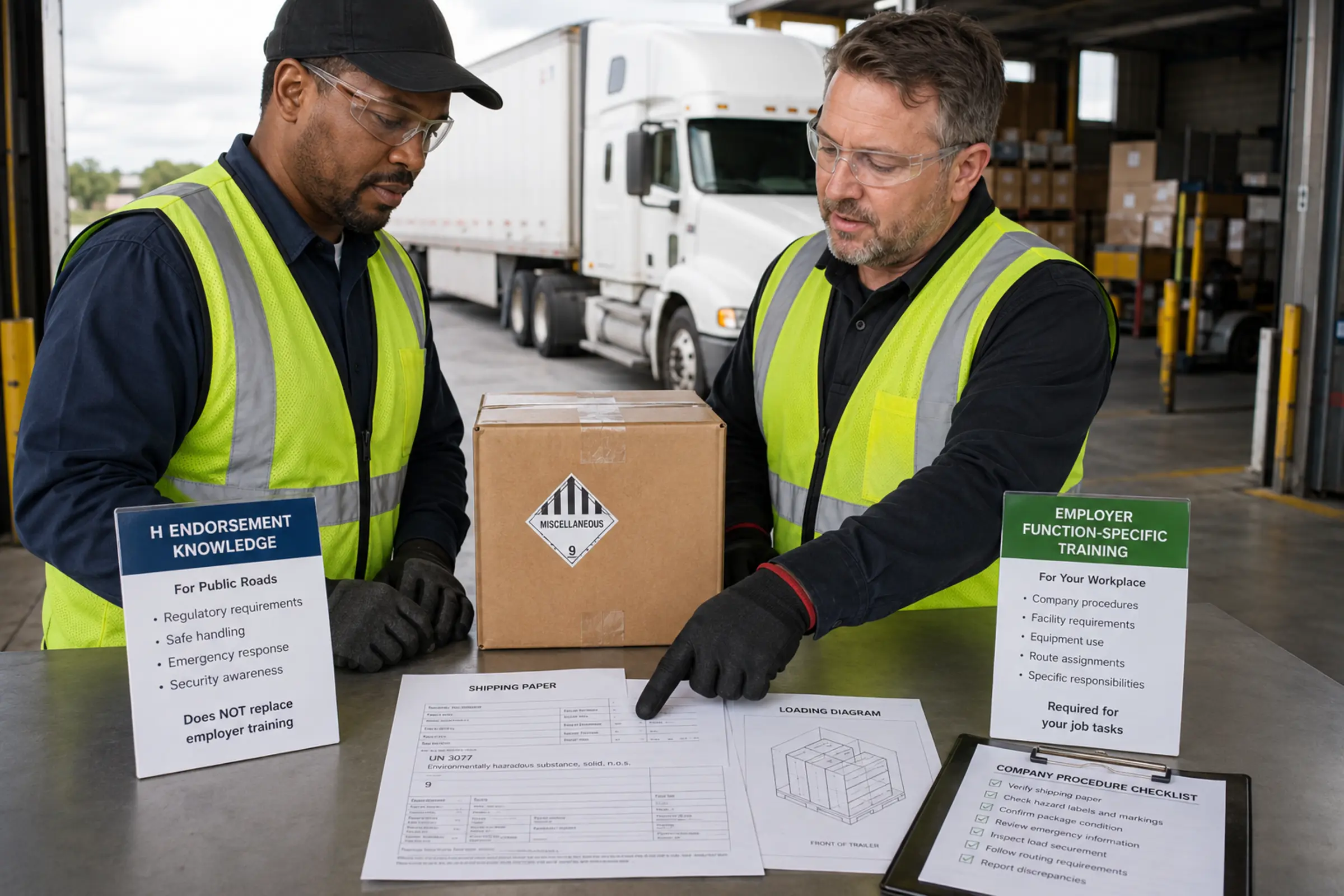
This is the distinction employers cannot miss.
The H endorsement is a driver licensing credential.
DOT hazmat employee training under 49 CFR Part 172, Subpart H is an employer training obligation tied to job functions that affect hazardous-material transportation safety.
A CDL driver with an H endorsement who performs covered hazmat employee functions may still need employer-provided training that includes:
- general awareness and familiarization
- function-specific training
- safety training
- security awareness
- in-depth security training when required
Recurrent hazmat employee training is generally required at least once every three years.
| Question | H endorsement ELDT | Employer DOT hazmat training |
|---|---|---|
| What is it? | A driver licensing credential | An employer training obligation tied to job functions |
| Main rule | FMCSA ELDT, 49 CFR Part 380 | 49 CFR Part 172, Subpart H |
| Who delivers it? | A Training Provider Registry provider | The employer ensures it is provided |
| What it covers | Theory curriculum before the state H knowledge test | General awareness, function-specific, safety, and security training |
| How often? | Before the first H endorsement | Recurrent at least once every three years |
So:
H endorsement ELDT does not automatically replace the employer’s 49 CFR 172.704 training program.
And a DOT hazmat employee training certificate does not automatically satisfy the separate FMCSA ELDT requirement for a first-time H endorsement unless it is delivered through the appropriate registered-provider framework and curriculum.
🚛 A Driver’s Practical H-Endorsement Roadmap
Step 1: Confirm ELDT applicability
Use FMCSA’s TPR applicability resources and your licensing history.
Step 2: Choose a registered ELDT provider
Verify the provider through the FMCSA Training Provider Registry before paying for the course.
Step 3: Complete H-endorsement theory training
Successfully complete the required curriculum and provider assessment.
Step 4: Confirm the provider submits completion
The provider submits the record to FMCSA. The state verifies the record electronically.
Step 5: Complete state H-endorsement testing and licensing steps
Follow your State Driver Licensing Agency’s process.
Step 6: Complete TSA security threat assessment requirements
TSA conducts the required HME security threat assessment for obtaining, renewing, or transferring the endorsement.
Step 7: Complete employer-specific DOT hazmat training if your job requires it
Your employer must evaluate your hazmat job functions and provide the required HMR training.
🧠 Why Employers Should Understand the Difference Too
A company hiring a driver with an H endorsement should not assume the license endorsement proves every employer training requirement is complete.
The employer still needs to ask:
- What hazmat functions will this driver perform?
- Will the driver load or unload hazmat?
- Will the driver prepare or verify shipping papers?
- Will the driver inspect markings, labels, or placards?
- Does the driver need function-specific company procedures?
- When was the driver’s last HMR recurrent training?
- Are training records complete?
The H endorsement proves a licensing qualification.
The employer’s hazmat training record proves the employer met its training responsibility for assigned hazmat functions.
📋 ELDT H Endorsement Checklist
- Confirm whether this is the first H endorsement on or after February 7, 2022.
- Verify ELDT applicability.
- Select a provider listed on FMCSA’s TPR.
- Complete the H-endorsement theory curriculum.
- Confirm the provider submits completion to the TPR.
- Follow state application and knowledge-test procedures.
- Complete TSA HME security threat assessment requirements.
- Check state-specific requirements that may exceed federal ELDT minimums.
- If employed in hazmat transportation, complete employer-required HMR training for actual job functions.
- Keep licensing and employer-training records separate and current.
✅ Key Takeaways
- ELDT applies to many drivers seeking the H endorsement for the first time after February 7, 2022.
- H-endorsement ELDT is theory only and must be completed before the state administers the H knowledge test.
- The training must come from an FMCSA Training Provider Registry provider.
- TSA’s security threat assessment is a separate H-endorsement requirement.
- The H endorsement does not replace employer DOT hazmat employee training under 49 CFR 172.704.
❓ Frequently Asked Questions
Do I need behind-the-wheel ELDT for the hazmat endorsement?
Not for the H endorsement itself. FMCSA’s guidance states that H-endorsement applicants complete the required theory training before the state knowledge test. There is no H-endorsement-specific behind-the-wheel ELDT component.
Can any online hazmat course satisfy ELDT?
No. The required ELDT must be provided by a training provider listed on FMCSA’s Training Provider Registry and must meet the applicable federal curriculum and reporting requirements.
I already had my CDL before 2022. Do I still need ELDT for a new H endorsement?
If you are seeking the H endorsement for the first time on or after February 7, 2022, FMCSA generally requires the endorsement ELDT even if you already held your CDL before that date, unless an exception applies.
Is the TSA background check part of ELDT?
No. The TSA security threat assessment is a separate process required for the hazardous-materials endorsement.
Does my H endorsement mean my employer does not need to train me on hazmat?
No. If your job functions make you a hazmat employee under the HMR, your employer must ensure you receive the applicable general-awareness, function-specific, safety, security, and other required training.
Training Excellence, Real-World Readiness.
🎯 Know Which "Hazmat Training" You Are Buying
A driver trying to earn an H endorsement and an employer trying to qualify a hazmat employee are solving two different compliance problems.
The first is a licensing pathway.
The second is a job-function training program.
Life Saving Education can help employers and drivers understand where DOT HazMat, HAZWOPER, OSHA, and transportation training requirements intersect. Any ELDT H-endorsement course marketed as qualifying for the FMCSA requirement should be verified against the Training Provider Registry before enrollment.
📚 Authoritative Sources
- FMCSA, Entry-Level Driver Training
- FMCSA Training Provider Registry
- FMCSA TPR Frequently Asked Questions
- eCFR, 49 CFR Part 380, Subpart F
- TSA, Hazardous Materials Endorsement
- PHMSA, Hazmat Training Requirements for Industry
⚖️ This article is provided by Life Saving Education for general educational purposes only. It is not medical, legal, security, or compliance advice, and it is not a substitute for hands-on training, professional guidance, law-enforcement direction, or an employer-specific emergency plan. Laws, regulations, guidance, and best practices change and may vary by jurisdiction and workplace. Verify current requirements for your situation. In an emergency, call 911 when it is safe to do so.