Prepared by the LSE Editorial Team. Reviewed by Joseph Andrade, Jr., RN, NRP.
Life Saving Education translates current emergency-care and workplace-safety guidance into practical training for employees, employers, healthcare teams, and first responders.
Most workplaces know exactly where the AED is.
There is a sign on the wall. Someone checks the battery. The pads have expiration dates. A first-aid kit sits nearby because everyone understands the basic idea: when a rare emergency happens, the equipment has to be there before the emergency starts.
OSHA is now asking employers to think about opioid overdose in much the same way.
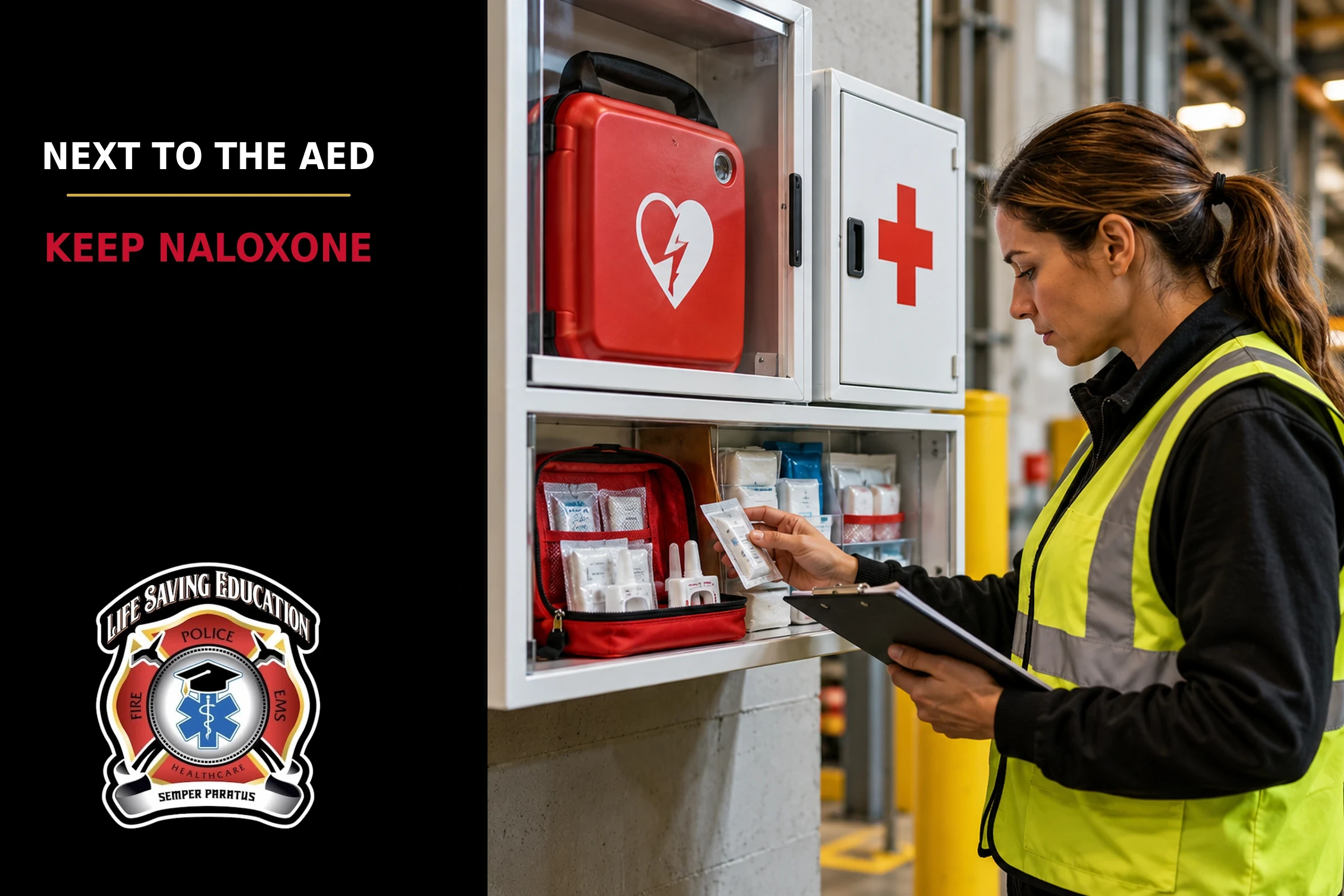
On September 24, 2026, OSHA released Opioid Overdose Rescue with Reversal Medications, a new fact sheet aimed at employers and workers. The agency recommends considering FDA-approved overdose-reversal medications such as naloxone or nalmefene as part of workplace emergency readiness. OSHA even points to a familiar storage location: alongside AEDs and first-aid kits.
That is a meaningful change in the conversation around workplace preparedness. It does not turn naloxone into a federally required first-aid item. It does give employers a practical framework for deciding whether their emergency plan is ready for an opioid overdose.
🧰 What OSHA’s New Guidance Actually Says
The fact sheet is short, but the message is direct. OSHA encourages workplaces to prepare before an overdose happens.
Keep reversal medication available
OSHA identifies FDA-approved medications such as naloxone and nalmefene as lifesaving options that can rapidly reverse opioid-induced respiratory depression.
Store it where people can find it
The agency recommends visible, easily accessible locations, including placement near AEDs and first-aid kits.
Train workers before the emergency
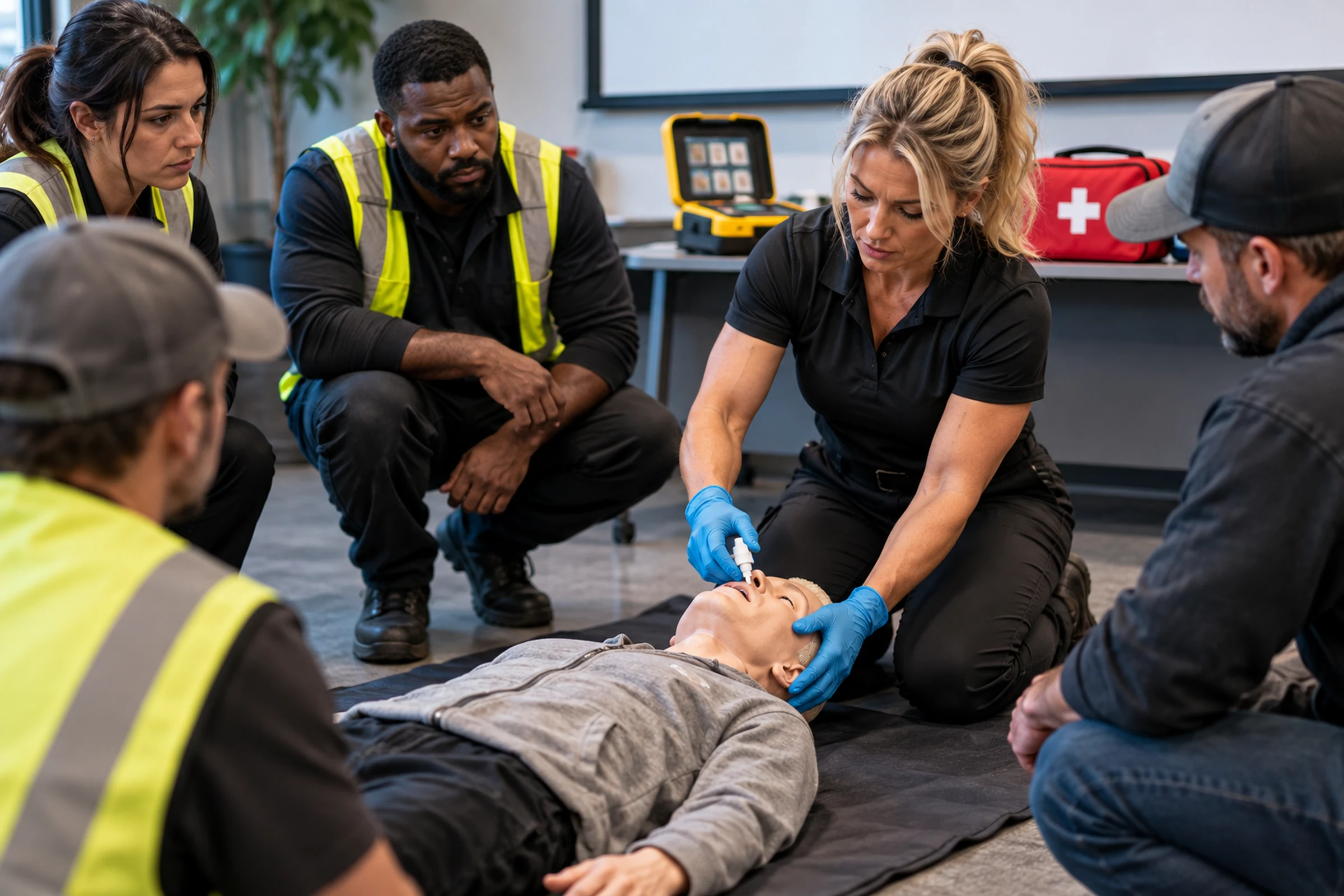
Employees should know the signs of overdose, how to administer the medication, how to position the person, and how to provide supportive care.
OSHA also emphasizes that overdose-reversal medication does not replace EMS. The workplace response still includes activating 911 and continuing care until professional responders arrive.
🫁 What an Opioid Overdose Looks Like
The emergency is usually a breathing problem before it becomes a cardiac-arrest problem.
Opioids can suppress the brain’s drive to breathe. A person may become profoundly sleepy or unresponsive while respirations become slow, irregular, or stop. OSHA’s new guidance highlights signs such as:
- slow, shallow, or stopped breathing,
- unresponsiveness or inability to wake the person,
- blue or gray lips or skin, depending on skin tone and lighting,
- and pinpoint pupils.
No single sign proves opioid exposure. The responder’s job is not to investigate what drug was taken. The job is to recognize a life-threatening pattern, activate EMS, support breathing and circulation, and use an available overdose-reversal medication according to training and product directions.
🚨 The Workplace Response in Plain Language
A good emergency plan gives employees a sequence they can remember under stress.
This is why naloxone belongs in the same preparedness conversation as the AED. The devices address different emergencies, but both depend on rapid recognition, immediate action, accessible equipment, and trained people.
📍 Where Should a Workplace Put Naloxone?
The best location is the one people can reach quickly without asking three managers for a key.
OSHA specifically suggests visible, accessible placement similar to AEDs and first-aid kits. That makes operational sense because those locations are already part of the workplace’s emergency map.
For a small office, one central emergency station may be enough. A large warehouse, campus, plant, hotel, transit facility, or multi-floor building may need several kits.
When choosing locations, ask:
- How long would it take an employee to retrieve the kit?
- Can workers access it on every shift?
- Is it behind a locked office door after hours?
- Will the medication remain within the manufacturer’s storage conditions?
- Can responders find it if the usual supervisor is absent?
If the answer depends on one specific person knowing where the kit is, the system is fragile.
📋 Buying the Kit Is the Easy Part
An emergency item becomes dependable only when somebody manages it.
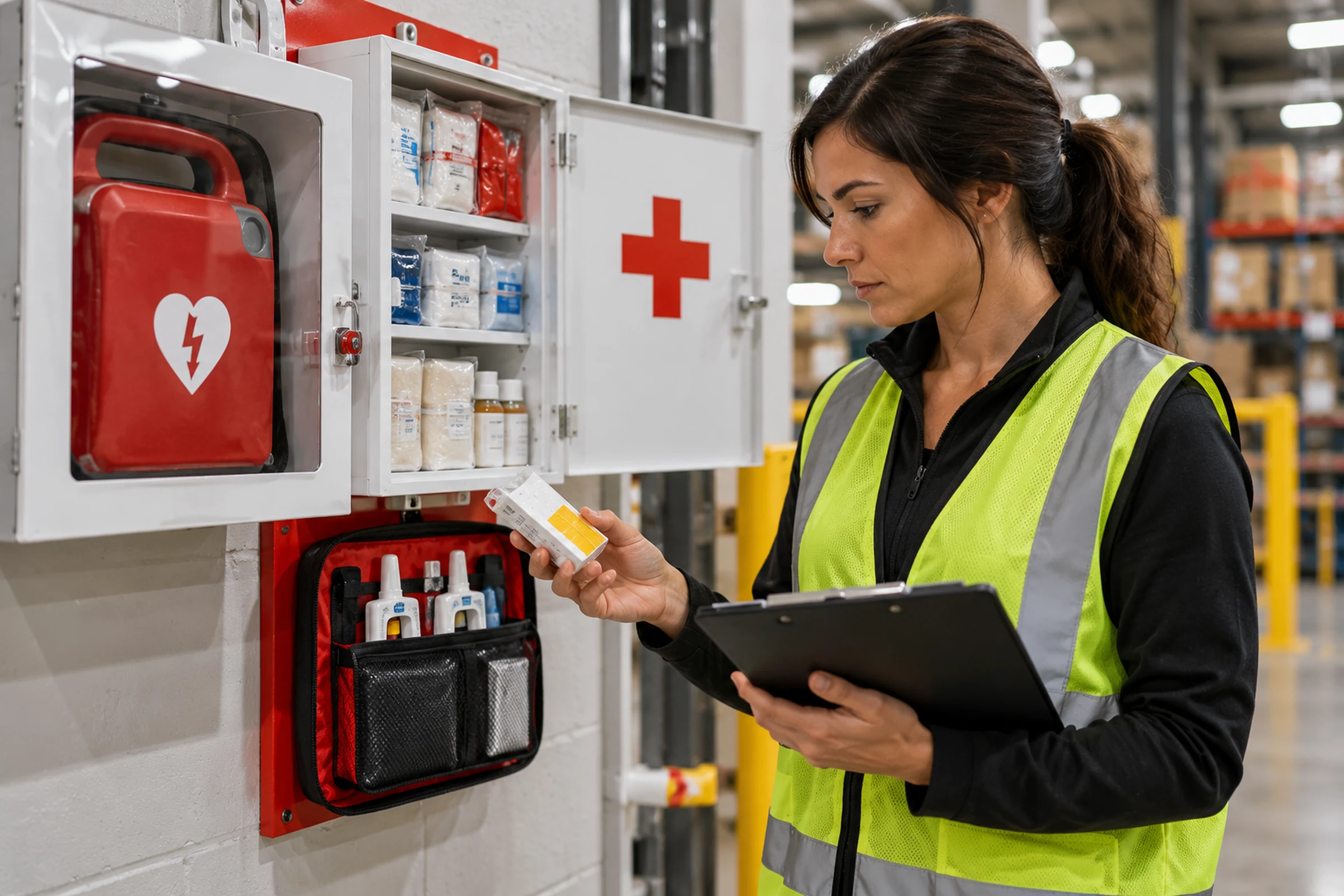
OSHA’s guidance encourages employers to think about the same routine details that already matter for AEDs and first-aid supplies: expiration dates, storage requirements, replacement stock, accessibility, and employee education.
A practical program should answer five questions before the first kit goes on the wall:
- Who checks it? Assign the responsibility instead of assuming someone will notice an expired product.
- How often is it checked? Put the check on an existing inspection schedule when possible.
- Where is replacement stock obtained? Know the purchasing path before a kit is used or expires.
- Who is trained? A kit available 24 hours a day is less useful if only day-shift supervisors know how to use it.
- What happens after use? Include EMS handoff, incident documentation, employee support, and restocking.
⚖️ Guidance Is Different From a Requirement
This is the part employers and instructors need to get right.
OSHA’s fact sheet is a recommendation document. It says the guidance creates no new compliance requirements.
That means an instructor should not tell a class, “OSHA now requires naloxone in every workplace.” That statement goes beyond the source.
A better explanation is:
State laws, industry rules, employer policies, collective-bargaining agreements, medical protocols, and licensing requirements may add other considerations. Employers should confirm the rules that apply where they operate.
👷 Which Workplaces Should Look at This First?
Any employer can consider overdose preparedness, but some environments have an especially strong reason to review it now.
That includes workplaces with large workforces, public-facing facilities, construction sites, warehouses, transportation operations, hospitality settings, healthcare-adjacent environments, manufacturing plants, campuses, and organizations where emergency-response teams already maintain first-aid or AED programs.
The decision should be based on risk, response time, workforce needs, local experience, and the organization’s emergency plan, rather than stigma about who “looks like” they might use opioids.
An overdose can involve a worker, contractor, customer, visitor, or member of the public. Emergency planning should focus on the event, not assumptions about the person.
🎓 What LSE Instructors and Employers Should Change Now
This guidance does not require rewriting an AHA course or adding unapproved material to a credentialed curriculum.
It does justify a review of workplace emergency planning and employer-specific education.
Make sure employer groups know where opioid-overdose response fits within their broader emergency plan. Keep course-specific content within the issuing organization’s rules.
Use the guidance as an emergency-readiness discussion, not as a new OSHA mandate.
Teach supervisors where the kit is, who calls 911, who meets EMS, and what happens after the event.
✅ Key Takeaways
- OSHA released new opioid-overdose workplace guidance on September 24, 2026.
- The agency recommends employers consider keeping FDA-approved overdose-reversal medication such as naloxone or nalmefene available.
- OSHA suggests storing overdose kits in visible, accessible locations such as near AEDs and first-aid kits.
- Workers should be educated to recognize an overdose, administer the medication, activate 911, and provide supportive care.
- The fact sheet is guidance and creates no new federal OSHA compliance requirement.
- A useful program includes purchasing, storage, expiration checks, replacement, training, and post-event procedures.
❓ Frequently Asked Questions
Does OSHA now require naloxone in every workplace?
No. OSHA’s September 2026 fact sheet is guidance and states that it creates no new compliance requirements.
Where does OSHA recommend storing overdose-reversal medication?
OSHA recommends highly visible, easily accessible locations and specifically compares placement with AEDs and standard first-aid kits.
Should we call 911 even after naloxone is given?
Yes. OSHA emphasizes immediate activation of emergency medical services because the medication’s effect may be temporary and the person still needs professional evaluation and care.
Is naloxone a substitute for CPR?
No. Responders should follow their CPR and first-aid training. If the person is in cardiac arrest, CPR and AED use remain essential while EMS is responding.
Can LSE provide workplace overdose-response training?
LSE can incorporate employer-specific emergency-preparedness education alongside its existing CPR, AED, first-aid, and workplace-safety offerings. Any standalone specialty program should be clearly identified as LSE professional development unless it is delivered under a separate credentialing program.
Build the Response Before You Need It
CPR, AED, first-aid, and workplace emergency training are most useful when the equipment, people, and plan work together. Life Saving Education can help organizations build practical training around the emergencies their teams may actually face.
📚 Sources and Further Reading
- OSHA: U.S. Department of Labor releases new workplace guidance to prepare employers and workers for opioid emergencies, September 24, 2026
- OSHA Publications: Opioid Overdose Rescue with Reversal Medications, Fact Sheet FS-4519
- Life Saving Education: First Aid Training
- Life Saving Education: CPR & AED Training
This article is for general educational purposes. It does not replace employer-specific emergency procedures, medical advice, legal advice, regulatory interpretation, or hands-on training.