Prepared by the LSE Editorial Team. Reviewed by Joseph Andrade, Jr., RN, NRP.
Life Saving Education follows current resuscitation science and turns new evidence into practical lessons for community responders, EMS clinicians, and instructors.
A choking emergency can change in seconds.
One moment, the person is awake and frightened, trying to cough or signal that something is wrong. Then the cough becomes weak. They cannot speak. Their level of consciousness changes. If the obstruction is not relieved, the emergency can become respiratory arrest and then cardiac arrest.
A new 2026 study from Victoria, Australia helps show what happens after that transition.
Researchers reviewed 29,684 EMS-attended out-of-hospital cardiac arrests from July 2020 through June 2024. Of those arrests, 223, or 0.8%, were attributed to foreign-body airway obstruction.
The number is small compared with all cardiac arrests. The outcomes were sobering: 74% had the obstruction removed, 48% achieved return of spontaneous circulation, and only 3.6% survived to hospital discharge.
The study reinforces a lesson that matters long before EMS reaches the patient: the best chance to stop a choking death may come before the person loses consciousness.
🫁 Choking Is an Airway Emergency Before It Is a Cardiac Arrest
Foreign-body airway obstruction, often shortened to FBAO, can be partial or severe.
With a mild obstruction, a person may still be able to cough forcefully and move air. Current AHA guidance says to encourage coughing while watching for signs that the obstruction is becoming severe.
Severe obstruction looks different. The 2025 AHA adult FBAO algorithm tells rescuers to watch for signs such as:
- a weak or absent cough,
- inability to speak,
- a change in color such as cyanosis,
- altered mental status,
- or apnea.
Those signs should trigger emergency activation and immediate choking care.
✋ The Adult Choking Sequence Changed in the 2025 AHA Guidelines
For a responsive adult with severe FBAO, the 2025 AHA Guidelines recommend repeated cycles of:
Repeat until the object is expelled or the person becomes unresponsive.
For a person in the late stages of pregnancy, or when the rescuer cannot encircle the abdomen, the AHA algorithm uses chest thrusts instead of abdominal thrusts.
The 2025 update matters because many people learned an older sequence that focused on repeated abdominal thrusts. Instructors should make sure current course materials and skill practice match the updated algorithm.
🚨 When the Person Becomes Unresponsive, the Problem Changes
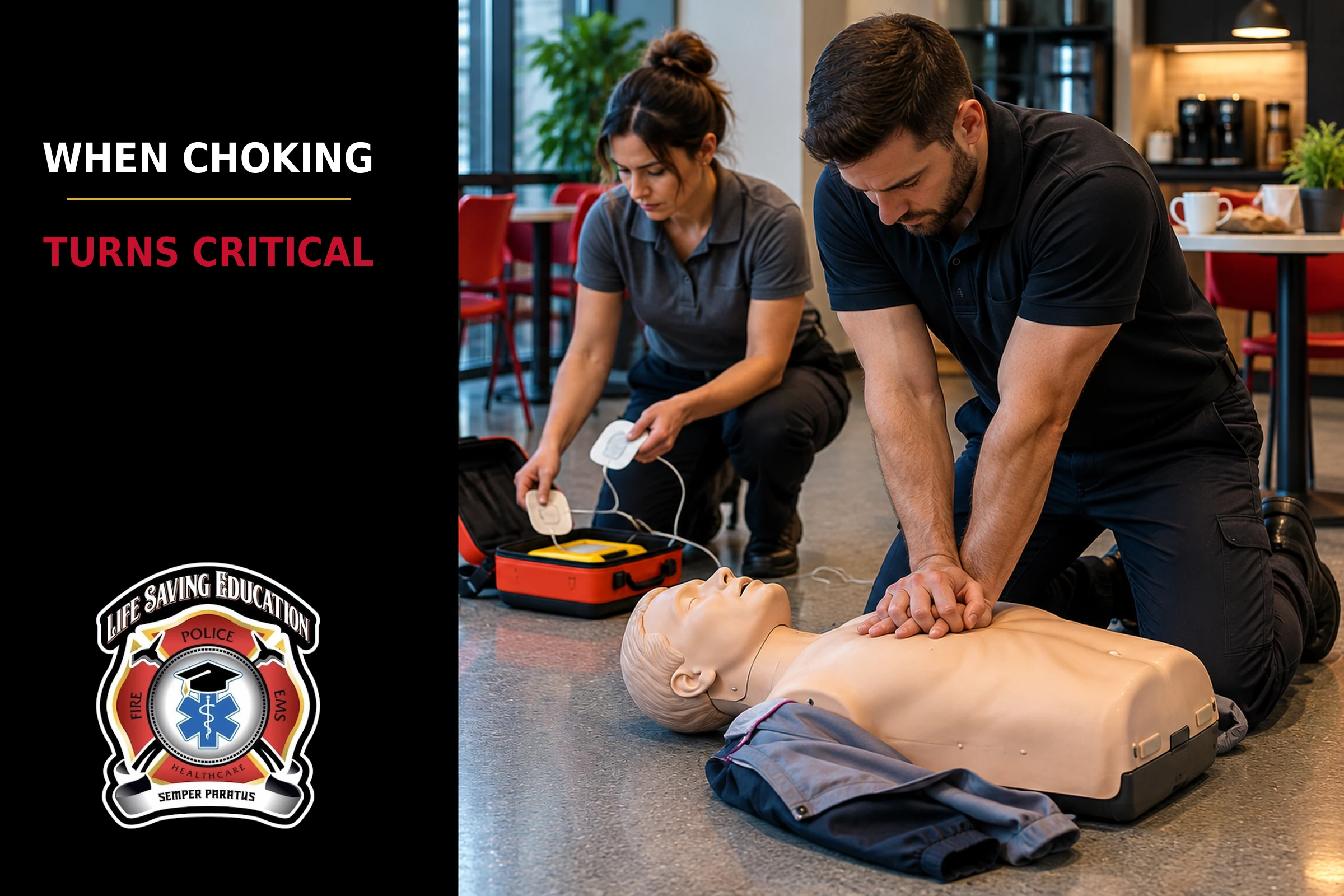
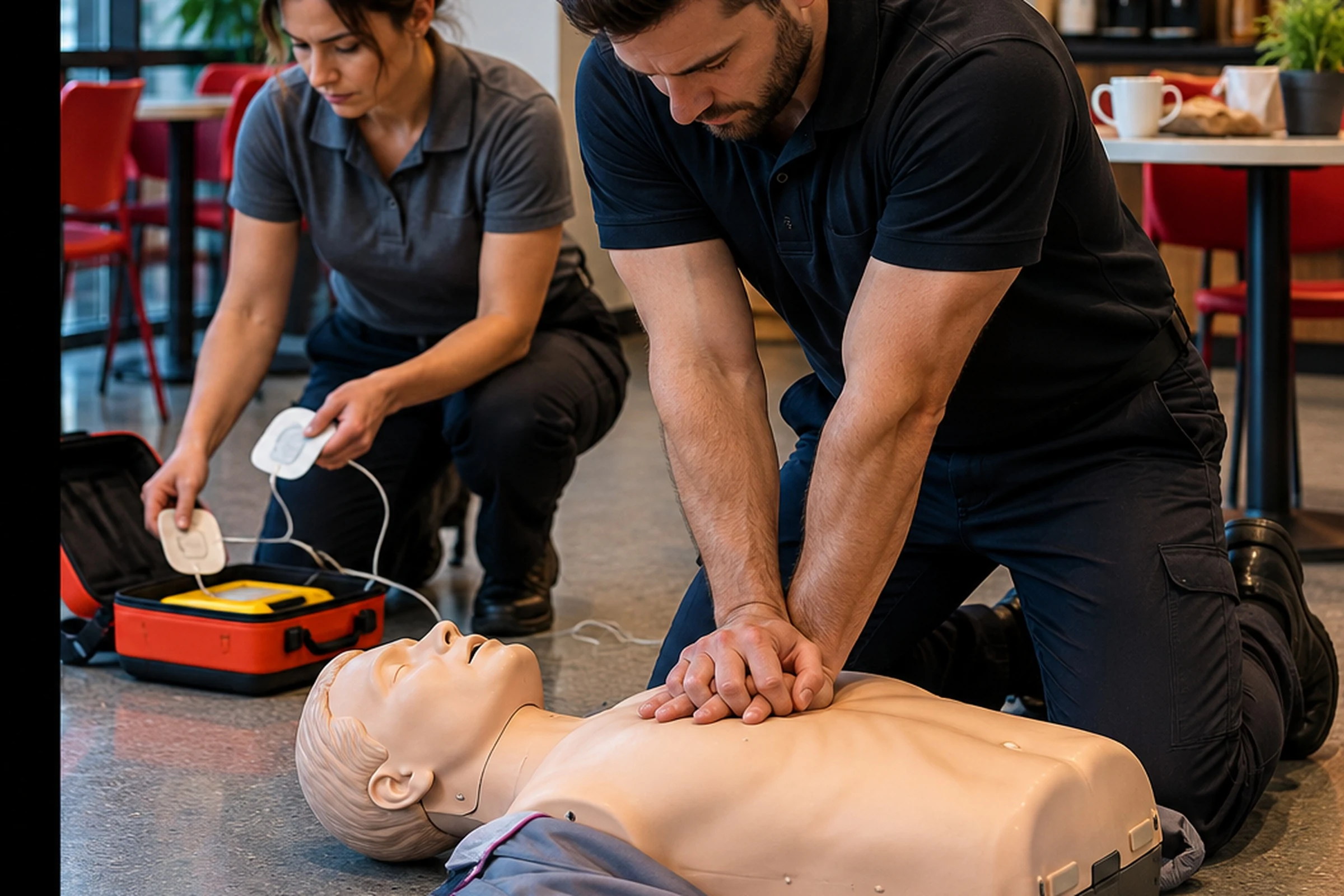
Once the choking patient becomes unresponsive, the AHA algorithm moves to CPR.
Start with chest compressions. When opening the airway to give breaths, look for a visible object in the mouth and remove it if you can see it.
Do not perform blind finger sweeps. The AHA guidelines specifically identify blind finger sweeps as harmful because they can push an unseen object deeper into the airway.
The shift from choking maneuvers to CPR is not a completely separate emergency. It is the next stage of the same failure to move air.
That is why a good training scenario should make learners practice the transition instead of ending the exercise the moment the manikin “becomes unconscious.”
📊 What the New 2026 Study Found
The September 2026 study in Resuscitation used the Victorian Ambulance Cardiac Arrest Registry to examine cardiac arrests caused by foreign-body airway obstruction.
The patients were older overall, with a median age of 77. Most incidents occurred in private residences or residential care homes.
Sixteen percent of patients received no bystander intervention before EMS care.
Among the EMS interventions reported:
- CPR was used in 84.2% of cases,
- Magill forceps were used in 58.6%,
- suction was used in 54.7%,
- and laryngeal mask airways were used in 35%.
The authors reported that Magill forceps and intubation each established ventilation successfully in 73% of the cases in which they were used. Laryngeal mask airway devices were frequently attempted but had a much lower reported success rate for establishing ventilation in this specific FBAO cohort.
Those results are interesting for EMS clinicians, but they should not be turned into a new airway algorithm on their own. This was a retrospective observational study in one Australian system. Device choice, training, dispatch, population, scope of practice, and treatment protocols may differ elsewhere.
🏠 Most of These Arrests Happened Where Bystanders Matter
More than half of the FBAO arrests occurred in private residences, and another 30% occurred in residential care homes.
That is important because the first responder may be a family member, coworker, caregiver, nurse aide, dining-room employee, or another resident.
EMS cannot remove an obstruction before someone calls. A paramedic cannot use suction or Magill forceps until the ambulance arrives. The early minutes belong to the people who are already there.
That makes choking recognition a practical public-safety skill, especially in settings that serve older adults.
👵 Why Older Adults Deserve Special Attention
In this study, 165 patients were older than 65. None survived to hospital discharge.
That finding should be handled carefully. It does not mean a choking arrest in an older adult is universally unsurvivable, and it is not a reason for a lay rescuer to withhold treatment.
It does show how dangerous this event was in the studied population.
Older adults may have swallowing problems, neurologic disease, frailty, dental issues, impaired cough, sedating medications, or dependence on others during meals. Residential-care facilities can use those risks to strengthen prevention and response planning.
A practical program can include:
- recognition of swallowing-risk precautions,
- staff choking-response training,
- rapid access to emergency communication,
- regular CPR/AED practice,
- and scenario drills that move from choking care to cardiac arrest.
🚑 What the EMS Findings Should Change in Training
The study gives EMS educators several useful discussion points without forcing a protocol change.
If a witnessed choking event preceded collapse, airway obstruction remains a reversible cause that deserves active attention during resuscitation.
Forceps, suction, laryngoscopy, and intubation only help when clinicians can use them quickly and safely within protocol and scope.
A supraglottic airway may not solve a foreign body located where ventilation remains blocked.
The study’s low survival rate should also make debriefing more honest. Return of spontaneous circulation is important, but ROSC did not translate into hospital survival for most patients in this cohort.
🧪 What the Study Does Not Prove
Good evidence translation includes the limits.
This study does not prove that one advanced-airway technique is universally best for choking cardiac arrest. It does not replace AHA BLS guidance. It does not establish a new termination-of-resuscitation rule. It also cannot tell us exactly how earlier bystander action would have changed each patient’s outcome.
What it does provide is a clear contemporary picture of a rare, high-risk arrest mechanism in one mature EMS system.
For instructors, that is enough to strengthen scenario design and reinforce the importance of early action.
🎓 A Better Choking Simulation
Many choking stations end too early.
The learner performs a few thrusts, the object appears, and the scenario stops.
Try this progression instead:
- The patient begins with a forceful cough and can still speak.
- The obstruction becomes severe. The cough weakens and speech stops.
- The learner activates the emergency response system and performs the current severe-FBAO sequence.
- The patient becomes unresponsive before the object is expelled.
- The learner transitions to CPR, beginning with compressions.
- During airway opening, the learner checks for a visible object before breaths.
- The team adds the AED and continues normal cardiac-arrest care.
That scenario teaches the decision points, not just a memorized maneuver.
✅ Key Takeaways
- A 2026 Victorian study identified 223 FBAO-related arrests among 29,684 EMS-attended OHCAs.
- Only 3.6% of the FBAO arrest patients survived to hospital discharge in this cohort.
- Sixteen percent received no bystander intervention before EMS care.
- The 2025 AHA adult choking algorithm recommends cycles of 5 back blows followed by 5 abdominal thrusts for responsive adults with severe FBAO.
- If the person becomes unresponsive, begin CPR with compressions and look for a visible object when opening the airway for breaths.
- Blind finger sweeps should not be performed.
- The new observational study is useful for education, but it does not replace AHA guidelines or local EMS protocols.
❓ Frequently Asked Questions
What are the current AHA steps for a responsive adult with severe choking?
The 2025 AHA algorithm recommends repeated cycles of 5 back blows followed by 5 abdominal thrusts until the object is expelled or the person becomes unresponsive. Use chest thrusts instead of abdominal thrusts in late pregnancy or when the rescuer cannot encircle the abdomen.
What should I do if the choking person becomes unresponsive?
Start CPR beginning with chest compressions, activate the emergency response system if that has not already happened, and check for a visible object in the mouth when opening the airway before breaths.
Should I do a blind finger sweep?
No. Current AHA guidance advises against blind finger sweeps because they can push an object deeper into the airway.
Did the new study show that Magill forceps are always better than other airway techniques?
No. The study reported higher ventilation success when Magill forceps or intubation were used in this cohort, but it was observational and system-specific. EMS clinicians should continue to follow local protocol, training, scope, and medical direction.
Where can I learn choking response and CPR?
Life Saving Education offers AHA Heartsaver First Aid CPR AED and other CPR/AED options for workplaces, community learners, caregivers, and healthcare professionals.
Practice the Transition, Not Just the Maneuver
Choking response, CPR, and AED use belong in the same emergency skill set. Hands-on practice helps rescuers recognize when the airway emergency has become a resuscitation.
📚 Sources and Further Reading
- Delardes B, et al. Out-of-hospital cardiac arrest from foreign body airway obstruction: a population-based study in Victoria, Australia. Resuscitation. 2026.
- DOI: 10.1016/j.resuscitation.2026.111309
- American Heart Association: 2025 Adult Basic Life Support Guidelines
- American Heart Association: 2025 Adult Foreign-Body Airway Obstruction Algorithm
- Life Saving Education: CPR & AED Training
- Life Saving Education: First Aid Training
This article is for education and does not replace an AHA course, EMS protocol, medical direction, clinical judgment, or hands-on training.