Prepared by the LSE Editorial Team. Reviewed by Joseph Andrade, Jr., RN, NRP.
Joseph is an active firefighter, paramedic, and registered nurse working in emergency and vascular access care, as well as an OSHA Outreach instructor and safety officer. He has spent his career on the response side of emergencies, from the fireground to the ambulance to the hospital bedside, and now trains civilians, workplaces, and first responders in the skills that save lives.
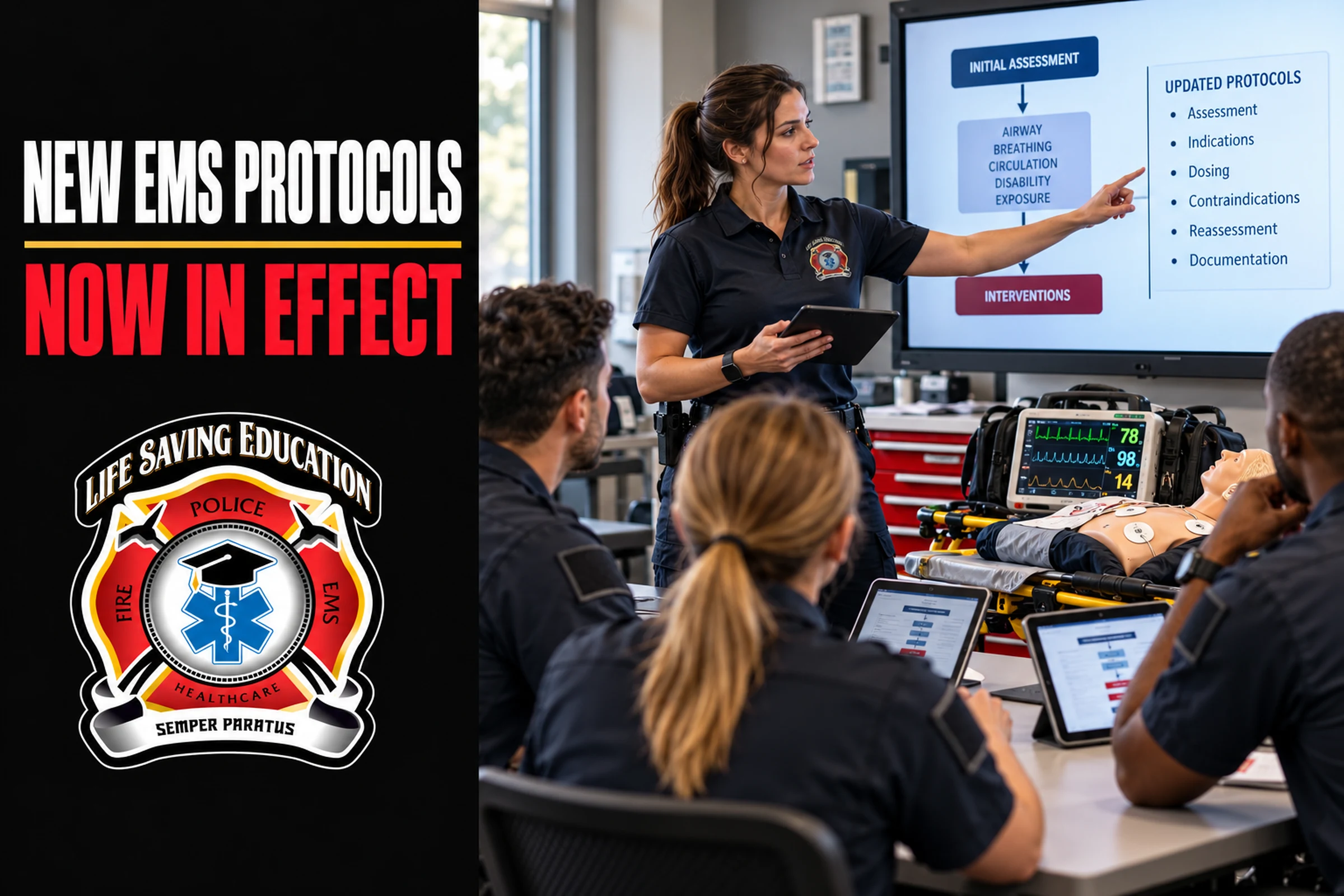
New York’s September 1 protocol rollout touches pediatric cardiac arrest, cardioversion, heat stroke, medications, postpartum hemorrhage, post-intubation care, RSI, whole blood, tourniquet conversion, and more. Here is the practical instructor-level review.
✅ Key Takeaways
- New York Statewide BLS Protocols V26.1 and Statewide Collaborative Protocols V26.1 became effective September 1, 2026.
- The substantive clinical changes were introduced in the V26.0 change set. V26.1 added clerical and consistency corrections before implementation.
- Pediatric cardiac-arrest protocols were reordered to emphasize earlier epinephrine in line with the 2025 AHA pediatric guidance.
- Adult narrow-complex tachycardia synchronized cardioversion was increased to 200 joules across indications in the collaborative protocols.
- Heat-emergency protocols now emphasize immediate active whole-body cooling for patients with elevated skin temperature and altered mental status, with transport potentially delayed when active cooling is available.
- New obstetric protocols address preeclampsia/eclampsia and postpartum hemorrhagic shock.
- RSI, post-intubation management, whole-blood calcium replacement, formulary, and BLS medication access received notable changes.
📋 A protocol change is only useful if the clinician knows what changed
On September 1, 2026, New York’s Statewide BLS Protocols V26.1 and Statewide Collaborative Protocols V26.1 became effective.
For instructors and agencies, the useful question is which changes alter patient care, equipment, medications, simulations, or competency expectations.
New York makes that task easier by publishing formal change logs.
The version number needs a little context.
The major clinical revisions were introduced in Version 26.0. Version 26.1 then incorporated clerical, formatting, and consistency corrections before the September 1 implementation.
So when someone says “the V26.1 changes,” the useful review includes both the underlying V26.0 clinical updates and the smaller V26.1 corrections that make up the effective September version.
🚑 Pediatric cardiac arrest: epinephrine moves higher
New York specifically revised pediatric asystole/PEA and pediatric VF/pulseless VT protocols to move epinephrine higher in the ALS intervention sequence.
The change log explains the reasoning.
The protocols are not numbered to imply a strict order, but clinicians often read bullet order as an implied sequence. New York therefore moved epinephrine higher to emphasize guidance suggesting that earlier epinephrine in pediatric cardiac arrest may be associated with better outcomes.
The pediatric protocols also clarify fluid administration, including a 20 mL/kg bolus that may be repeated once where applicable.
Instructor implication
Do not simply tell learners that the bullet moved.
Use the change to reinforce:
- rapid vascular or intraosseous access,
- timely epinephrine,
- minimal interruption of CPR,
- rhythm-specific priorities,
- and the difference between an algorithm’s visual flow and the actual priorities of high-quality resuscitation.
The change also shows how bullet order can influence behavior even when the document says the steps are not strictly sequential.

❤️ Adult cardiac arrest: lidocaine infusion is removed
The collaborative protocol change log removes the option for lidocaine infusion in adult post-ROSC care and in ventricular fibrillation/pulseless ventricular tachycardia pathways.
In place of the infusion option, the protocol uses a single repeat lidocaine bolus of 0.75 mg/kg in the specified context.
Similar cleanup appears in wide-complex tachycardia language, removing the lidocaine infusion option.
Instructor implication
Medication charts, pharmacology slides, post-ROSC checklists, and simulation scripts should be checked for outdated lidocaine infusion language.
Small medication changes like this are easy to miss in old slides, pocket cards, and simulation answer keys.
▸ Adult narrow-complex tachycardia: synchronized cardioversion at 200 J
One of the most visible changes is in adult narrow-complex tachycardia.
New York’s collaborative protocol change log states that, consistent with the 2025 AHA guidance, synchronized cardioversion was increased to 200 joules across indications.
Instructor implication
This should trigger a review of:
- tachycardia algorithm slides,
- monitor/defibrillator simulation settings,
- scenario answer keys,
- medication-versus-electricity decision points,
- and any older synchronized-cardioversion energy tables.
For learners, the teaching point is broader than memorizing a number.
Unstable tachycardia requires prompt recognition and synchronized cardioversion when indicated. Energy settings need to match the current protocol and device context.
▸ Bradycardia: epinephrine infusion replaces norepinephrine as the preferred vasopressor
For symptomatic adult bradycardia and heart blocks, the collaborative protocols removed norepinephrine and replaced it with epinephrine infusion as the vasopressor of choice, available as a standing order for paramedics.
Instructor implication
Review bradycardia scenarios that previously expected norepinephrine.
Medication-preparation exercises, infusion tables, and monitor simulations should reflect the current protocol.
▸ Anaphylaxis: epinephrine infusion moves to standing order
The adult anaphylaxis and allergic-reaction protocol moves epinephrine infusion to paramedic standing order.
This matters because severe anaphylaxis may persist despite intramuscular epinephrine and require escalation.
Instructor implication
Teaching should emphasize that an epinephrine infusion is an escalation step within a monitored ALS context, not a replacement for prompt intramuscular epinephrine in initial anaphylaxis management.
▸ Agitated patient: olanzapine becomes more prominent
The adolescent agitated-patient protocol moves olanzapine to paramedic standing order.
For adults, olanzapine also moves to standing order, with 2.5 to 5 mg dosing added for adults age 65 and older.
The medication formulary was updated by removing haloperidol and adding olanzapine.
Instructor implication
Behavioral-emergency pharmacology content should be reviewed carefully.
This is also an opportunity to reinforce:
- medical causes of agitation,
- de-escalation,
- monitoring after sedation,
- age-related dosing,
- airway readiness,
- and documentation.
▸ Heat emergencies: cool first, transport may wait
The heat-emergency update is one of the most operationally important changes.
For patients with elevated skin temperature and altered mental status, New York directs clinicians to begin active whole-body cooling immediately and continue until mental status returns.
The change log states that transport may be delayed if a means of active cooling is available.
The listed cooling methods, in decreasing order of preference, include:
- ice-water immersion or cold-water immersion,
- tarp-assisted cooling with oscillation,
- cold-water dousing,
- cold-water-soaked towels with ice packs.
Why this matters
Heat stroke is time-sensitive.
The protocol recognizes that definitive care begins with rapid cooling, not simply with moving the patient toward the hospital while core temperature remains dangerously elevated.
Instructor implication
Heat-emergency scenarios should test whether students actually start cooling.
A learner who says, “Load and go,” without establishing effective cooling should not receive full credit simply because transport is important.

💊 BLS medication expansion: acetaminophen and ibuprofen
The BLS change log moves oral acetaminophen and ibuprofen to EMT or higher in adult and pediatric fever and pain-management contexts.
The BLS medication formulary was updated to include those medications.
V26.1 also added a specific adult acetaminophen contraindication related to use of more than 650 mg of an acetaminophen-containing product within four hours unless medical control approves.
Instructor implication
Agencies must still be trained and equipped as required.
Course materials should not imply that every EMT in every region automatically carries every medication simply because the statewide protocol permits it.
Scope, agency authorization, regional requirements, formulary, and local implementation still matter.
▸ Nausea and vomiting: isopropyl alcohol and ondansetron
New York moved the option for a patient to self-administer inhaled isopropyl alcohol from a pad to all provider levels in the adult and pediatric nausea/vomiting protocols.
Ondansetron by specified routes was moved to AEMT or higher, with pediatric dosing clarified at 2 mg IM/IV for patients 25 kg or less and 4 mg IM/IV for those above 25 kg.
Instructor implication
This is a good place to distinguish protocol permission from universal agency stocking.
Students should understand route, dose, age/weight criteria, contraindications, and local implementation.
▸ Obstetrics receives major attention
The protocol update adds a new preeclampsia/eclampsia protocol.
It also adds a new hemorrhagic-shock protocol for postpartum hemorrhage.
The newborn/neonatal-care section was revised in line with the 2025 AHA guidance to emphasize waiting at least one minute before clamping and cutting the umbilical cord when appropriate and placing the infant immediately on the mother’s bare chest after delivery.
The change log also adds supraglottic airway reference for paramedics in newborn/neonatal care.
Why this matters
Obstetric emergencies are low-frequency, high-stakes calls for many EMS clinicians.
That makes protocol changes especially important because clinicians may not encounter enough real cases to naturally update their practice.
Instructor implication
OB simulations should be reviewed for:
- delayed cord clamping,
- skin-to-skin positioning,
- neonatal packaging,
- eclampsia management,
- postpartum hemorrhage recognition,
- hemorrhagic shock,
- and medication updates.
▸ Post-intubation management broadens
The adult post-intubation protocol now includes supraglottic airway devices under its indications.
V26.1 further clarifies that the protocol applies to adult patients with an advanced airway in place.
The change set also clarifies ongoing neuromuscular blockade in ventilator dyssynchrony, with rocuronium or vecuronium dosing based on ideal body weight in the specified context.
Instructor implication
This is an important conceptual shift.
Post-airway management is not just “post-ET tube management.”
Patients with supraglottic airways still require:
- ventilation assessment,
- oxygenation,
- capnography when available and appropriate,
- sedation/analgesia considerations where relevant,
- reassessment,
- and device security.
Airway education should reflect the whole advanced-airway pathway.
▸ RSI: rocuronium dose increases
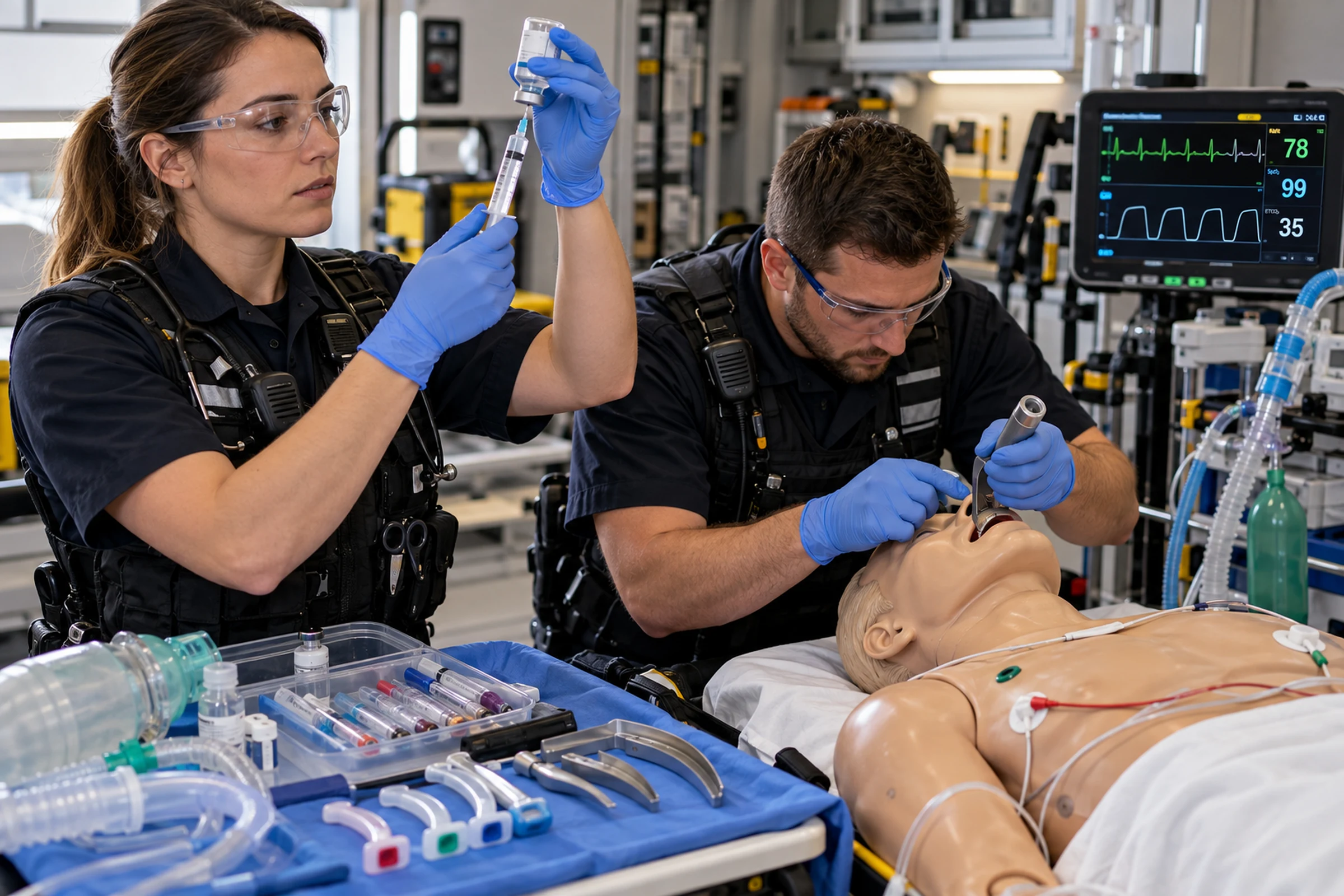
For adult rapid-sequence intubation, New York increased rocuronium to 1.5 mg/kg ideal body weight, with a maximum dose of 150 mg.
The change log states that this is based on current evidence.
Push-dose epinephrine was also added for post-procedural hypotension, consistent with the post-ROSC protocol.
Instructor implication
RSI checklists, medication cards, simulation cases, dose calculators, and competency documents need review.
This is exactly the kind of high-risk dosing change that should not remain buried in a general protocol-update lecture.
▸ Whole blood: calcium replacement added
In adult hemorrhagic shock, the collaborative protocols add a standing order for 1 gram of calcium chloride for every 500 mL of whole blood administered, through a separate IV line from the line used for blood.
Why this matters
Prehospital blood programs are expanding, and protocol details around calcium replacement are increasingly relevant to advanced EMS systems.
Instructor implication
Training should address:
- why calcium can matter during blood-product resuscitation,
- compatibility and line considerations,
- protocol-specific dosing,
- and the difference between local blood programs and general statewide EMS practice.
Do not generalize this protocol to agencies that do not carry whole blood.
▸ Tourniquet conversion clarified at EMT level
The trauma change log clarifies the ability and process for EMT or higher providers to convert a tourniquet.
This is another item that should not be taught from memory.
Tourniquet conversion requires careful attention to:
- hemorrhage control,
- elapsed time,
- injury pattern,
- shock,
- reassessment,
- transport time,
- and protocol criteria.
Instructor implication
Bleeding-control scenarios should include decision-making after initial tourniquet placement, not just the act of applying the tourniquet.
▸ Other trauma and formulary updates
The protocols clarify cefazolin or moxifloxacin considerations for amputation and musculoskeletal trauma when equipped and trained.
Burn protocols clarify pediatric fluid administration and tetracaine level-of-care language.
The medication formulary:
- removes haloperidol,
- adds olanzapine,
- adds furosemide,
- adds oxytocin,
- clarifies certain diphenhydramine routes,
- and updates infusion references.
The regional alternative to lactated Ringer’s was broadened to “any balanced crystalloid,” with the change log noting blood-product compatibility considerations.
▸ What V26.1 itself changed
The formal change logs are unusually clear on this point.
V26.1 primarily made clerical, formatting, and consistency corrections to V26.0.
Examples include:
- adding an acetaminophen contraindication for recent acetaminophen-containing product use,
- clarifying the post-intubation protocol applies to any adult with an advanced airway,
- correcting an ideal-body-weight conversion,
- clarifying olanzapine as “if equipped and trained,”
- adding oxytocin to match the new postpartum hemorrhage protocol,
- and updating pediatric assessment reference material.
The practical lesson:
Do not dismiss V26.1 as “just clerical” without reviewing it.
Small wording corrections can still change how clinicians interpret a medication or protocol.
▸ What agencies should do now
1. Replace old protocol files
Remove outdated quick-reference PDFs from shared drives, tablets, LMS platforms, and printed binders.
2. Update scenario answer keys
Simulation often preserves old practice longer than lectures do.
3. Review medication cards
Focus on rocuronium, olanzapine, epinephrine infusion, lidocaine, acetaminophen, ibuprofen, calcium chloride, oxytocin, and formulary changes.
4. Audit cardiac scenarios
Pediatric epinephrine sequencing and adult cardioversion changes deserve deliberate practice.
5. Update heat-emergency training
Make learners actively cool heat-stroke patients.
6. Rebuild obstetric scenarios
Preeclampsia/eclampsia and postpartum hemorrhage need dedicated practice.
7. Review local adoption
Statewide protocol language does not eliminate agency, regional, medical-director, training, equipment, and credentialing requirements.
🎓 What instructors should not do
A long slide-by-slide reading of the change log is unlikely to change field behavior. Group the updates by clinical problem and make learners use them in short scenarios.
Group changes by clinical problem:
- cardiac arrest and dysrhythmias,
- airway and RSI,
- heat emergencies,
- obstetrics,
- pain and fever,
- nausea/vomiting,
- hemorrhage and trauma,
- medications.
Then use short scenarios to make clinicians apply the new rules.
✅ What to remember
New York’s September 1 protocol rollout is more than a document refresh.
It changes or clarifies care across several high-risk areas:
- pediatric cardiac arrest,
- synchronized cardioversion,
- vasoactive infusions,
- heat stroke,
- pain and fever,
- nausea,
- obstetric emergencies,
- advanced airway management,
- RSI,
- hemorrhagic shock,
- tourniquet conversion,
- and medication formulary.
The most important instructor task is not to read the change log aloud.
It is to identify where old teaching could now produce wrong care and replace that teaching before the next call.
❓ Frequently Asked Questions
Did all of the clinical changes originate in V26.1?
No. The major clinical revisions were introduced in the V26.0 change set. V26.1 is the effective September 1 version and added clerical, formatting, and consistency corrections. Instructors should review both parts of the formal change logs.
Does permission in a statewide protocol mean every agency automatically carries the medication?
No. “If trained and equipped,” regional approval, medical-director authorization, agency policy, formulary, credentialing, and equipment availability may still apply. Instructors should distinguish protocol capability from local implementation.
What cardiac changes deserve the fastest training update?
High-value items include earlier emphasis on epinephrine in pediatric cardiac arrest, the adult narrow-complex tachycardia synchronized-cardioversion change to 200 J, epinephrine infusion replacing norepinephrine in symptomatic bradycardia/heart block, and removal of certain lidocaine-infusion language.
Why is the heat-emergency change important?
It emphasizes immediate active whole-body cooling for patients with elevated skin temperature and altered mental status and allows transport to be delayed when effective cooling is available. That can change how crews prioritize actions during heat stroke.
What obstetric changes should instructors prioritize?
New protocols for preeclampsia/eclampsia and postpartum hemorrhagic shock, plus updated newborn care emphasizing delayed cord clamping and immediate skin-to-skin placement when appropriate.
What should RSI educators update?
The adult RSI change increases rocuronium to 1.5 mg/kg ideal body weight with a 150 mg maximum and adds push-dose epinephrine for post-procedural hypotension in the described protocol context.
📋 Suggested 60-Minute Protocol Update Class
Block 1: Cardiac and resuscitation, 15 minutes
- Pediatric epinephrine emphasis
- Adult cardioversion
- Lidocaine changes
- Bradycardia vasopressor change
Block 2: Airway and RSI, 10 minutes
- Post-intubation protocol broadened to advanced airways
- Neuromuscular blockade clarification
- Rocuronium dose change
- Push-dose epinephrine
Block 3: Heat, medications, and nausea, 10 minutes
- Active cooling priorities
- Acetaminophen/ibuprofen scope
- Isopropyl alcohol
- Ondansetron
Block 4: Obstetrics and hemorrhage, 15 minutes
- Preeclampsia/eclampsia
- Postpartum hemorrhage
- Delayed cord clamping
- Whole-blood calcium
Block 5: Trauma and implementation, 10 minutes
- Tourniquet conversion
- Antibiotic considerations
- Formulary updates
- Agency/local adoption check
Finish with short scenarios rather than a written change-log quiz. The goal is correct patient care, not memorization of document formatting.
🦺 LSE Training Connection
Protocol literacy is a clinical skill. EMS education should teach clinicians how national guidance, state protocols, regional systems, agency policy, and medical direction fit together.
Request training for your organization or browse LSE courses.
Training You Can Count On. When Seconds Count.
Images are AI-generated educational illustrations, not photographs of the cited incidents or study participants. Displayed screens and documents are illustrative.
📚 Authoritative Sources
- New York State Department of Health. Adult and Pediatric Protocols.
https://www.health.ny.gov/professionals/ems/protocol - NYSDOH Policy 26-03.B. Collaborative Protocol Change Log V26.1, Effective 09.01.2026.
https://healthweb-back.health.ny.gov/professionals/ems/pdf/26-03_b.pdf - NYSDOH Policy 26-04.B. BLS Protocol Change Log V26.1, Effective 09.01.2026.
https://healthweb-back.health.ny.gov/professionals/ems/pdf/26-04_b.pdf - American Heart Association. 2025 CPR and ECC Guidelines.
https://cpr.heart.org/en/resuscitation-science/cpr-and-ecc-guidelines