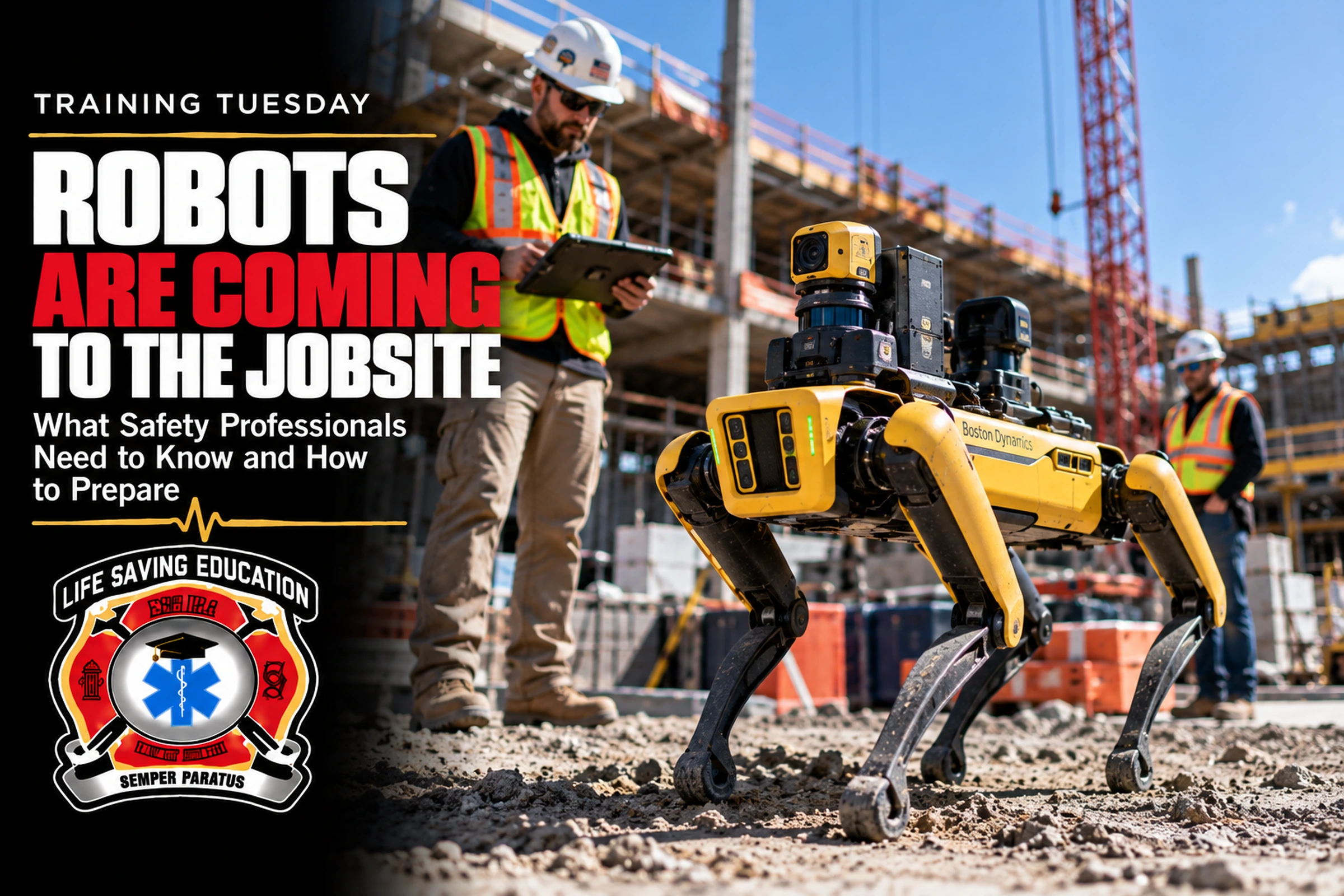
Prepared by the LSE Editorial Team. Reviewed by Joseph Andrade, Jr., RN, NRP.
Joseph works across emergency response, healthcare, and workplace safety and develops practical training for civilians, employers, and first responders.
For decades, many workers encountered industrial robots in controlled manufacturing environments. Construction is different. The site changes by the hour. Trades overlap. Dust, rain, glare, uneven terrain, temporary routes, trucks, subcontractors, stored materials, and pedestrians all occupy the same evolving environment.
Now add autonomous and semi-autonomous machines.
On October 7, 2026, NIOSH published new guidance on safety in construction robotics. Its message is balanced: robots can reduce worker exposure to dangerous and physically demanding tasks, but human-robot interaction can create new hazards that require new safety strategies.
🏗️ What Counts as Construction Robotics?
NIOSH describes autonomous earthmoving and material-hauling equipment, collaborative robots, robotic additive construction, climbing robots, digital twins integrated with robotic systems, coordinated fleets, and systems that adapt to changing worksite conditions.
Robotics are already being developed and used for material handling, inspection, layout, earthmoving, demolition, masonry assistance, and repetitive or hazardous work.
Why Construction Is Harder
A fixed industrial robot may operate inside a guarded cell. A construction robot may operate where the cell effectively moves.
NIOSH notes that construction work areas are continually reconfigured, multiple employers may overlap, environmental conditions can affect sensing and navigation, and workers who do not operate the robot may enter its work area without understanding its behavior.
Old Hazards, New Mechanisms
NIOSH identifies struck-by, caught-in or caught-between, crushing, unexpected movement, blind spots, limited visibility, and dropped or unstable loads.
Workers may expect eye contact with an equipment operator. An autonomous machine may have no operator in the cab. They may expect engine noise before movement. Electric equipment may be quieter. They may expect a machine to follow the same route. Software, sensors, work assignments, or changing conditions may alter it.
Sensors Are Controls, Not Magic
Modern robots may use cameras, lidar, radar, proximity sensors, wireless communications, positioning systems, software, and machine vision. NIOSH identifies potential problems including sensor degradation from dust, rain, glare, or poor lighting, communication failures, software or firmware changes, object-recognition limitations, unexpected behavior after faults, and localization failures.
Workers should never be taught that the machine will always see them.
Prevention Through Design
Questions should be asked before the robot begins work: Can it eliminate a high-risk task? Can people and machines be separated? Can routes minimize crossings? What happens when communications fail? What is the safe state after a fault? Where are emergency stops? Who can reset the system? How will subcontractors and visitors be protected? How will charging and stored energy be controlled?
The Non-Operator May Be at High Risk
The worker exposed to a robotic hazard may not be the person who controls it. Training should distinguish between operators and maintainers, workers sharing the area, and visitors or short-duration workers.
Hazardous Energy Still Matters
A robot can be off from a production perspective while still containing electrical, hydraulic, pneumatic, mechanical, gravitational, battery, or other stored energy. Maintenance, troubleshooting, jam clearing, adjustment, and fault recovery can place workers in hazardous positions.
Battery and Charging Hazards
NIOSH also identifies fire hazards from charging large battery systems. Training should address manufacturer instructions, charging locations, damaged batteries, isolation procedures, emergency response, and the employer’s site-specific fire plan.
Leading Indicators Matter
Near misses, emergency-stop activations, manual overrides, unexpected autonomous disengagements, sensor faults, localization failures, maintenance events involving safety systems, and unauthorized entry into robot operating areas are safety data, not merely technical annoyances.
What a Robotics JHA Should Ask
Identify the task, machine, work envelope, people entering the area, routes, energy sources, sensing technology, environmental limitations, communications, foreseeable failures, emergency procedures, and expected changes. Ask what can strike or crush a worker, what can move unexpectedly, what happens when visibility is obstructed or communications fail, and who has authority to stop the operation.
Training Must Become Dynamic
A stronger model includes initial orientation, task-specific training, pre-shift communication, toolbox refreshers, change-management briefings, and emergency drills. Retraining or briefing may be necessary when software, firmware, hardware, operating areas, or procedures materially change.
The Robot Should Remove Risk, Not Relocate It
A demolition robot can keep a worker farther from unstable structures. A masonry robot can reduce repetitive lifting. Inspection robots can reduce exposure to falls or confined spaces. But a hazard removed from one worker can be transferred to another if the system is poorly designed.
The better question is: How does the entire risk profile change when this robot is introduced?
✅ Key Takeaways
- Automation can remove workers from hazards while creating new human-robot interaction risks.
- Work-zone separation, sensing limitations, hazardous energy, and fault response belong in the JHA.
- Training must reach operators, maintainers, nearby workers, subcontractors, and visitors.
- Changes to software, hardware, routes, or procedures may require new briefings or training.
Bottom Line
The safest contractor will not blindly reject automation or blindly trust it. It will understand how automation changes the work system and train everyone who shares that system.
Training You Can Count On. When Seconds Count.
Prepare the Workforce for the Changing Jobsite
Life Saving Education provides practical construction and workplace safety training built around real-world hazards and changing technology.