Prepared by the LSE Editorial Team. Reviewed by Joseph Andrade, Jr., RN, NRP.
Joseph is an active firefighter, paramedic, and registered nurse working in emergency and vascular access care, as well as an OSHA Outreach instructor and safety officer. He has spent his career on the response side of emergencies, from the fireground to the ambulance to the hospital bedside, and now trains civilians, workplaces, and first responders in the skills that save lives.
The rain may stop before the danger does. Floodwater can conceal moving currents, damaged roads, electricity, sewage, chemicals, sharp debris, animals, and infectious hazards.
✅ Key Takeaways
- Stay out of floodwater whenever possible.
- Floodwater may contain sewage, chemicals, hazardous waste, debris, electrical hazards, and disease-causing organisms.
- A flooded roadway can hide washed-out pavement, open drainage structures, and strong current.
- Open wounds should be protected from floodwater and cleaned with soap and clean water after exposure.
- Portable generators and other fuel-powered equipment can create lethal carbon monoxide hazards after storms.
- Employers should treat flood cleanup as hazardous work, not an informal “cleanup day.”
▸ It Doesn’t Have to Look Dangerous
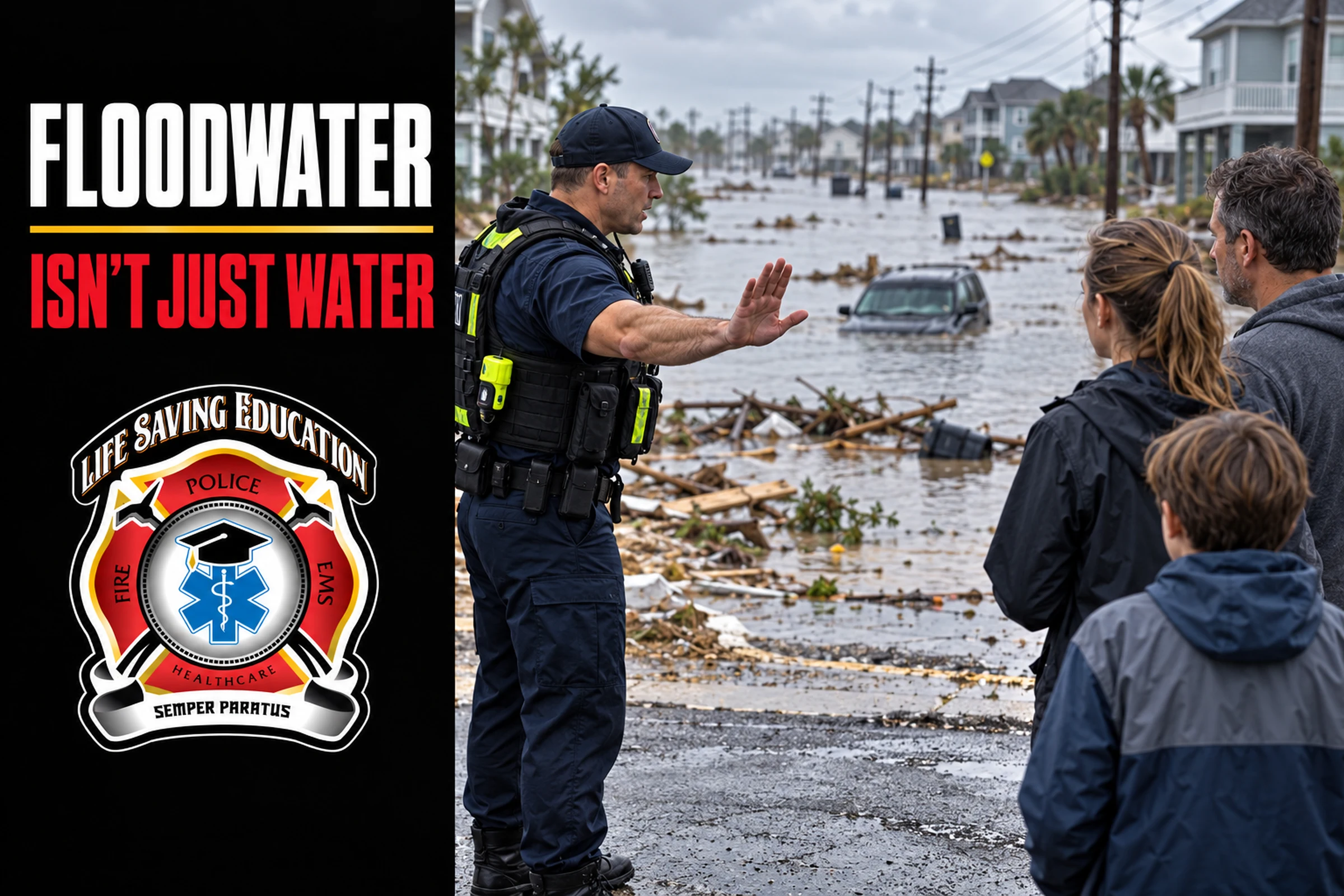
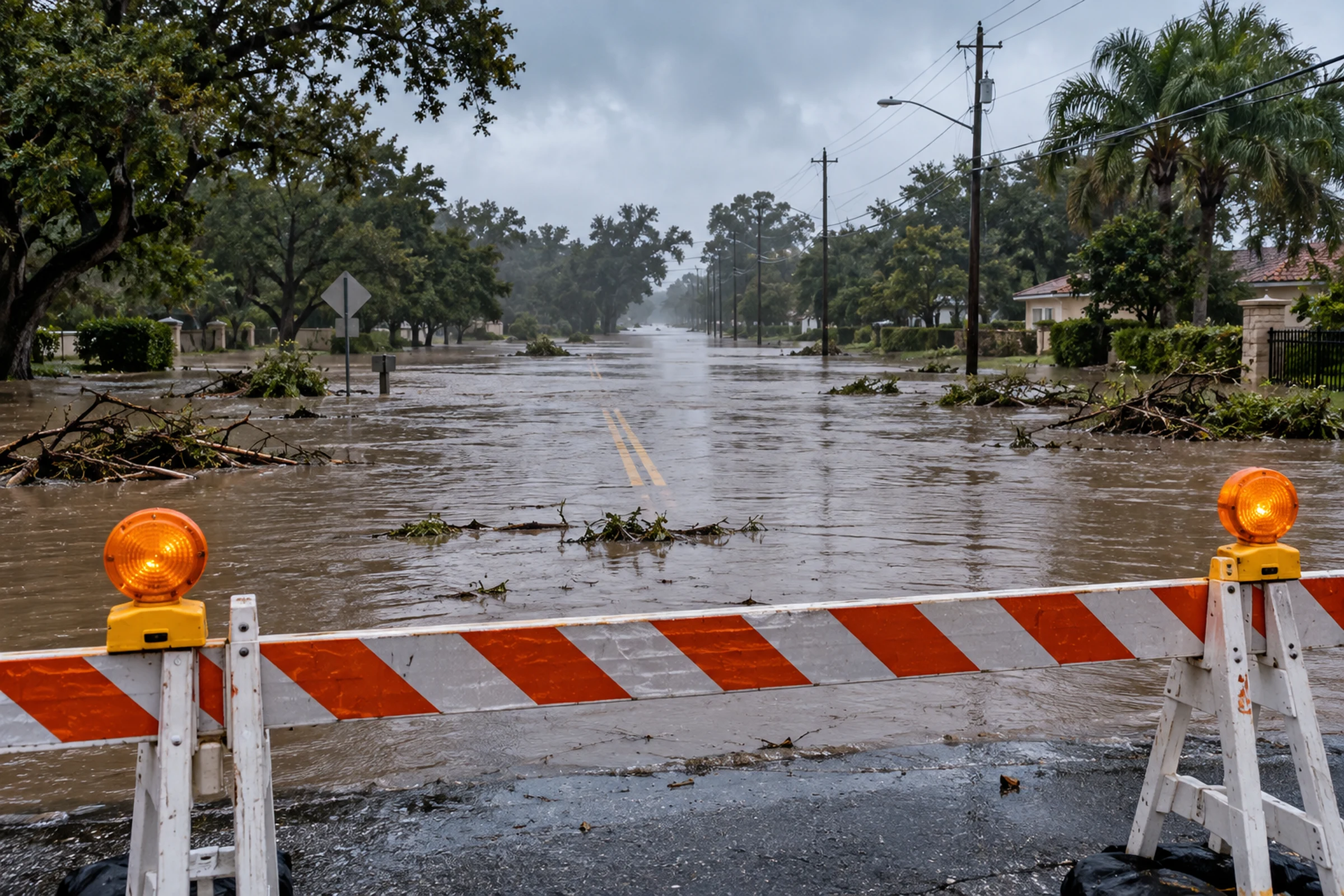
A flooded street can look deceptively calm. The water may appear shallow, the other side may be visible, and another vehicle may already have crossed. That can make entering the water feel reasonable even when the road, current, and contamination are impossible to judge from the surface.
CDC’s guidance is simpler:
Stay out of floodwater whenever possible.
Floodwater can contain sewage, chemicals, hazardous waste, debris, displaced animals, downed electrical lines, and disease-causing organisms. It can also conceal unstable ground and moving water powerful enough to knock people down or move vehicles.
The rain can stop while the hazards remain.
🌊 Floodwater is not just dirty rainwater
Once water moves through communities, roads, farms, industrial areas, sewage systems, homes, and businesses, it becomes an uncontrolled mixture.
CDC warns that floodwater may contain:
- human and animal waste,
- industrial and household chemicals,
- debris,
- downed electrical lines,
- germs,
- medical waste,
- displaced animals,
- and other hazards.
You cannot determine what is present by looking at the water.
Water color does not tell you whether the water is safe. Treat floodwater as contaminated unless reliable authorities say otherwise.
▸ The first danger is drowning
Flood-related deaths are frequently drowning deaths.
The National Weather Service warns that people routinely underestimate the force of moving water. Its public-safety guidance notes that relatively shallow fast-moving water can knock a person down, and deeper water can move vehicles.
Those numbers should not be treated as a threshold below which water is safe.
Current speed, road grade, vehicle weight, surface condition, and the condition of the road beneath the water all matter.
Avoid flooded roadways instead of trying to estimate whether your vehicle can make it through.
▸ The road underneath may no longer exist
Floodwater hides:
- washed-out pavement,
- open manholes,
- drainage channels,
- collapsed shoulders,
- debris,
- deep holes,
- and unstable ground.
A familiar road can become unfamiliar terrain within minutes.
That is why driving around a barricade is so dangerous.
A barricade may be the only visible warning that the roadway beyond it has washed out or become unsafe.
🌊 “My truck can make it” is not a flood plan
Larger vehicles can create false confidence.
Four-wheel drive helps a vehicle transmit power to the road.
It does not stop moving water from exerting force against the vehicle.
It does not make a washed-out road reappear.
It does not prevent an engine from stalling.
It does not stop rising water from reducing tire contact with the road.
No vehicle technology makes intentionally driving into floodwater a good emergency plan.
🌊 Floodwater and open wounds
Floodwater exposure becomes more concerning when skin integrity is compromised.
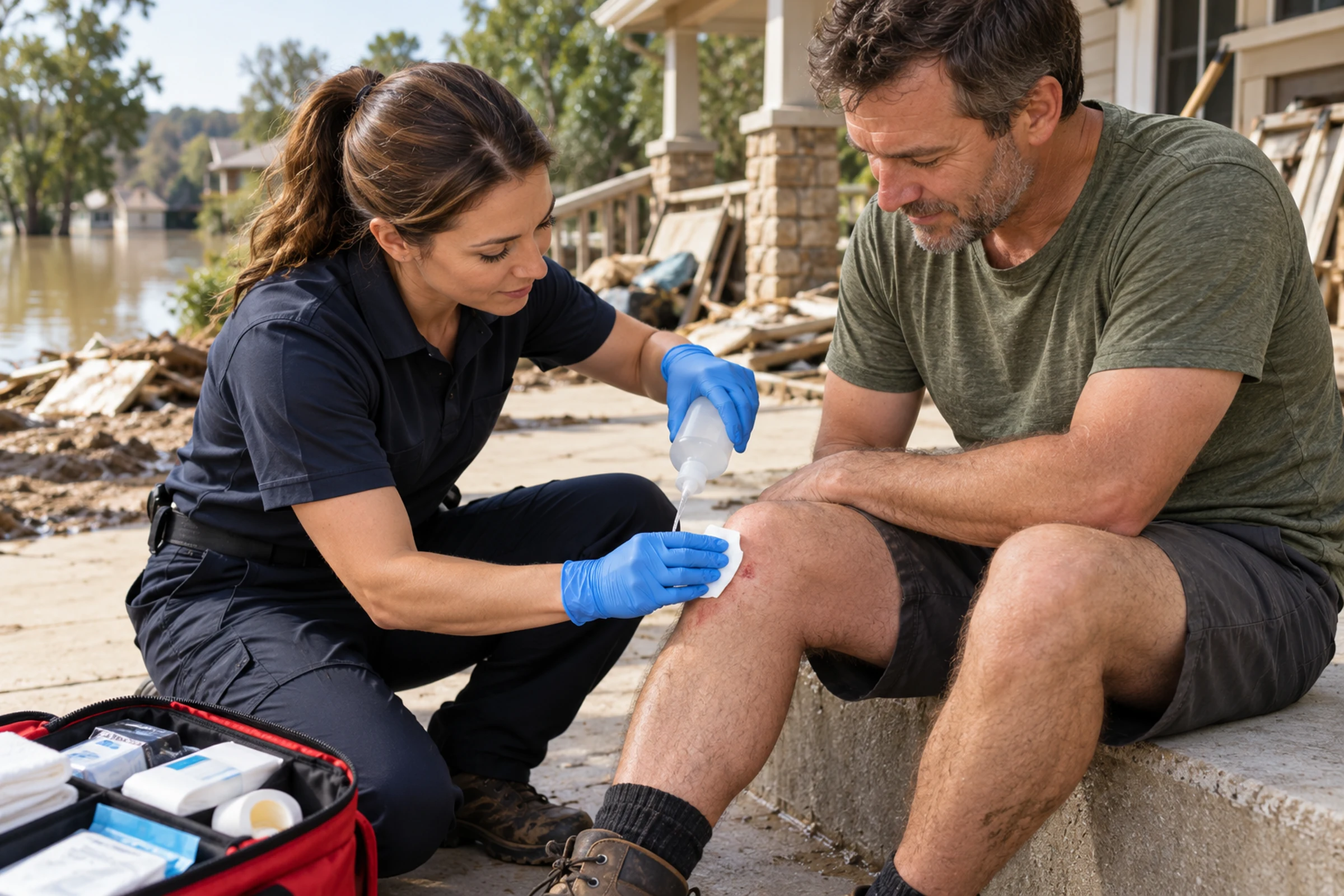
CDC advises people with open wounds to avoid floodwater whenever possible. Clean wounds should be covered with waterproof dressings. If a wound contacts floodwater, wash it with soap and clean water.
Seek medical evaluation when a wound:
- contains embedded debris,
- is a significant dirty puncture,
- resulted from an animal bite,
- develops increasing redness or swelling,
- drains,
- becomes increasingly painful,
- or is associated with fever or other systemic symptoms.
A practical rule:
Do not use floodwater to clean a wound, and do not intentionally expose an open wound to floodwater.
🌊 Tetanus questions after flood injuries
Floodwater itself does not automatically mean someone requires a tetanus booster.
The need depends on the type of wound and the person’s vaccination history.
Dirty punctures and wounds contaminated by soil, feces, or debris deserve careful review.
That makes tetanus status worth checking before severe-weather season rather than trying to reconstruct vaccination history after an injury.
🌊 Children should not play in floodwater
To a child, a flooded street may look like a temporary swimming pool.
It is not.
CDC advises keeping children out of floodwater.
Children may be especially vulnerable because they:
- may swallow contaminated water,
- may not recognize current,
- may not see sharp debris,
- may have cuts and scrapes,
- and may not understand electrical hazards.
Adults need to establish the boundary.
🌊 Electricity and water remain a lethal combination
Flooding can damage:
- household electrical systems,
- service equipment,
- appliances,
- extension cords,
- generators,
- and utility infrastructure.
Do not turn power on or off while standing in water.
Do not assume the power is off simply because a neighborhood is dark.
Downed lines, damaged services, solar systems, generators, and utility restoration can all create electrical hazards.
A house that looks intact can still have dangerous electrical damage.
▸ Generator danger often begins after the storm
Power loss creates another hazard: carbon monoxide.
Portable generators, pumps, pressure washers, and other fuel-powered equipment produce carbon monoxide.
OSHA warns that gasoline- and diesel-powered generators, pumps, and pressure washers should be operated outdoors rather than in enclosed or confined areas.
Carbon monoxide is especially dangerous because people cannot reliably detect it through sight or smell.
Never run a portable generator:
- inside a home,
- in a garage,
- in a basement,
- near openings where exhaust can enter,
- or inside another enclosed space.
Storm cleanup should not create a second emergency.
🌊 Flood cleanup is work
This distinction is important for employers.
Once workers are sent into storm-damaged areas, the situation becomes more than community preparedness.
It becomes occupational safety.
Flood cleanup may expose workers to:
- contaminated water,
- electrical hazards,
- carbon monoxide,
- debris,
- damaged structures,
- sharp objects,
- mold,
- hazardous chemicals,
- heavy lifting,
- heat stress,
- and unstable surfaces.
An employer should not send employees into a flooded workplace with only:
Be careful.
That is not a hazard assessment.
▸ PPE depends on the job
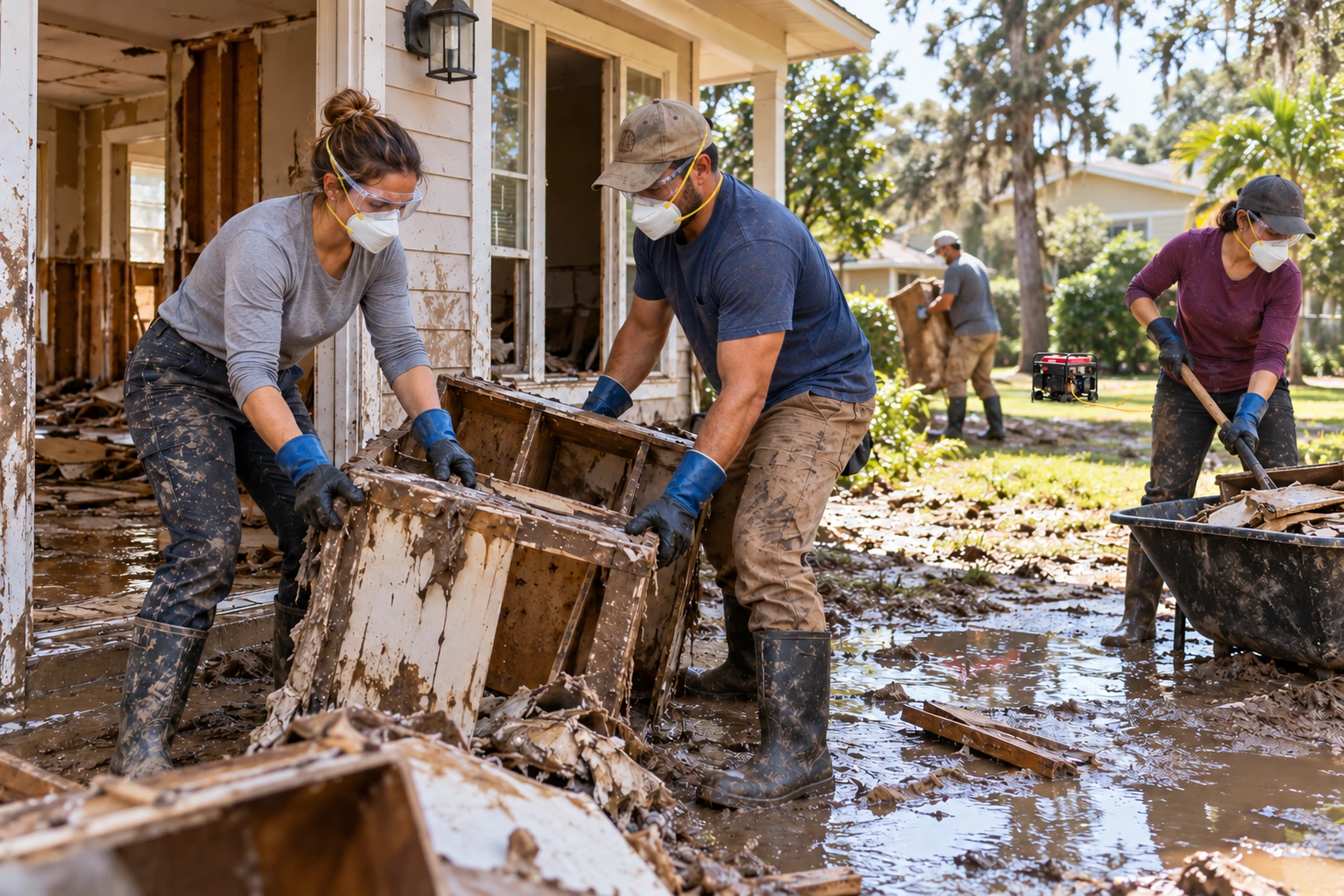
For incidental contact with floodwater, CDC recommends protective measures such as rubber boots, gloves, and eye protection when entry cannot be avoided.
Occupational response may require more.
The correct PPE depends on the hazards actually present:
- contaminated water,
- chemicals,
- sharp debris,
- electrical hazards,
- mold,
- respiratory exposure,
- sewage,
- temperature,
- and task duration.
There is no universal flood-cleanup PPE kit.
PPE selection begins with understanding the job and the hazards.
⚠️ Mold becomes the next hazard
Once floodwater enters a building, moisture remains after standing water recedes.
Cleanup and drying should begin as soon as it can be done safely.
Mold growth can contribute to respiratory symptoms and allergic reactions, particularly in people with asthma, allergies, chronic respiratory disease, or immune compromise.
Significant contamination may require trained remediation rather than simply sending untrained workers into a damaged building.
🌊 Food and drinking water may also be affected
Floodwater can contaminate:
- private wells,
- food,
- refrigerators,
- utensils,
- preparation surfaces,
- and household water systems.
Do not assume food is safe because the packaging looks intact.
Follow local drinking-water and public-health advisories after flooding.
Emergency preparedness works better when households already maintain basic supplies rather than relying on last-minute access to stores.
▸ What families should do before the next storm
Know whether you live or work in a flood-prone area
Flood risk is easier to address before water begins rising.
Enable emergency alerts
Warnings are only useful if people receive them.
Plan more than one evacuation route
Your usual route may be the first route to flood.
Keep medication and essential documents accessible
Do not store everything critical in a basement that may flood.
Prepare for power loss
Maintain flashlights, charging options, water, food, and a safe generator plan if you use a generator.
Review vaccination records
Do it now, not after stepping on submerged debris.
Teach children that floodwater is off limits
Do not wait until water is in the street to establish the rule.
🏢 What employers should do
Employers in hurricane and flood-prone areas should determine in advance:
- who is expected to report after a storm,
- whether employees will perform cleanup,
- what hazards those tasks create,
- who has appropriate training,
- what PPE is needed,
- how electrical hazards will be controlled,
- whether hazardous substances may be present,
- how heat and hydration will be managed,
- how injuries will be reported,
- and when work should stop until specialized responders arrive.
Workers should not discover their disaster-response role after they arrive at a flooded jobsite.
🌊 What to do after floodwater contact
If contact occurs:
- Leave the water when it is safe to do so.
- Wash exposed skin with soap and clean water.
- Clean and protect wounds.
- Change contaminated clothing.
- Wash contaminated clothing before reuse.
- Monitor wounds for infection.
- Seek medical care for significant injuries, contaminated punctures, embedded debris, or infection signs.
Workers should also follow their employer’s reporting and medical-evaluation procedures.
✅ What to remember
Floodwater does not have to look violent to be dangerous.
The risk may be the current.
It may be the missing road underneath.
It may be a live electrical source.
It may be sewage.
It may be chemicals.
It may be broken glass.
It may be contamination entering an open wound.
Or it may be the generator started in a garage after the water goes down.
The most useful advice remains the simplest:
Stay out of floodwater whenever possible.
For families, that means avoiding flooded roads and contaminated water.
For employers, it means treating flood response and cleanup as real work involving identifiable hazards, training, equipment, supervision, and limits.
The storm passing overhead does not mean the hazard has passed with it.
❓ Frequently Asked Questions
Is shallow floodwater safe to walk through?
No depth should be assumed safe simply because it looks shallow. Current, uneven terrain, washed-out pavement, open drainage structures, debris, contamination, and electrical hazards may not be visible.
Can I drive through floodwater if I have a truck or four-wheel drive?
Four-wheel drive does not eliminate the forces of moving water, hidden roadway damage, or the possibility that water will reduce tire contact with the road. Avoid flooded roads and follow barricades and local emergency instructions.
What should I do if floodwater gets into a cut?
Leave the contaminated water when safe, wash the area with soap and clean water, protect the wound, and monitor for infection. Seek medical care for significant injuries, embedded debris, dirty punctures, bites, increasing redness, swelling, drainage, worsening pain, fever, or other concerning symptoms.
Does contact with floodwater automatically mean I need a tetanus booster?
No. The decision depends on the wound type and vaccination history. Dirty or puncture wounds should prompt review of tetanus status with a healthcare professional.
Is an N95 enough for flood cleanup?
Not automatically. Flood cleanup can involve mold, chemicals, sewage, dust, and other hazards. Respirator selection depends on the actual airborne hazard and should be part of a broader hazard assessment. Some cleanup tasks may not be appropriate for untrained workers.
When is it safe to run a portable generator?
Only in a location that prevents carbon monoxide from entering occupied spaces. Never run a portable generator inside a home, garage, basement, or other enclosed or partially enclosed area. Follow manufacturer and public-safety guidance for distance from doors, windows, and vents.
Should employees be required to report for flood cleanup without special training?
Employers should evaluate the hazards and determine what training, PPE, supervision, electrical controls, respiratory protection, and other precautions are necessary before assigning cleanup work. Some conditions require specialized responders or contractors.
🧰 A Simple Family Flood-Safety Checklist
Before severe weather:
- Turn on emergency alerts.
- Know more than one evacuation route.
- Keep medication, chargers, and important documents where they can be reached quickly.
- Maintain safe drinking water and basic food supplies.
- Review generator placement and fuel storage before the power fails.
- Check first-aid supplies.
- Review tetanus vaccination status.
- Teach children never to enter floodwater.
After flooding:
- Do not drive around barricades.
- Do not enter water to retrieve property unless qualified responders say it is safe.
- Treat standing water as contaminated.
- Avoid wet electrical equipment.
- Photograph damage from a safe position when possible.
- Follow local drinking-water advisories.
- Use qualified help for structural, electrical, chemical, or major mold hazards.
🎓 Employer Training Note
Flood response can be a useful crossover topic for OSHA and First Aid education. A short exercise can ask supervisors to plan cleanup of a partially flooded workplace with wet electrical equipment, damaged shelving, mold, contaminated water, heavy debris, and heat exposure. The goal is to identify when routine employees can work safely and when the task must stop for specialized resources.
🦺 LSE Training Connection
First aid and CPR/AED training cannot prevent flooding, but it can prepare people to respond to injuries and medical emergencies while professional help is delayed or resources are stretched.
Request training for your organization or browse LSE courses.
Training You Can Count On. When Seconds Count.
Images are AI-generated educational illustrations, not photographs of the cited incidents or study participants. Displayed screens and documents are illustrative.
📚 Authoritative Sources
- CDC. Floodwater After a Disaster or Emergency.
https://www.cdc.gov/floods/safety/floodwater-after-a-disaster-or-emergency-safety.html - National Weather Service. Turn Around Don’t Drown.
https://www.weather.gov/safety/flood-turn-around-dont-drown - OSHA. Flood Preparedness and Response.
https://www.osha.gov/flood/response - CDC. Returning Home After a Natural Disaster.
https://www.cdc.gov/natural-disasters/safety/returning-home-after-natural-disaster.html