Prepared by the LSE Editorial Team. Reviewed by Joseph Andrade, Jr., RN, NRP.
Joseph is an active firefighter, paramedic, and registered nurse working in emergency and vascular access care, as well as an OSHA Outreach instructor and safety officer. He has spent his career on the response side of emergencies, from the fireground to the ambulance to the hospital bedside, and now trains civilians, workplaces, and first responders in the skills that save lives.
I keep a tourniquet in my personal truck. Not the ambulance, my own truck, in the center console where I can reach it one-handed. Twenty years ago, the version of me that was just starting out would have thought that was crazy, maybe even dangerous. We were taught that tourniquets were a last resort that cost people their limbs.
We were wrong. And the reason I know we were wrong is that a generation of military medics went to war, solved a problem the hard way, and sent the answer home.
That answer has a name. It is called Tactical Combat Casualty Care, and it is one of the most important things to happen to emergency medicine in the last thirty years. If you have ever seen a Stop the Bleed kit on a wall, watched a bystander save a life with a tourniquet, or packed a first aid kit with hemostatic gauze, you have already touched the results. Most people just do not know the story behind it.
This is that story, and why it matters for you.
The problem that started everything
For most of the history of warfare, the leading cause of death on the battlefield was not the wound itself. It was bleeding. A soldier hit in the arm or leg could bleed to death in minutes from an injury that, treated fast, was completely survivable.
The numbers are stark. A landmark 2012 study by Dr. Brian Eastridge and colleagues reviewed United States military deaths from 2001 to 2011. They found that 87.3 percent of combat injury deaths happened before the casualty reached a medical treatment facility. Of the prehospital deaths considered potentially survivable, 90.9 percent were associated with hemorrhage—uncontrolled bleeding.
Sit with that for a second. The single biggest opportunity to save a life on the battlefield was not a surgeon in a field hospital. It was whatever happened in the first few minutes, right where the casualty fell, often at the hands of a buddy with no medical degree.
The problem was that the medicine of the day was not built for that moment. Civilian trauma care, which the military had largely adopted, was designed around getting a patient to a hospital. It treated the tourniquet as a desperate measure and prioritized airway management in a way that made sense in an emergency room but not under fire. Medics were carrying the wrong priorities into the worst possible conditions.
1996: The birth of Tactical Combat Casualty Care
In 1996, a small group of military physicians decided the standard approach was failing the people it was supposed to protect. Dr. Frank Butler, a Navy SEAL and physician, along with John Hagmann and George Butler, published a paper in Military Medicine that laid out a new framework built specifically for combat. They called it Tactical Combat Casualty Care, or TCCC.
The insight behind Tactical Combat Casualty Care was deceptively simple. The care a casualty needs depends on the tactical situation around them. Trying to do careful, hospital-style assessment while bullets are still flying gets more people killed, including the rescuer. So TCCC split care into phases based on the reality on the ground.
The framework organized combat casualty care into three phases. Care Under Fire, meaning the treatment you give while still under active threat, is stripped down to the actions that keep the casualty and rescuer alive, including stopping life-threatening extremity bleeding with a tourniquet when indicated. Tactical Field Care is the more complete assessment and treatment provided once the immediate threat is controlled. Tactical Evacuation Care is the treatment given while moving the casualty to a higher level of care.
This was a radical reordering of priorities. In the traditional approach drilled into every medical provider, airway came first. TCCC recognized that in combat, catastrophic bleeding can kill faster than a blocked airway, and it put bleeding control at the very top for the care-under-fire phase.
It also rehabilitated the tourniquet. The old fear that tourniquets inevitably caused amputation turned out to be based on outdated evidence and worst-case anecdotes. When military medics started applying modern tourniquets early and correctly, studies found a survival benefit, especially when they were applied before the casualty entered shock. The tourniquet went from a feared last resort to a first-line lifesaving tool for appropriate extremity hemorrhage.
MARCH: the simple system that replaced the old one
Out of Tactical Combat Casualty Care came a memory tool that has quietly taken over trauma education. It is called MARCH, and it reorders the priorities of trauma care to match what kills people fastest in the field.
Here is what each letter stands for.
M is for Massive hemorrhage. Stop life-threatening bleeding first. Tourniquets for appropriate limb bleeding, and wound packing with firm pressure for wounds where a tourniquet cannot be applied.
A is for Airway. Once the bleeding is controlled, assess whether the casualty can maintain an open airway and use the interventions appropriate to your training level.
R is for Respiration. Look for chest injuries that interfere with breathing and provide treatment within your scope and training.
C is for Circulation. Reassess for other bleeding, evaluate shock, and consider resuscitation based on the casualty, available resources, and level of care.
H is for Hypothermia and Head injury. Prevent heat loss, because hypothermia worsens coagulopathy, and protect against the secondary effects of traumatic brain injury.
The power of MARCH is that its core priorities can be taught at different levels. A soldier, police officer, teacher, factory worker, or parent does not need a medical degree to understand that life-threatening bleeding must be controlled immediately.
From the battlefield to Main Street
For years, Tactical Combat Casualty Care lived primarily in the military world. The turning point for civilians came from tragedy.
After the 2012 shooting at Sandy Hook Elementary School, the American College of Surgeons convened trauma surgeons, emergency physicians, law-enforcement representatives, and military experts to examine survival in active-shooter and intentional mass-casualty events. Their recommendations became known as the Hartford Consensus.
The central finding echoed the battlefield lesson. In these events, uncontrolled bleeding was a major cause of preventable death, and the people best positioned to intervene were often the bystanders already on scene. The Hartford Consensus argued that the public needed access to bleeding-control tools and the training to use them.
It is the same larger principle behind bystander CPR and early AED use: professional responders matter, but the person already standing next to the patient can change the outcome before an ambulance arrives.
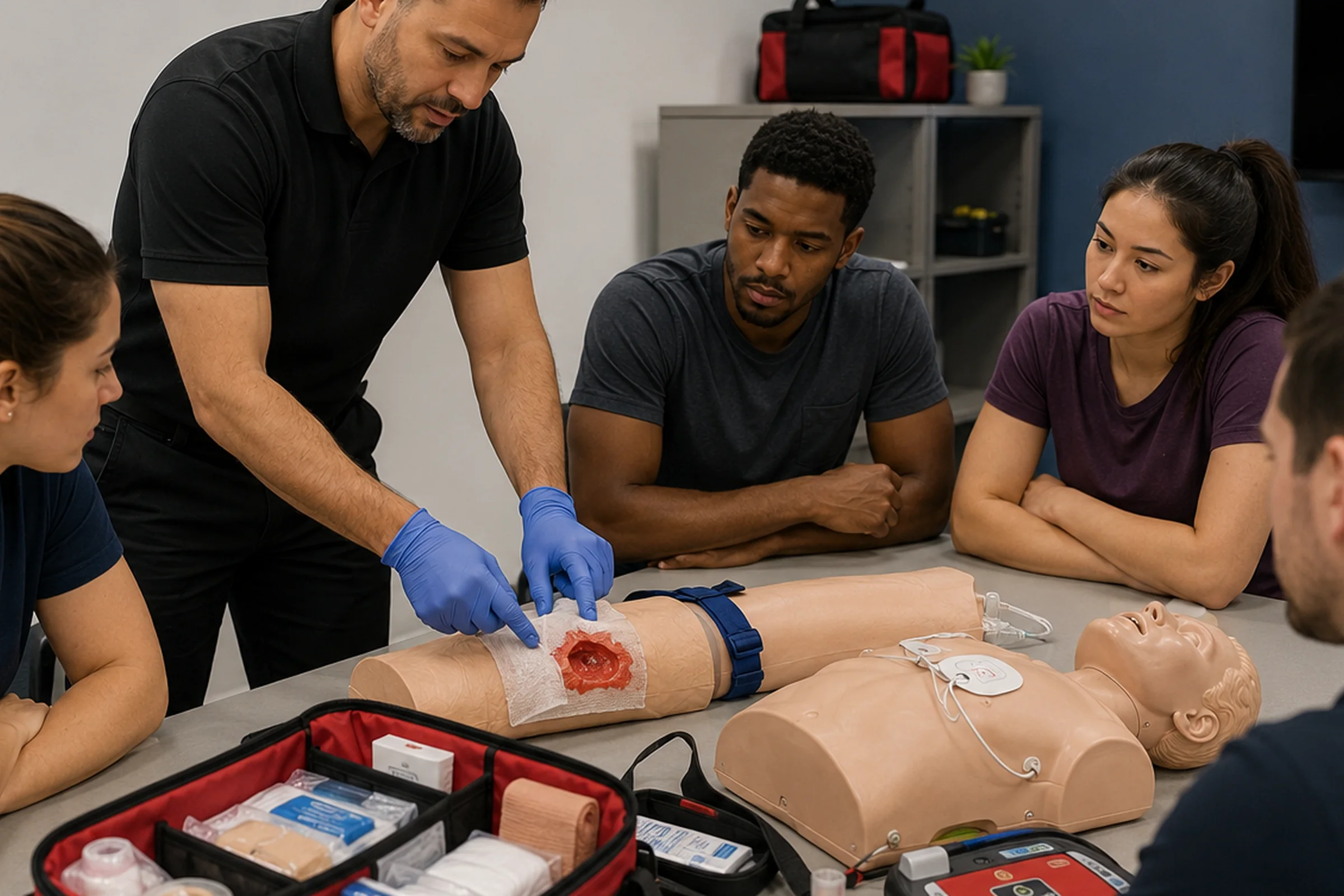
That work contributed directly to the national Stop the Bleed campaign, launched in 2015. Stop the Bleed translates core hemorrhage-control skills into public education: direct pressure, wound packing, and tourniquet application. The same fundamental tools that changed combat medicine are now taught in schools, offices, stadiums, houses of worship, and community organizations.
Bleeding-control kits now hang next to AEDs in many public buildings. That is the battlefield coming home.
TECC: the civilian translation
There is one more piece to this pipeline that most of the public never hears about, and it matters for the responders in the audience.
Tactical Combat Casualty Care was designed for the battlefield, and some of its assumptions do not translate cleanly to a civilian street. Soldiers are often younger and healthier than the overall civilian population. Civilian responders care for children, older adults, pregnant patients, and people with complex medical histories. The threats, resources, command structures, legal considerations, and evacuation systems can also differ.
So the civilian tactical-medicine community developed an adaptation called Tactical Emergency Casualty Care, or TECC, maintained by the Committee for Tactical Emergency Casualty Care. TECC translates the proven concepts of TCCC for law enforcement, fire, EMS, rescue teams, and active bystanders operating in high-threat civilian incidents.
TECC uses three dynamic phases—Direct Threat, Indirect Threat, and Evacuation Care—and places additional emphasis on interagency communication, casualty extraction, civilian patient populations, and the realities of fire, EMS, law enforcement, and rescue operations.
If your department conducts active-threat or rescue-task-force training, TECC principles are likely part of the framework behind it.
The tools in your glovebox came from war
Look inside a well-built modern first aid or trauma kit and you are looking at a collection of battlefield lessons.
The windlass tourniquet, the kind with a rod you twist to tighten, was refined and proven through modern military experience. Hemostatic gauze emerged from the search for better ways to control severe bleeding in places a tourniquet cannot reach, such as junctional wounds. Even the discipline of carrying these tools where they can be reached immediately, rather than buried in a cabinet or trunk, reflects lessons learned under operational pressure.
The through-line is this: hard, painful, real-world experience under the worst conditions imaginable produced knowledge, and that knowledge did not stay locked in the military. It flowed outward into civilian EMS, public bleeding-control programs, and the kit in your car. People who will never wear a uniform are alive today because of what military medicine learned.
What is coming next
The pipeline from battlefield to bedside is still running. Several advances are moving from military use toward wider civilian adoption, and honesty requires labeling where each one actually stands.
Prehospital whole blood. The military pushed hard on giving blood as far forward as possible, and civilian EMS systems increasingly carry whole blood or blood components on ambulances and helicopters. The evidence supports early prehospital transfusion for selected bleeding patients, but whether whole blood is superior to balanced components remains unsettled. Two large randomized trials published in the New England Journal of Medicine in 2026 found that prehospital whole blood was not superior to the comparison strategies used in those trials. This is a real and expanding capability, but the best product, patient selection, logistics, and system design are still being studied.
Tranexamic acid, or TXA. This is a low-cost antifibrinolytic medication that helps stabilize blood clots. The CRASH-2 trial, published in 2010, found a reduction in all-cause mortality among bleeding trauma patients who received TXA, and later analyses reinforced the importance of early administration. It is now included in many trauma systems and EMS protocols, but it remains a medication that must be used under an appropriate medical protocol.
Freeze-dried plasma. Plasma that can be stored and transported more easily than conventional frozen plasma has longstanding military value and is moving toward broader civilian use. Availability remains limited and system-dependent.
Advanced tools such as REBOA and technology-assisted triage. Methods for temporarily controlling internal hemorrhage and tools intended to improve casualty prioritization are being studied and refined. These remain specialized or emerging capabilities rather than public first-aid interventions.
The pattern holds. What is learned under military operational pressure often informs tomorrow’s civilian trauma system. The tourniquet took decades to make that journey. The next generation of tools may move faster, but each still needs careful evidence, training, oversight, and appropriate use.
What this means for you
You do not need to be a soldier, medic, or nurse to benefit from any of this. That is the entire point.
The most useful thing you can do with this story is act on it. Learn to control life-threatening bleeding. Put a legitimate bleeding-control kit in your car, workplace, and home, just as you would keep a fire extinguisher. Store it where it can be reached quickly, inspect it periodically, and get hands-on training with the equipment you carry.
A practical glovebox readiness checklist
- Use a reputable commercial tourniquet from a trusted supplier rather than an unverified imitation.
- Include wound-packing gauze, gloves, trauma shears, and a pressure bandage.
- Store the kit where the driver or passenger can reach it quickly—not under luggage or buried with roadside equipment.
- Protect the contents from moisture, extreme damage, and contamination.
- Inspect the kit periodically and replace opened, damaged, or expired supplies.
- Practice with dedicated training equipment so your emergency kit remains ready for actual use.
For a wider overview of Life Saving Education’s medical and safety resources, begin with our training resource guide.
If you are a responder, make sure your tactical and trauma education reflects current TCCC or TECC guidance appropriate to your mission, medical direction, scope of practice, and agency protocols. These are living systems that change as evidence and operational experience grow.
Battlefield medicine bought this knowledge at a terrible price. The least we can do is use it responsibly.
Key Takeaways
- Hemorrhage was associated with 90.9 percent of potentially survivable prehospital combat deaths in the landmark 2001–2011 review.
- Tactical Combat Casualty Care, first published in 1996, reorganized trauma care around the tactical environment and the causes of preventable death.
- The MARCH sequence puts massive hemorrhage before airway because catastrophic bleeding can kill within minutes.
- Modern tourniquets moved from a feared last resort to a proven first-line intervention for appropriate life-threatening extremity bleeding.
- Military hemorrhage-control lessons helped shape the Hartford Consensus, Stop the Bleed, and the civilian TECC framework.
- The translation continues through prehospital transfusion, TXA, freeze-dried plasma, and other emerging trauma capabilities.
Frequently Asked Questions
What does Tactical Combat Casualty Care actually mean?
Tactical Combat Casualty Care, or TCCC, is a set of battlefield trauma guidelines first published in 1996. It organizes care into phases based on the tactical situation and prioritizes the interventions most likely to prevent death at that point in the incident.
Is it true that tourniquets cause you to lose a limb?
Modern military and civilian evidence does not support treating tourniquets as an automatic cause of amputation. When a commercial tourniquet is indicated and applied correctly, early use can save a life. The risk of uncontrolled extremity hemorrhage is immediate, while complications depend on factors such as placement, duration, injury severity, evacuation time, and medical care.
What is the difference between TCCC and TECC?
TCCC was developed for military combat operations. TECC translates many of its principles for civilian high-threat incidents and accounts for civilian patient populations, interagency operations, rescue and evacuation systems, and the realities of law enforcement, fire, EMS, and active bystanders.
Can a regular person really learn this?
Yes. Public bleeding-control courses teach direct pressure, wound packing, and tourniquet application in a hands-on format. These core skills are designed to help ordinary people act during the minutes before professional responders arrive.
What should I keep in a bleeding-control kit?
A practical kit commonly includes a reputable commercial windlass tourniquet, gauze suitable for wound packing, gloves, trauma shears, and a pressure or compression bandage. The contents matter, but training, accessibility, inspection, and familiarity with the equipment matter just as much.
Learn the skill that came home from war
Reading about bleeding control is a start. Practicing it with your hands is what prepares you to act. Life Saving Education teaches ACS Stop the Bleed and first-aid programs for workplaces, schools, public-safety organizations, and community groups, taught by instructors with real emergency-response and clinical experience.
If you want your team ready, contact Life Saving Education and we will build a session around your people and risks. You can also explore our full course catalog or review onsite group-training options.
Sources
- Eastridge BJ, et al. Death on the battlefield (2001–2011): implications for the future of combat casualty care. Journal of Trauma and Acute Care Surgery. 2012.
- Butler FK, Hagmann J, Butler EG. Tactical Combat Casualty Care in Special Operations. Military Medicine. 1996.
- American College of Surgeons. History of ACS Stop the Bleed and the Hartford Consensus.
- Committee for Tactical Emergency Casualty Care. TECC guidance and civilian translation of TCCC principles.
- CRASH-2 Trial Collaborators. Effects of tranexamic acid on death in trauma patients with significant hemorrhage. The Lancet. 2010.
- Kragh JF Jr, et al. Survival with emergency tourniquet use to stop bleeding in major limb trauma. Annals of Surgery. 2009.
- Smith JE, et al. Prehospital Whole Blood in Traumatic Hemorrhage — A Randomized Controlled Trial. New England Journal of Medicine. 2026.
- Neal MD, et al. Prehospital Resuscitation with Type O Whole Blood for Trauma and Hemorrhage. New England Journal of Medicine. 2026.
- National Association of Emergency Medical Technicians. Tactical Combat Casualty Care education.
This article is provided by Life Saving Education for general educational purposes only. It is not medical, legal, or compliance advice, and it is not a substitute for hands-on training, medical direction, agency protocols, or professional guidance. Regulations and clinical guidelines change and vary by jurisdiction. In an emergency, call 911.