🫀 Training Tuesday
Prepared by the LSE Editorial Team. Reviewed by Joseph Andrade, Jr., RN, NRP.
Joseph works across emergency response, healthcare, and workplace safety and develops practical training for civilians, employers, and first responders.
Everyone on the crew can be competent and a cardiac arrest can still become disorganized. The compressor needs relief, the next person is across the room, the monitor operator is waiting for space, and the team leader is occupied with a procedure. Nobody intended a long pause. The way the work was arranged created one.
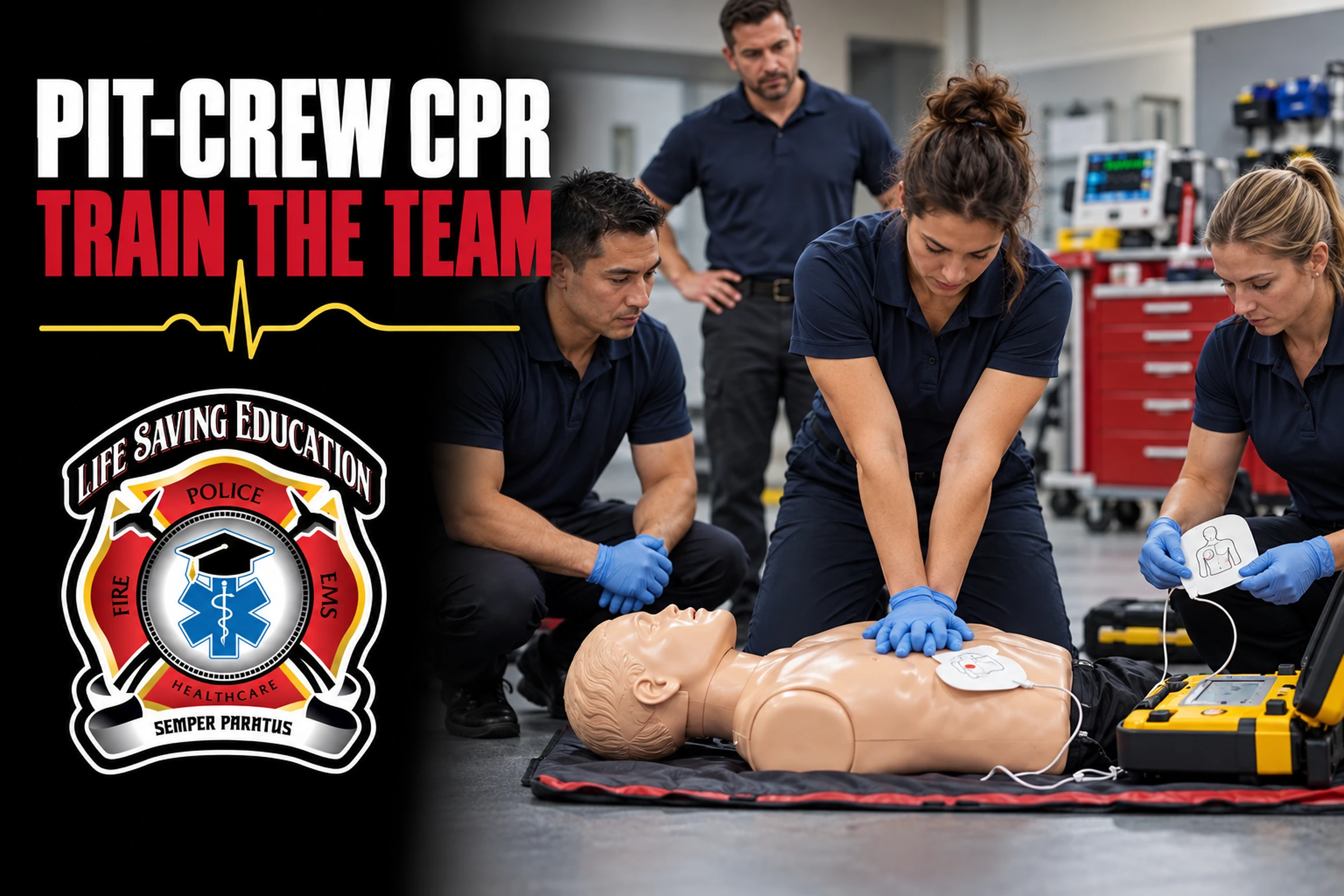
Pit-crew CPR addresses that coordination problem. It gives responders a shared approach to positions, responsibilities and transitions so they can prepare for the next action while care continues.
A study from south-central Connecticut examined a regional educational initiative across 27 EMS agencies. Its findings support taking team performance seriously, with an important limit: the study was observational, so it cannot establish that the training alone caused better outcomes.
📊 The Connecticut findings
The retrospective before-and-after study used Cardiac Arrest Registry to Enhance Survival (CARES) data from 1,917 adults with non-traumatic out-of-hospital cardiac arrest: 922 before the intervention and 995 afterward. The initiative combined didactic education with hands-on simulation.
| Outcome | What the study reported |
|---|---|
| Neurologically intact survival | Increased gradually over time. Adjusted odds ratio 1.20 per four-month interval (95% CI 1.01 to 1.44) |
| Sustained ROSC | Immediate increase at intervention start. Adjusted odds ratio 1.41 |
| Survival to hospital discharge | Did not significantly change |
An odds ratio of 1.20 is not a 20-percentage-point increase in survival. Nor is it a guaranteed benefit for the next agency that adopts a role card. The results describe an association in a particular regional system.
🏎️ What pit-crew CPR asks a team to do
The motorsports comparison is useful because a pit crew organizes predictable work before the car arrives. Members know their positions, tools and responsibilities. They do not spend the critical moment negotiating who will do each task.
In resuscitation, the same principle helps a crew organize compressions, compressor relief, rhythm analysis, ventilation and leadership. ALS functions, documentation and additional roles depend on staffing, scope, protocols and equipment.
A model must fit the response system. A two-person ambulance crew cannot use the same arrangement as an engine company working with an ALS unit and a supervisor. The plan should describe how roles expand as help arrives and how essential tasks are covered before then.
Common functions include:
Chest compressions and planned compressor relief.
AED or monitor operation.
Airway and ventilation.
Vascular access and medications where authorized.
Team leadership and oversight.
Recording and timekeeping when personnel permit.
Assigning a function is only the beginning. Each responder should understand what to prepare, what to communicate and how to transfer the task.
🔁 Practice transitions deliberately
A cardiac arrest has repeated transitions: a new responder arrives, a rhythm analysis approaches, the compressor rotates, an intervention is completed, or the patient develops signs of circulation. These are points where teams can lose time.
Training should make those moments visible. Have the crew anticipate the transition and then measure what happens. If compressions stop, identify when they stopped, when they restarted and what occupied the interval.
That is more useful than a general instruction to work faster. A team may need to move a bag, change where the relief compressor waits, or agree on a brief announcement before analysis.
Use the current resuscitation program, device instructions and agency protocol to teach the clinical sequence. The exercise should improve execution of that sequence, not create a competing local algorithm.
🙋 Have the next compressor ready
A relief plan should not depend on the active compressor becoming visibly exhausted. The next responder needs to know when the change is expected and where to position safely.
During simulation, watch the preparation as closely as the switch. Is the relief compressor close enough to take over? Is equipment blocking the route? Does the monitor operator know a change is planned? Can the exchange occur during an appropriate planned pause without extending it?
Measure the interruption when equipment permits. Review the result with the crew and repeat the transition. A specific time and a clear description of what happened give the team something to improve.
If staffing is limited, rehearse that limitation. A plan that works only with a full complement of responders will leave the first-arriving crew improvising.
⚡ Prepare for rhythm analysis before the pause
The approaching rhythm check should be apparent to the people who need to act. The monitor operator can prepare, the relief compressor can position and the leader can coordinate the team.
For a shockable rhythm, practice the authorized sequence for minimizing unnecessary pauses while keeping everyone clear for defibrillation. Equipment-specific details belong in supervised training with the actual device and the agency’s approved procedures.
A lecture can explain the objective. Simulation reveals whether the crew can reach the controls, hear one another and perform the sequence with the equipment arranged as it would be on a call.
Ask the team to describe where its attention went. If everyone watched the monitor while nobody prepared to resume compressions, that is a coordination problem worth rehearsing.
🫁 Keep airway work integrated with the arrest
Airway care can draw the attention of the entire team, particularly when a procedure becomes difficult. The leader still needs to track compressions, rhythm analysis, defibrillation and the rest of the authorized resuscitation plan.
Give the airway clinician a clear role and a way to communicate needs. Rehearse equipment preparation and assistance without crowding the patient’s head or interrupting unrelated tasks.
The appropriate airway strategy depends on the patient, current guidance, scope and medical direction. The training objective here is to maintain coordinated care while that strategy is carried out.
When reviewing a scenario, ask whether the airway task required the interruption that occurred. If not, identify the equipment placement, role assignment or communication that would let care proceed together.
🧭 Give the leader a view of the scene
When staffing permits, the leader should be able to see the patient, monitor and crew. A leader absorbed in a hands-on task may miss a fatigued compressor, a delayed transition or a request for help.
Sometimes staffing requires the leader to perform a procedure. Train that situation explicitly. Decide how the crew will maintain time awareness, recognize changes and communicate while the leader’s attention is divided.
Leadership practice should include anticipation. What is coming next? Who is ready? What equipment will be needed? If circulation returns, how will the team reorganize for post-arrest care under its protocol?
Clear, brief communication is usually more useful than a running narration. A responder should know when an instruction is directed to them and confirm that the task is understood or completed.
🤝 Make the plan work across agencies
The Connecticut initiative involved 27 agencies, which makes it relevant to systems where several organizations converge on the same patient.
A first responder may start CPR before an engine arrives. A BLS crew may already be working when an ALS clinician enters. A supervisor or mutual-aid unit may join later. Each arrival changes the available personnel and can either improve the organization or disrupt it.
Regional training can establish a shared way to join an ongoing resuscitation. Responders need to know who is leading, which tasks are covered and where help is needed.
Agencies do not have to own identical equipment to discuss these questions together. They do need to recognize differences that affect workflow and practice the handoffs they actually use.
Have incoming personnel enter a scenario after care is underway. Observe whether the existing crew can integrate them without restarting the discussion or abandoning a task.
📏 Choose measurements that answer a training question
A long list of metrics can overwhelm a short drill. Select a few that match the objective and explain them before the exercise.
| Training objective | What to observe |
|---|---|
| Smoother compressor changes | Relief positioning and the duration of the interruption. |
| Better defibrillation coordination | Equipment readiness and unnecessary pauses around the authorized sequence. |
| Reliable CPR performance | Available feedback on rate, depth, recoil and compression fraction. |
| Clear roles | Unassigned tasks, duplicated work and whether instructions are acknowledged. |
| Less scene congestion | Bag placement, access to the patient and movement around equipment. |
| Organized response to ROSC | Recognition and the transition to protocol-directed post-arrest care. |
Use feedback equipment within its limitations. A simulator metric is information about that exercise; it is not a direct prediction of patient survival.
🗣️ Debrief the sequence of events
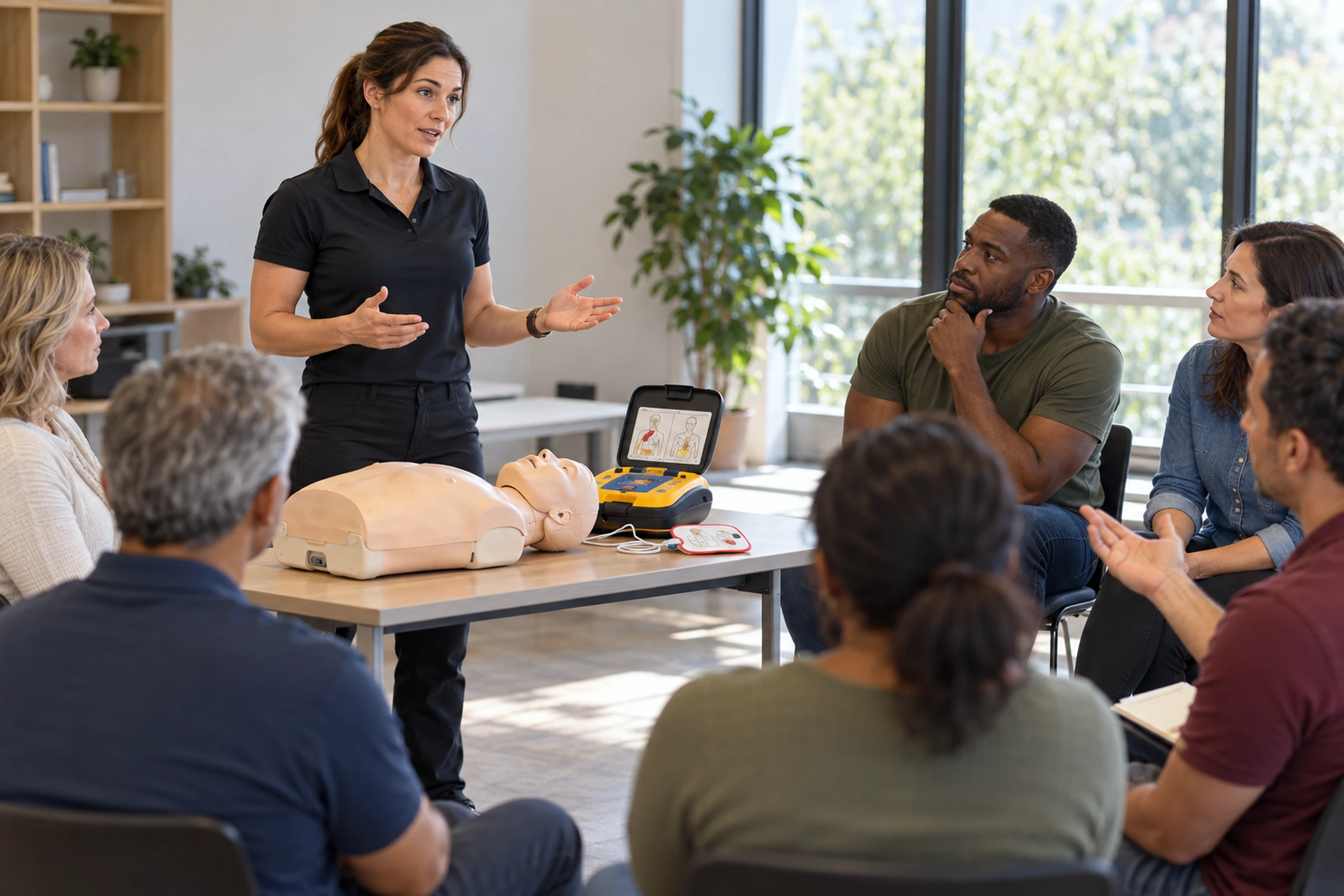
Rather than ending with “communicate more,” reconstruct the sequence. Why was the relief responder elsewhere? Was the role assigned clearly? Did the team announce the upcoming transition? Was the equipment layout making unnecessary movement unavoidable?
Choose one change and run the sequence again. Moving a bag or adjusting a responsibility may be more effective than repeatedly telling one person to hurry.
Individual technique still matters. A team debrief should address both the skill and the conditions that helped or hindered its use.
🚒 A station drill that fits a limited training window
Start with the staffing and equipment your crew normally has. Assign roles using the agency’s approved model, then run a brief manikin scenario that includes one compressor exchange and one rhythm-analysis transition.
Pause the drill for a focused debrief. Ask each responder what they expected to happen, what happened instead and what would make the next attempt clearer.
Repeat the same scenario with the agreed change. Keeping the conditions similar makes the effect easier to see. Once the basic arrangement works, add a realistic constraint such as a narrow room or another agency arriving partway through.
Do not add every challenge at once. A drill intended to improve one transition becomes difficult to assess if the team is also managing multiple unrelated surprises.
🧑🚒 What fire-based EMS can bring to the process
Fire crews already train around assignments, equipment and standard operating procedures. Apply that operational discipline to cardiac arrest.
Discuss who brings the monitor, who starts compressions, how airway responsibility is assigned and where relief personnel position. Rehearse leadership transfer when ALS arrives. Include the bedroom, bathroom or confined living space that changes the arrangement.
These conversations also identify assumptions between agencies. One crew may expect the arriving unit to take leadership while the arriving clinician expects the original leader to continue. A joint drill can resolve that ambiguity before a patient is involved.
📅 Build training into continuing practice
A laminated role card can support a shared approach, but the team needs repeated practice using it. Include resuscitation coordination in refresher training and review available performance information through the agency’s quality-improvement process.
The Connecticut findings are encouraging without promising a result for every implementation. The useful next step is to examine your own transitions, choose a measurable problem and rehearse it with the people who respond together.
For related preparation, review BLS Provider class preparation, our PALS and ACLS comparison, and the discussion of New York EMS protocol updates. Current local protocols and medical direction remain controlling.
✅ Key Takeaways
- A Connecticut study of 1,917 adult cardiac arrests across 27 EMS agencies linked a pit-crew CPR initiative with gradually improved neurologically intact survival and an immediate rise in sustained ROSC.
- Survival to hospital discharge did not significantly change, and the observational design cannot prove the training alone caused the results.
- Pit-crew CPR is about shared roles, positions and planned transitions, adapted to your actual staffing.
- Measure interruptions during compressor changes and rhythm analysis, debrief the sequence, and repeat with one change at a time.
- Practice with the agencies that actually respond together.
❓ Frequently Asked Questions
Does an odds ratio of 1.20 mean survival went up 20%?
No. An odds ratio of 1.20 is not a 20-percentage-point increase in survival. It describes an association in one regional system.
Can a two-person crew use pit-crew CPR?
Yes, but the model must fit the response system. The plan should describe how roles expand as help arrives and how essential tasks are covered before then.
Does pit-crew CPR replace our protocols?
No. Use the current resuscitation program, device instructions and agency protocol to teach the clinical sequence. The drill should improve execution of that sequence, not create a competing local algorithm.
Training You Can Count On. When Seconds Count.
Bring the Lesson Into Your Next Training Session
Find training for your role, workplace or response team.
📚 Authoritative Sources
- Yang et al., regional pit-crew CPR educational initiative
- Cardiac Arrest Registry to Enhance Survival
- American Heart Association CPR and ECC guidelines
Hero: AI-generated educational illustration, not an incident photograph. This article is educational and does not replace current protocols, medical direction, or hands-on training.