Prepared by the LSE Editorial Team. Reviewed by Joseph Andrade, Jr., RN, NRP.
Joseph works across emergency response, healthcare, and workplace safety and develops practical training for civilians, employers, and first responders.
Measles is not a disease most EMS crews expect to encounter on an ordinary shift. That is part of the problem.
A patient may initially look like another febrile respiratory illness. The crew may already be in a small room before the rash, travel history, exposure history, cough, coryza, or conjunctivitis raises concern. By then, several responders may have entered the space, the patient may be unmasked, and the ambulance may already be committed to transport.
New York State has updated its EMS-specific response guidance. Policy Statement 26-07, EMS Measles Response Guidance, appears in the New York State Department of Health Bureau of EMS policy library and supersedes the older 2019 guidance.
The update matters because it connects recognition to dispatch screening, responder immunity documentation, respiratory protection, patient masking, transport, receiving-facility notification, ambulance air clearance, and post-exposure follow-up.
For instructors, the goal isn’t to turn every fever-and-rash scenario into measles. It’s to make airborne-infection readiness practical again.
| Topic | What New York’s guidance says |
|---|---|
| Policy | Bureau of EMS Policy Statement 26-07, EMS Measles Response Guidance (supersedes the 2019 guidance) |
| Crew protection | Standard and airborne precautions with a fit-tested N95 or higher, even for personnel with presumptive immunity |
| Patient | Well-fitting medical or procedure mask when clinically appropriate and tolerated |
| Intubated patients | HEPA filter on the device’s exhalation pathway |
| Ambulance | Patient compartment out of service for two hours after the patient exits, or shorter with documented air-change data and agency policy |
| Follow-up | State measles EMS contact form for exposure documentation |
🦠 Why Measles Matters to EMS
Measles is highly contagious and spreads through airborne transmission. The patient does not need to cough directly into a responder’s face for the environment to matter.
New York’s healthcare-provider guidance tells clinicians to consider measles in a patient with febrile rash illness and compatible symptoms such as cough, coryza, and conjunctivitis, particularly when there is recent international travel or known exposure. Suspected cases should be reported promptly to the local health department.
For EMS, the challenge is making that information actionable before unnecessary personnel enter the patient’s immediate environment.
📞 Before Patient Contact: Dispatch and Entry
Dispatch is part of infection control
The updated guidance gives communications centers a meaningful role.
Where feasible, dispatch screening can identify information that changes the response before the crew reaches the patient. Questions about fever, rash, exposure, travel, and compatible symptoms can help crews prepare respiratory protection and limit unnecessary exposure.
Dispatchers are not diagnosing measles. They are identifying a potential airborne-infection problem early enough for responders to change how they approach the scene.
That distinction is worth teaching. A dispatcher does not need diagnostic certainty to provide useful risk information.
Limit the number of exposed responders
One of the simplest controls is also one of the most effective: do not send everyone into the patient area when only a few people are needed.
For a stable patient, the crew can perform an initial doorway assessment and determine what personnel and equipment are actually necessary.
This is a useful scenario-training point because EMS culture often rewards rapid physical entry. In an infectious-disease response, speed still matters, but uncontrolled personnel movement can create avoidable exposures.
😷 Protecting the Crew and the Patient
Respiratory protection means more than carrying an N95
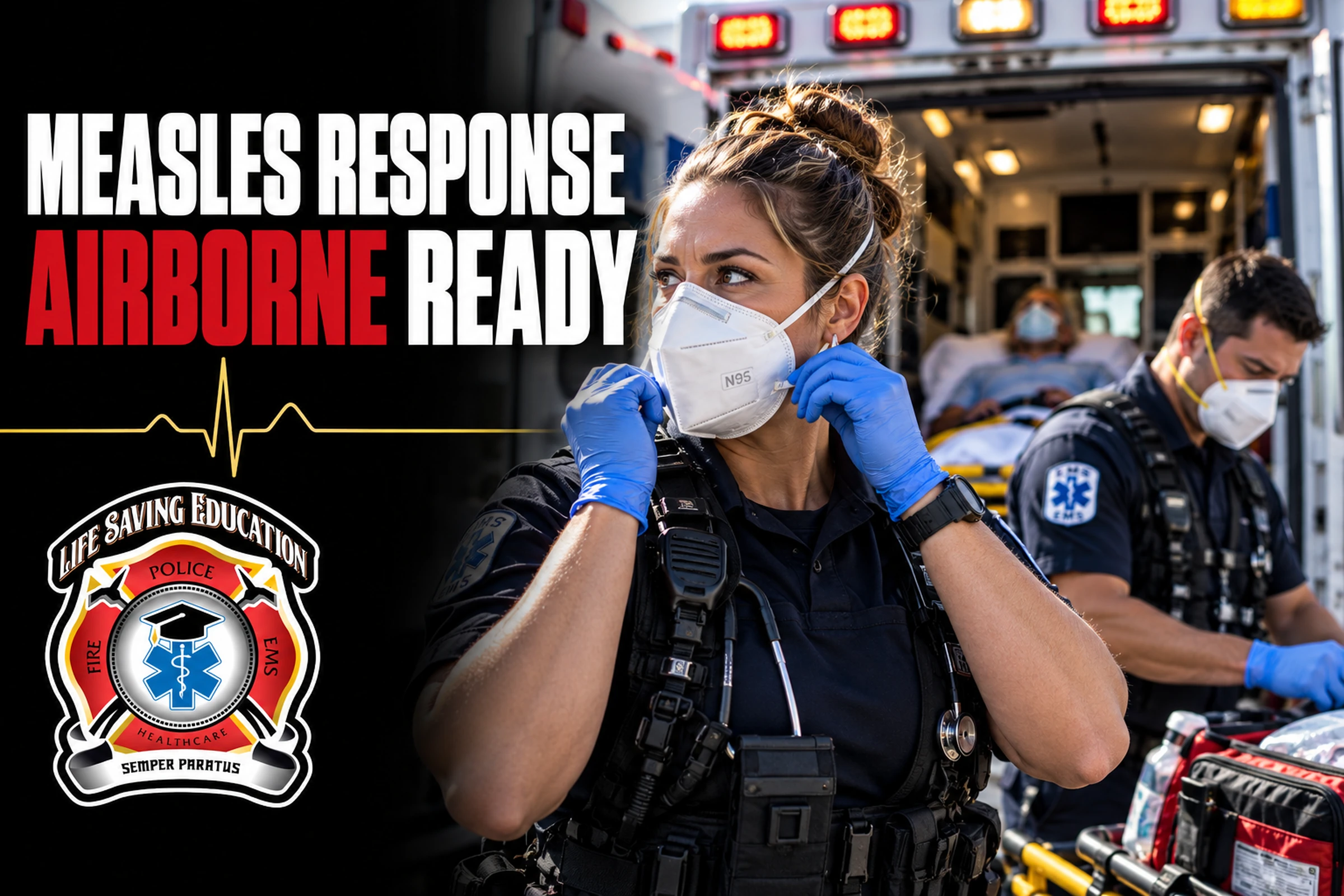
New York’s guidance recommends standard and airborne precautions, including a fit-tested N95 or higher-level respiratory protection for EMS personnel caring for a suspected measles patient.
An N95 in a cabinet is not the same as a functioning respiratory-protection program.
For employers covered by OSHA respiratory-protection requirements, proper use can involve medical evaluation, fit testing, training, selection, maintenance, and program administration.
Knowing when an N95 is indicated is clinical and operational education. Being authorized and properly fit-tested to use it is an employer respiratory-protection responsibility.
The updated guidance also recommends respiratory protection even for personnel with presumptive evidence of measles immunity.
Put a mask on the patient when tolerated
Source control matters. When clinically appropriate and tolerated, the patient should wear a well-fitting medical or procedure mask. That should happen early enough to matter.
Instructors can build this into a scenario by forcing the crew to make the decision before the patient is moved through common areas or loaded into the ambulance.
Airway management raises the stakes

Airway interventions deserve special attention because they can increase exposure risk.
The New York guidance addresses ventilation of intubated patients and recommends a HEPA filter on the device’s exhalation pathway.
Agencies should ask whether the correct filter is available, whether crews know where it is, whether they know how it interfaces with the equipment actually carried, whether the setup has been practiced, and whether it is consistent with manufacturer instructions, medical direction, and agency policy.
🔗 Related: Is Your Respirator Really NIOSH Approved? The Counterfeit PPE Problem
🚑 Transport, Handoff, and Return to Service
Tell the receiving hospital before arrival
A hospital that knows a suspected measles patient is arriving can prepare an appropriate destination and reduce exposure in triage areas, hallways, waiting rooms, and treatment spaces.
The crew should not wait for laboratory confirmation before communicating a reasonable suspicion. Describe the clinical presentation, relevant travel or exposure history, precautions in use, and estimated arrival time without announcing an unconfirmed diagnosis.
The ambulance may need time before it returns to service
One of the most operationally significant parts of the guidance involves vehicle clearance.
New York recommends keeping the patient compartment out of service for two hours after the patient exits. The guidance also allows an agency to establish a shorter period when it has documented manufacturer air-change information and an agency policy supporting the alternative.
The lesson is that airborne contamination affects fleet availability and that agencies need a documented plan before the call occurs.
Supervisors should know the ambulance’s documented air-change performance, compartment isolation, HVAC configuration, who authorizes return to service, where the unit waits during clearance, how cleaning occurs, and how the system manages temporary unit loss.
Exposure follow-up cannot begin with “Who was on that call?”
Agencies should know who entered the patient environment. If a suspected case is later confirmed, reconstructing exposure from memory is inefficient and unreliable.
The state guidance includes a measles EMS contact form. Agencies should incorporate exposure documentation into their operational process rather than treating it as an afterthought.
🔗 Related: New York EMS Protocols V26.1: What Changed and What Instructors Need to Update
🎯 Turn the Measles Guidance Into a Seven-Phase Simulation
A measles lecture built around a photograph of a rash is not enough. A better lesson follows the call.
Phase 1: Dispatch
The crew receives information about fever, rash, travel, or known exposure and identifies what PPE and approach may change.
Phase 2: Arrival
The team limits entry, applies respiratory protection, and performs an initial assessment without unnecessarily bringing the whole crew into the room.
Phase 3: Patient contact
The patient is masked when appropriate while the crew performs necessary assessment and care.
Phase 4: Airway contingency
The team identifies how respiratory protection, filtration, and equipment setup would change if advanced airway management becomes necessary.
Phase 5: Transport
The crew manages compartment separation and ventilation according to agency policy and equipment capabilities.
Phase 6: Hospital handoff
The receiving facility receives advance notification with a factual report.
Phase 7: After the call
The crew completes exposure documentation, follows vehicle air-clearance and cleaning procedures, and initiates occupational-health or public-health follow-up when indicated.

📋 What Agencies and Instructors Should Review Now
What agencies should review now
New York agencies should review:
- Responder immunity documentation
- Respiratory-protection program status
- N95 availability and fit testing
- Dispatch screening language
- Patient-mask supplies
- HEPA filtration capability
- Ambulance HVAC and air-change documentation
- Receiving-facility notification procedures
- Local-health-department contacts
- Exposure documentation
- Post-exposure occupational-health procedures
- Staffing plans when an ambulance must remain temporarily out of service
What this means for LSE instructors
LSE instructors can use this policy to strengthen EMS continuing education, respiratory-protection education, instructor development, HAZWOPER, and workplace programs. The lesson is transferable even when the disease changes: recognition, PPE, contamination control, communication, documentation, and follow-up have to work as one system.
Agencies can bring this into their fire and EMS training programs with LSE, onsite in the Washington, DC region and across the East Coast.
💡 LSE Bottom Line
The 2026 New York measles guidance turns infectious-disease preparedness into a chain of operational decisions. Dispatch matters. The number of people entering the room matters. Respiratory protection matters. Patient source control matters. Airway equipment matters. Hospital notification matters. Ambulance airflow matters. Exposure documentation matters.
The best time to determine how an agency will handle a suspected airborne-infectious patient is not after the crew has already transported one.
Educational content only. Follow current AHA course materials, local EMS protocols, medical direction, and your scope of practice.
✅ Key Takeaways
- New York’s Policy Statement 26-07 replaces the 2019 EMS measles guidance.
- Dispatch screening for fever, rash, travel, and exposure lets crews prepare before entry.
- Send only the people the patient needs into the room.
- Use a fit-tested N95 or higher, even with presumptive immunity, and mask the patient when tolerated.
- Notify the receiving hospital early with the facts, not an unconfirmed diagnosis.
- Plan for the ambulance to stay out of service for two hours unless documented air-change data and policy support less.
❓ Frequently Asked Questions
What respiratory protection does New York recommend for EMS on suspected measles calls?
Standard and airborne precautions, including a fit-tested N95 or higher-level respiratory protection. The guidance recommends this even for personnel with presumptive evidence of measles immunity.
Should a suspected measles patient wear a mask during EMS care?
Yes, when clinically appropriate and tolerated. A well-fitting medical or procedure mask should go on early, before the patient moves through common areas or into the ambulance.
How long does an ambulance stay out of service after a suspected measles patient?
New York recommends keeping the patient compartment out of service for two hours after the patient exits. An agency can set a shorter period when it has documented manufacturer air-change information and a supporting agency policy.
Should EMS tell the hospital before measles is confirmed?
Yes. Crews should share a reasonable suspicion without waiting for lab confirmation: the clinical presentation, travel or exposure history, precautions in use, and arrival time, without announcing an unconfirmed diagnosis.
What signs should make EMS consider measles?
A febrile rash illness with cough, coryza, or conjunctivitis, especially with recent international travel or a known exposure.
Training You Can Count On. When Seconds Count.
Make Airborne-Infection Readiness Practical
LSE helps EMS agencies turn new guidance into scenario training crews can actually run, onsite in the Washington, DC region and across the East Coast.