Prepared by the LSE Editorial Team. Reviewed by Joseph Andrade, Jr., RN, NRP.
Joseph works across emergency response, healthcare, and workplace safety and develops practical training for civilians, employers, and first responders.
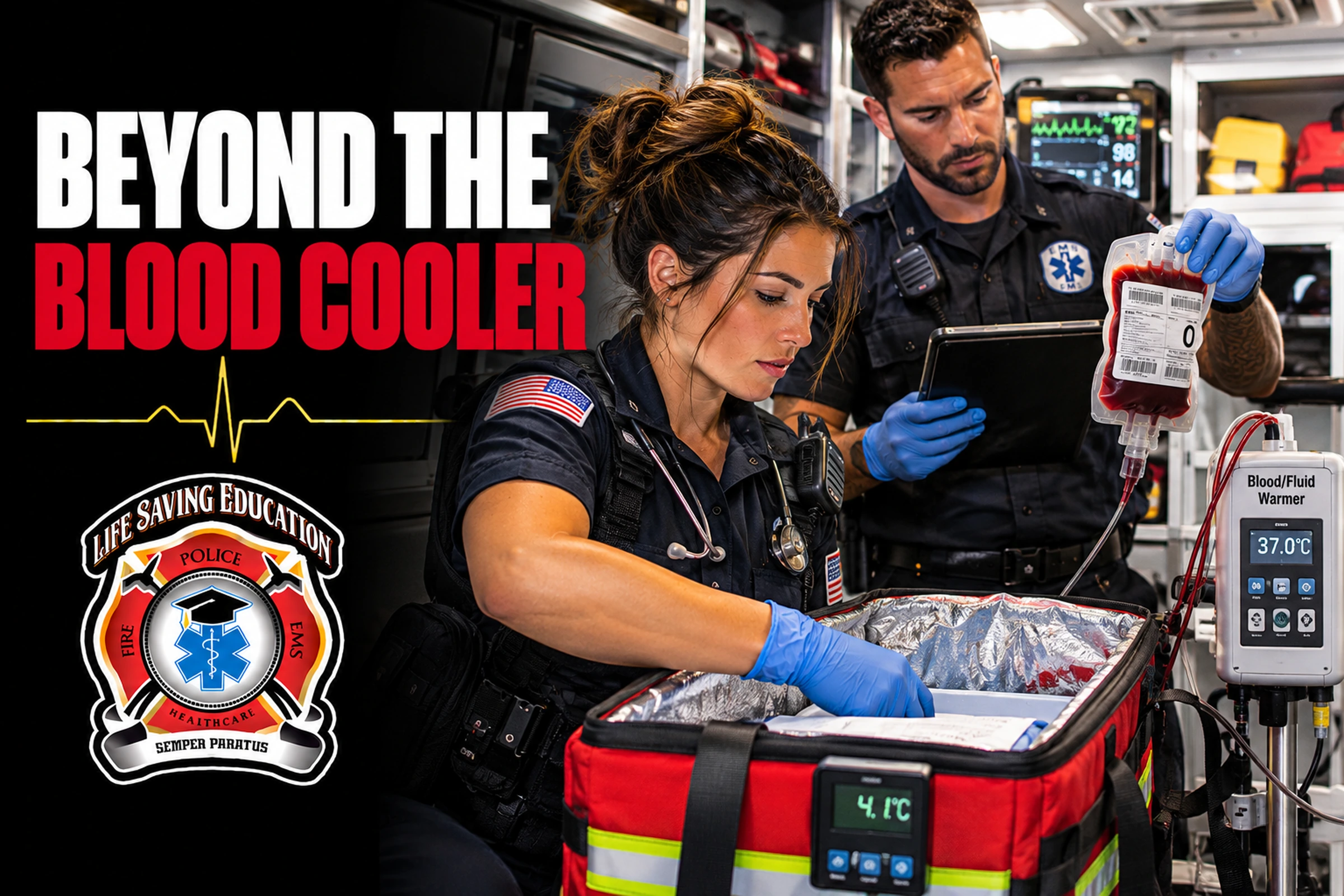
A blood cooler on an ambulance is easy to photograph. The system behind it is much harder to see.
That system is what determines whether a prehospital blood program is safe, sustainable, and useful when a critically bleeding patient is minutes from irreversible shock.
Across the United States, EMS agencies are expanding access to prehospital blood and blood components. The federal Office of EMS has emphasized that implementation requires far more than purchasing equipment. Programs need stakeholder coordination, blood-sharing relationships, equipment, education and training, data and continuous quality improvement, and documented clinical guidelines.
The question is no longer simply whether an ambulance can carry blood. The better question is whether the EMS system can reliably manage blood from the supplier to the patient, recognize the right patient, administer the product correctly, identify complications, preserve traceability, hand the patient off cleanly, and learn from every activation and every missed opportunity.
Why a Prehospital Blood Program Has Become a Major EMS Issue
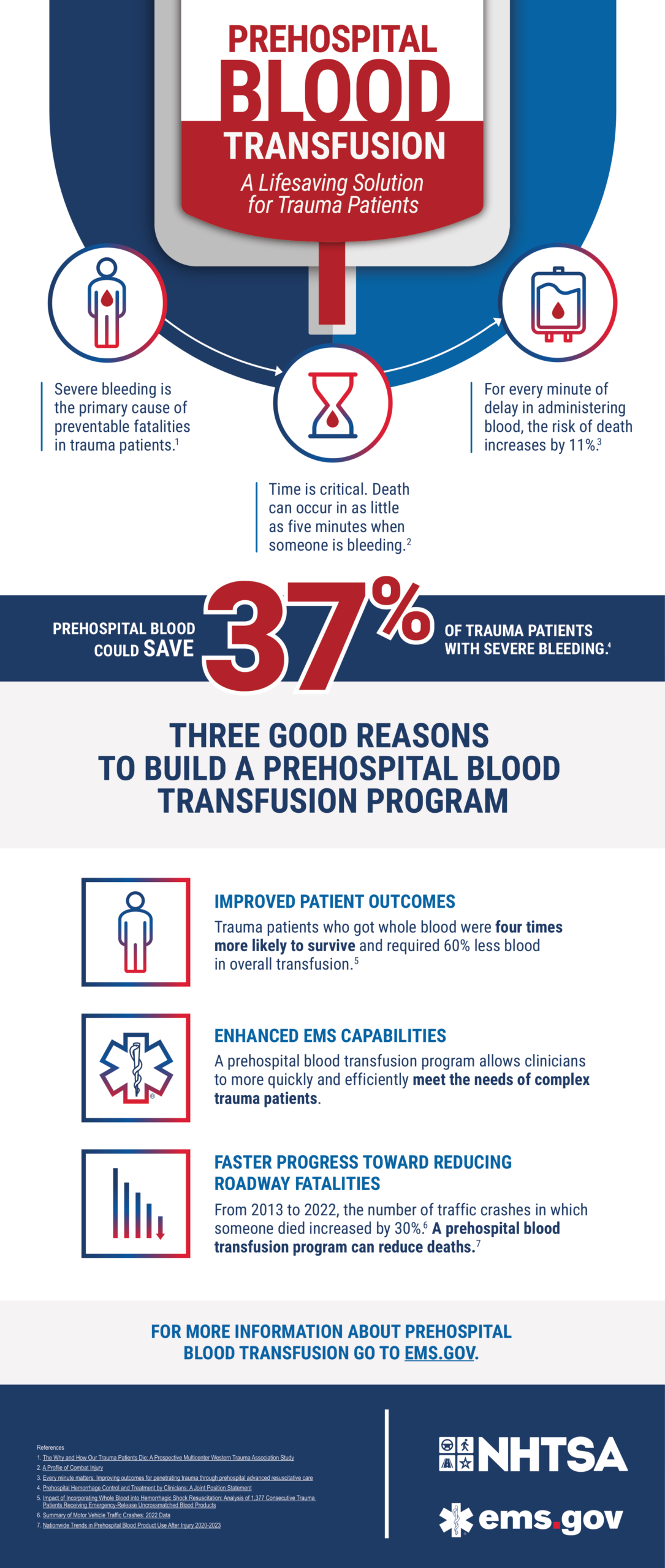
Hemorrhage remains one of the most time-sensitive problems in trauma care. When a patient is actively losing blood, replacing circulating volume with crystalloid alone does not restore oxygen-carrying capacity or the other functions of blood. Blood-product resuscitation has therefore progressively moved closer to the point of injury through military medicine, air-medical systems, trauma centers, and increasingly ground EMS.
Enthusiasm still has to be matched with precision. Recent randomized evidence has not established that whole blood is universally superior to component therapy. That does not make prehospital transfusion unimportant. It means educators should teach the evidence as it exists and avoid turning a complex clinical question into a slogan.
The First Decision Is Not Which Cooler to Buy
An agency may naturally begin by asking which cooler or warmer to purchase and how many units to carry. Those questions matter, but governance comes first.
A program should bring together EMS leadership, medical direction, trauma and emergency physicians, blood-bank or blood-center representatives, quality personnel, educators, and the appropriate regulatory stakeholders. Before blood is placed on an ambulance, the system should define who is eligible, who may administer it, which product will be carried, how temperature will be monitored, how unused units will rotate, how recalls and quarantine will be handled, how reactions will be managed, and what information must accompany the patient.
Patient Selection Has to Work Under Pressure
A useful protocol must allow a trained clinician to recognize the intended patient during a difficult call. Life-threatening hemorrhage may be obvious, but it may also be internal or initially compensated. Education should teach clinicians to integrate mechanism, visible blood loss, mental status, pulse quality, heart rate, blood pressure, shock index when used locally, suspected internal bleeding, response to hemorrhage control, transport time, and the overall clinical picture.
Scenario-based training is especially valuable for patients near the edge of the protocol. Examples include an older patient taking a beta blocker, a prolonged extrication with initially compensated shock, or a patient whose pressure temporarily improves before deteriorating during transport. The goal is not to work outside protocol. It is to make the protocol usable when the patient does not look like a textbook example.
The Product Has a Chain of Custody
Blood is not ordinary EMS inventory. Programs need a documented pathway from the supplier through storage and transport to administration or return. Temperature control, product identity, integrity, expiration, seals, tubing, warmer readiness, and documentation all require defined checks.
The uneventful shift matters too. Agencies need clear rules for when unused blood rotates back, what constitutes an unacceptable temperature excursion, who makes that determination, and how wastage is documented. Blood is a limited resource, and avoidable wastage can threaten program sustainability.
Warming Is More Than Plugging In a Device
Blood-warming equipment should be treated as clinical equipment, not an accessory. Crews need hands-on familiarity with the actual device they will use, including setup, compatible administration sets, power requirements, flow limitations, alarms, and troubleshooting.
Training should deliberately create problems. Give the crew a low-battery condition, an occlusion, a vascular-access change, or a warmer alarm during a deteriorating trauma scenario. Competence in a quiet classroom is not the same as competence in a moving ambulance with a hypotensive patient.
The Transfusion Is a Procedure
Prehospital transfusion training should have a defined procedural sequence. Local details vary, but clinicians commonly need to address patient eligibility, product verification, vascular access, administration-set preparation, warming when indicated, baseline assessment, initiation, reassessment, reaction recognition, documentation, and receiving-facility communication.
Closed-loop verification deserves deliberate practice. In a high-stress environment, verification should be a standardized behavior rather than an informal glance at a label.

Train for the Complication, Not Just the Successful Transfusion
Most training naturally focuses on starting blood. A mature program also prepares clinicians for what happens when something goes wrong. Crews should know the local procedure for suspected transfusion reactions, equipment failure, loss of access, temperature concerns, damaged packaging, and uncertainty about product identity or traceability.
Simulation is the safest place to build those decision-making habits. The training environment can force clinicians to stop, reassess, communicate, and follow the agency’s reaction or troubleshooting procedure without placing a patient at risk.
Credentialing Should Require More Than Watching a Presentation
Prehospital transfusion is a high-risk, relatively low-frequency skill in many systems. A reasonable training pathway can combine didactic education, hands-on equipment orientation, deliberate practice, scenario assessment, knowledge testing, direct skills verification, and recurrent competency review.
Recurrent simulation matters because individual clinicians may go months without administering blood. Skill decay is predictable. Training frequency should reflect the operational risk and the agency’s experience.
🔗 Related: Every Minute Matters. But Not Every Minute Is Equal: Prehospital Time and Trauma Outcomes
Agencies building scenario-based training around new clinical capabilities can explore LSE’s Fire and EMS training programs.
Build the Handoff Before the First Patient
A receiving trauma team needs more than the statement, “We gave blood.” The handoff should communicate the product, amount, start and completion times, whether it remains infusing, patient response, suspected reaction, hemorrhage-control interventions, and the identifiers required for traceability.
EMS, the receiving hospital, and the blood supplier should design that exchange before the first real patient. Otherwise the first patient becomes the test of whether the clinical handoff, electronic chart, and blood-bank record can connect.
Continuous Quality Improvement Is Where the Program Gets Better
A prehospital blood program should create a reviewable event every time blood is administered, but administrations are not the only events worth studying. Agencies should consider reviewing patients who met criteria but did not receive blood, canceled activations, product wastage, temperature excursions, equipment failures, protocol deviations, delays, documentation problems, and suspected reactions.
The purpose of CQI should be system improvement. If crews repeatedly lose time because the blood resource is stored away from the responding unit, that may be a deployment problem. If eligible patients are missed because activation criteria are unclear, the answer may be training or protocol revision. If wastage rises, the rotation process may need redesign.
What LSE Would Put Into a Prehospital Blood Training Program
Life Saving Education would build the curriculum around operational performance rather than lecture alone. A complete program can include hemorrhagic-shock recognition, blood-product fundamentals, cooler and temperature-control procedures, warmer setup, product verification, administration, complication recognition, realistic simulation, hospital handoff, documentation, and CQI review.
Every component must still be tailored to local medical direction, scope of practice, blood-bank requirements, product instructions, and jurisdictional regulation.
The Bottom Line
Putting blood on an ambulance is not the finish line. It is the beginning of a clinical, logistical, educational, and quality-management system.
The strongest programs build the infrastructure behind the cooler before the first patient needs it. They define patient selection, protect the product, train clinicians on the actual equipment, rehearse complications, create a reliable handoff, and review both successful transfusions and missed opportunities.
That is what turns prehospital blood from a piece of equipment into a dependable patient-care capability.
🔗 Related: The First Minutes of a Toxic-Gas Release
✅ Key Takeaways
- A prehospital blood program is a clinical and logistics system, not simply a piece of equipment.
- Patient selection, storage, temperature control, traceability, administration, and handoff need written processes.
- Clinicians should train with the actual cooler, warmer, tubing, documentation, and verification workflow they will use.
- Programs should rehearse complications and equipment failures, not only successful transfusions.
- Continuous quality improvement should review administrations, missed activations, wastage, temperature excursions, delays, and documentation problems.
- Recent randomized trials did not show whole blood to be superior to component therapy on their primary outcomes, so education should present the evidence accurately.
❓ Frequently Asked Questions
What does an EMS prehospital blood program need?
A complete program needs clinical guidelines, stakeholder coordination, a blood-sharing and resupply process, temperature-controlled storage, administration equipment, clinician education, documentation, hospital handoff, and continuous quality improvement.
Is whole blood always better than blood components in trauma?
No. Large 2026 randomized trials did not show whole blood to be superior to component therapy on their primary outcomes. Agencies should follow current evidence, medical direction, local protocols, and product availability.
Why does prehospital blood need temperature monitoring?
Blood products have defined storage and handling requirements. Programs need reliable temperature control and documented processes for transport, return, quarantine, and disposition of products outside acceptable conditions.
How should paramedics train for prehospital transfusion?
Training should combine clinical education with hands-on equipment practice, verification, realistic scenarios, complication management, documentation, handoff, and recurrent competency review.
Training You Can Count On. When Seconds Count.
Build Practical EMS Training Around Real Decisions
LSE develops practical education for EMS teams that connects clinical evidence, equipment, simulation, and operational performance.
📚 Authoritative Sources
Clinical disclaimer: Follow current AHA course materials, local EMS protocols, medical direction, scope of practice, blood-bank requirements, product instructions, and agency-specific policy.