Prepared by the LSE Editorial Team. Reviewed by Joseph Andrade, Jr., RN, NRP.
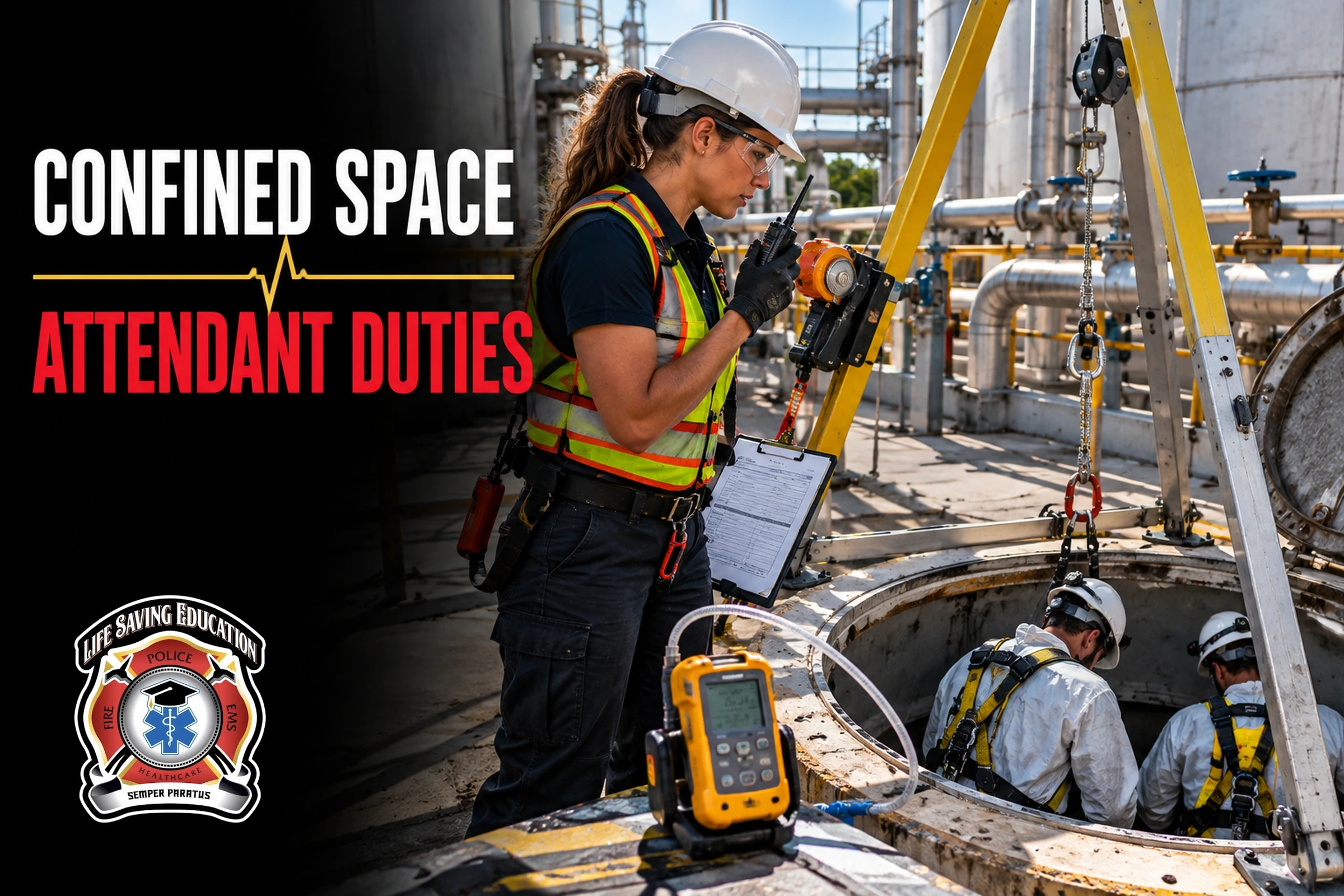
In a permit-required confined space, the attendant is the worker outside the space whose attention stays on the people inside and the conditions around the entry. OSHA does not treat this as a passive spotter role. Under 29 CFR 1910.146(i), the attendant must know the hazards, maintain an accurate entrant count, communicate with entrants, monitor conditions, order evacuation when required, summon rescue, control unauthorized access, perform assigned non-entry rescue, and avoid duties that interfere with protecting entrants.
✅ Key takeaways
- The attendant normally remains outside the permit space until relieved.
- The attendant must continuously maintain an accurate count of authorized entrants.
- The attendant can and must order evacuation when specified danger conditions occur.
- The attendant summons rescue rather than improvising an unprotected entry rescue.
- Other assigned work cannot interfere with monitoring and protecting entrants.
What is a confined space attendant?
An attendant is stationed outside one or more permit spaces to monitor authorized entrants and perform the duties assigned by the employer’s permit-space program. The role is defined by the federal general-industry permit-required confined-space standard. For the broader program requirements, see our confined space safety guide.

The 10 attendant duties in OSHA 1910.146(i)
- Know the hazards. Understand the hazards entrants may face, including how exposure occurs, warning signs or symptoms, and potential consequences.
- Recognize behavioral effects. Be alert for changes in an entrant that may indicate hazardous exposure.
- Maintain an accurate entrant count. Continuously know who is in the space and ensure the identification method on the permit remains accurate.
- Remain outside. Stay outside during entry operations until relieved by another attendant.
- Communicate with entrants. Maintain communication as necessary to monitor status and tell entrants when evacuation is required.
- Monitor inside and outside conditions. Order immediate evacuation when a prohibited condition is detected, an entrant shows behavioral effects of exposure, an outside condition could endanger entrants, or the attendant cannot safely perform all required duties.
- Summon rescue. Contact rescue and other emergency services as soon as entrants may need assistance escaping.
- Control unauthorized access. Warn unauthorized people away, tell them to exit if they enter, and inform entrants and the entry supervisor.
- Perform assigned non-entry rescue. Follow the employer’s rescue procedure when non-entry retrieval is appropriate.
- Avoid interfering duties. Do not perform other work that conflicts with monitoring and protecting entrants.
The attendant should not become the next victim
The requirement to remain outside is central to the role. When an entrant collapses, an impulsive entry by an unprotected coworker can turn one victim into several. The planned response is to summon the designated rescue service and use non-entry retrieval when the employer’s procedure and equipment make that method appropriate.

What “no interfering duties” means
The attendant’s attention cannot be treated as spare labor. Running equipment, leaving to retrieve materials, or becoming absorbed in unrelated tasks can compromise entrant monitoring. OSHA can permit one attendant to monitor more than one permit space, but the employer’s program must address how that attendant will perform all required duties and respond if more than one space needs attention.
Non-entry rescue and retrieval systems
Where retrieval is required and appropriate, a typical system includes a full-body harness or other permitted chest-body arrangement, retrieval line, and an external mechanical device for qualifying vertical spaces. Retrieval is not automatically appropriate in every configuration. The employer must determine when retrieval equipment would contribute to rescue and when it could increase the entrant’s overall risk.
Training requirements for attendants
Under 1910.146(g), training must be provided before an employee is first assigned permit-space duties, before assigned duties change, when operations introduce a hazard the employee has not previously been trained about, and when the employer has reason to believe there are deviations from procedures or inadequacies in an employee’s knowledge or use of those procedures. Training must establish proficiency. Read our confined space training requirements guide for the complete framework.
Attendant pre-entry checklist
- Do I understand the hazards and acceptable entry conditions on this permit?
- Can I identify every authorized entrant currently inside?
- Is our communication method working?
- Do I know exactly how to summon the designated rescue service?
- Is required retrieval equipment ready and configured correctly?
- Can I perform my attendant duties without distraction?
- Do I know the conditions that require immediate evacuation?
Frequently asked questions
Can a confined space attendant enter the space to rescue a coworker?
Not simply because an emergency occurs. The attendant’s assigned role is outside the space. Entry rescue requires the employer’s rescue plan, appropriate training, equipment, and protection. An attendant may perform non-entry rescue when the employer’s procedure calls for it.
Can the attendant have another job during the entry?
Only if that work does not interfere with the attendant’s required duties. If another task prevents continuous monitoring or an effective emergency response, it is incompatible with the attendant role.
Can one attendant watch multiple permit spaces?
Potentially, but only when the employer’s permit-space program provides the means and procedures for the attendant to fulfill all required duties for those spaces, including emergency response priorities.
Does OSHA require annual attendant retraining?
Federal 1910.146 does not impose a blanket annual refresher for attendants. Retraining is triggered by changes in duties or hazards and by observed deviations or knowledge deficiencies. Employers, clients, insurers, or state requirements may impose additional intervals.
Build the role into the entry plan
An effective attendant is not just someone assigned to stand at the opening. The role depends on hazard knowledge, reliable communication, clear evacuation authority, a workable rescue plan, and practiced use of the equipment at that specific worksite. LSE provides confined space training for entrants, attendants, and supervisors and onsite group training.
Educational note: This article summarizes federal OSHA requirements for general-industry permit-required confined spaces. Construction work is covered by 29 CFR 1926 Subpart AA, and OSHA-approved State Plans may have additional requirements. Follow the employer’s written permit-space program.
Primary authority: OSHA 29 CFR 1910.146.