Prepared by the LSE Editorial Team. Reviewed by Joseph Andrade, Jr., RN, NRP.
Joseph works across emergency response, healthcare, and workplace safety and develops practical training for civilians, employers, and first responders.
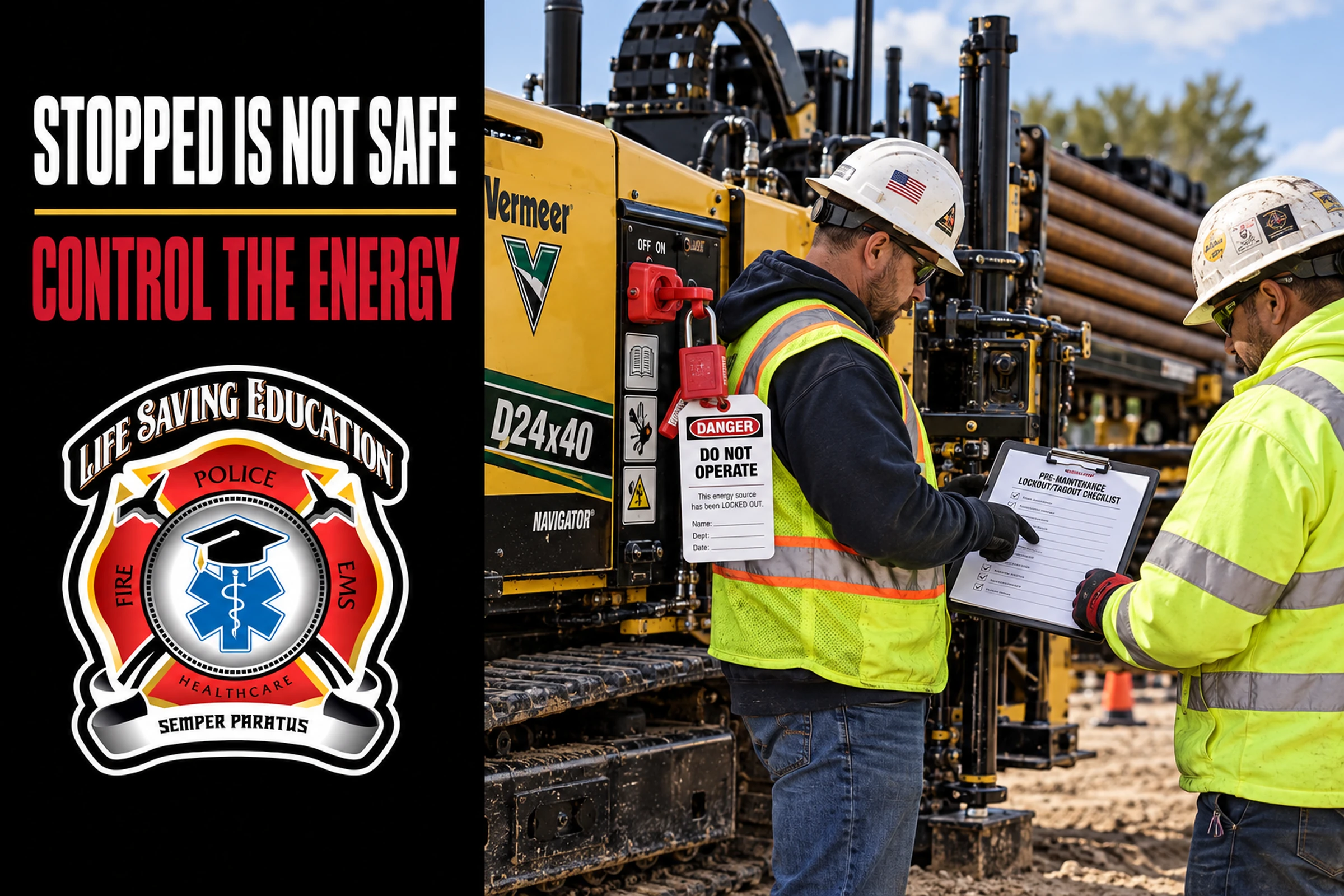
On September 23, 2026, OSHA announced citations following a fatal March incident at a pipeline installation project in New Smyrna Beach, Florida. According to OSHA’s enforcement announcement, a worker was fatally struck during work involving horizontal directional drilling equipment. OSHA alleged that the employer exposed workers to hazardous energy and proposed a willful citation.
Important: OSHA citations are allegations unless and until the enforcement process is complete. The legal outcome may change, but the safety lesson is immediate.
🛑 “Off” Is a Control Position, Not Proof of Isolation
A machine that has stopped moving is not necessarily safe.
Rotation, springs, flywheels, elevated parts, gravity, or restrained components.
Residual pressure can move components even after normal controls are neutral.
Control circuits and disconnects must be identified and isolated correctly.
Pressure, suspended loads, heat, and motion can remain after shutdown.
The correct question is not, “Is it stopped?” The question is, “Can it move, energize, release, rotate, fall, pressurize, or otherwise injure someone while the task is being performed?”
🧍 The Danger Zone Changes During Servicing
Normal operation often keeps workers outside the point of operation. Servicing changes that relationship. Hands move closer to rotating components. Guards may be removed. Workers may position their bodies between equipment parts or enter areas normally protected by distance.

🔒 Lockout/Tagout Is a System
A padlock by itself is not a program. A complete energy-control process requires the employer to understand the equipment, the energy sources, and the servicing task.
- Identify all hazardous energy sources.
- Notify affected employees.
- Shut the equipment down using normal controls.
- Isolate the energy sources.
- Apply lockout or tagout devices as required.
- Release, block, restrain, or otherwise control stored energy.
- Verify isolation before work begins.
- Perform the servicing work.
- Inspect the area before restoration.
- Remove devices under the employer’s established procedure.
- Restore energy in a controlled manner.
✅ Verification Is the Step That Catches Assumptions
One of the strongest training questions is simply: How do you know?
- How do you know the shaft cannot rotate?
- How do you know hydraulic pressure is gone?
- How do you know the disconnect isolated the correct circuit?
- How do you know stored energy has been released or restrained?
- How do you know another control source cannot restart the equipment?
Verification forces the crew to prove the condition rather than assume it.
🧰 What a Pre-Task Discussion Should Cover
What exactly are we doing?
Where will hands and bodies be placed?
What can rotate, move, drop, pressurize, heat, or energize?
What devices control those energy sources?
What must be blocked, bled, restrained, or dissipated?
What proves the equipment is in a safe state?

🛠️ Horizontal Directional Drilling Adds Complexity
Horizontal directional drilling can involve powerful rotational and thrust forces, drill rods, tooling, hydraulic systems, and work performed close to moving equipment. Workers may be exposed at the machine, along the drill string, during connection and disconnection, while changing tooling, or during troubleshooting.
That makes communication and equipment-specific procedures especially important.
🎓 Use Incidents as Scenarios, Not Entertainment
Fatality cases should not be taught for shock value. A useful case study asks learners to identify where the system could have interrupted the event.
The goal is not to memorize one drilling machine. The goal is to build the habit of recognizing energy.
✅ Key Takeaways
- A stopped machine is not automatically an isolated machine.
- Hazardous energy includes more than electricity and may remain after normal shutdown.
- Servicing changes the danger zone by placing workers closer to moving components.
- Energy-control procedures must address stored energy and verification, not just lock placement.
- Incident case studies are most useful when learners identify where the system could have prevented the event.
❓ Frequently Asked Questions
Is putting a machine in neutral enough?
No. A control position does not by itself establish that hazardous energy has been isolated or stored energy has been controlled.
Why is verification important?
Verification is what confirms that the intended isolation actually occurred and helps catch wrong disconnects, residual pressure, unexpected motion, or incomplete control of stored energy.
Does PPE solve the problem?
PPE may be part of the overall safety system, but it cannot substitute for controlling powerful hazardous energy before a worker enters a danger zone.
Are OSHA citations final when first announced?
No. Citations are allegations and may be contested. Training should distinguish the enforcement allegation from the broader safety lesson.
Train Workers to Control Energy, Not Just Recognize It
Life Saving Education provides construction and industrial safety training built around realistic tasks, hazard recognition, and practical controls.
Explore Construction & Industrial Training
Plan Group Training
📚 Sources and Further Reading
This article discusses a public OSHA enforcement announcement for training purposes. Alleged violations remain allegations unless and until resolved through the enforcement process.