Prepared by the LSE Editorial Team. Reviewed by Joseph Andrade, Jr., RN, NRP.
Joseph works across emergency response, healthcare, and workplace safety and develops practical training for civilians, employers, and first responders.
The vehicle fire was no longer the obvious problem. That’s what makes this incident worth studying.
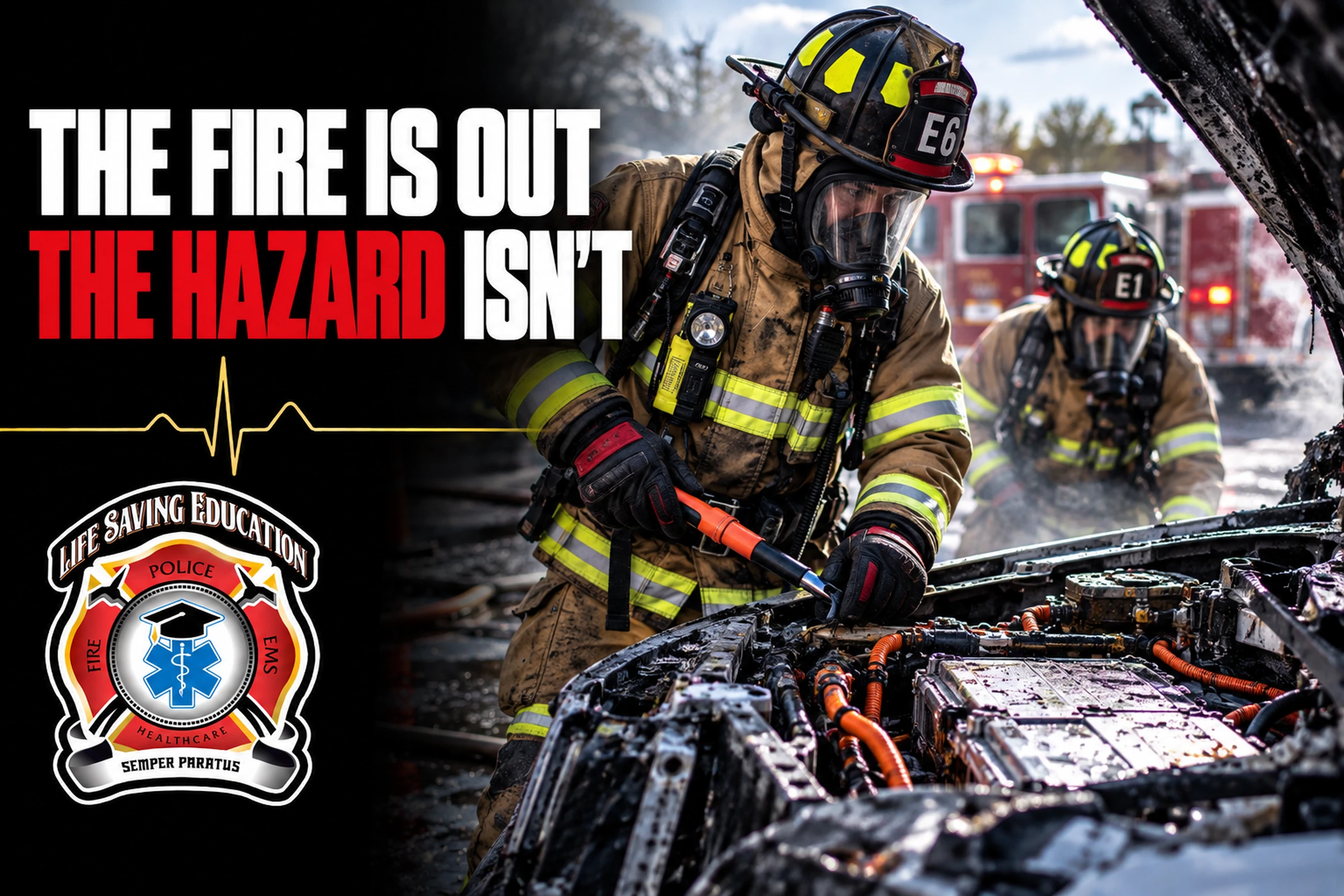
A 2026 NIOSH firefighter investigation describes an electric-vehicle collision in which crews performed rescue and battery-related operations. Later, while the damaged vehicle was being moved, the remaining lithium-ion battery entered thermal runaway and released a large smoke plume.
Some firefighters had already removed respiratory protection. Several were exposed. Five sought medical care. Four remained off duty nearly 11 months later because of persistent symptoms, particularly exertional shortness of breath.
NIOSH could not identify the exact plume composition because environmental sampling was not performed at the time of the exposure. The report therefore should not be used to claim that one specific chemical caused each firefighter’s illness.
Its operational lesson is still unmistakable: The visible fire ending does not necessarily end the respiratory hazard.

📋 What Happened at This EV Battery Fire
The incident changed phases
Firefighters are trained to think in operational phases: arrival, rescue, fire attack, overhaul, transfer, and termination.
Electric-vehicle battery incidents complicate those boundaries. A damaged battery can remain unstable after flame knockdown. Movement can disturb damaged cells. Handling can expose additional components. A tow operation can change battery orientation. Thermal runaway or off-gassing can begin or recur.
The handoff to recovery is not automatically the end of the hazardous-material phase.
NIOSH’s first recommendation is direct
NIOSH recommends that firefighters operating within established hazard-control zones at damaged-vehicle incidents use SCBA in potentially hazardous, unknown, or immediately dangerous to life or health atmospheres.
For confirmed EV and lithium-ion battery incidents, NIOSH recommends maintaining respiratory protection within hazard-control zones throughout suppression, handling, and removal when thermal runaway or battery off-gassing remains possible.
Most departments are good at enforcing SCBA during active fire attack. The weak point tends to come later.
⚠️ EV Battery Fire SCBA Discipline After Knockdown
Doffing is a tactical decision
Removing SCBA should not happen simply because visible flame is gone, the hood is cool, the vehicle is on a tow truck, the incident feels like overhaul, the crew is tired, or someone says the battery looks stable.
Doffing should follow hazard assessment. For EV/LIB incidents, that assessment can include battery damage, evidence of thermal runaway, temperature, smoke or vapor, off-gassing indicators, wind, vehicle position, planned movement, manufacturer information, monitoring capability, and incident-specific risk assessment.
Movement can be an event
Tow and recovery operations deserve their own tactical briefing. Before a damaged EV is lifted, winched, rotated, or loaded, command should ask what could change.
Will movement stress the battery? Will personnel enter a downwind area? Will the hazard zone need to move? Are firefighters still needed during the operation? Is SCBA required? Does the recovery company understand the battery hazard? What happens if smoke begins during loading?
A tow truck is not just transportation. At a damaged EV incident, vehicle movement can become an operational evolution.
Hazard zones should be dynamic
NIOSH recommends establishing hazard-control zones using incident-specific risk assessment and factors such as environment and plume behavior.
Wind changes. Apparatus moves. The vehicle moves. Personnel rotate. The battery condition changes. Hot, warm, and cold zones may need to change with the incident.
The tow operator belongs in the plan
Recovery personnel may arrive after the most visible emergency activity has ended. Command should communicate known battery damage, areas to avoid, whether thermal runaway occurred, where personnel should stand, what movement is planned, what conditions would stop the operation, and what to do if smoke, heat, or other warning signs appear.
⚠️ Recognizing a Battery That Is Still Active
Thermal runaway indicators belong in firefighter education
Depending on the battery and incident, warning signs can include increasing temperature, unusual smoke or vapor, hissing or popping, jet-like flame, rapid cell-to-cell involvement, reignition, and unexpected heat after apparent knockdown.
The goal is not to make firefighters battery chemists. It is to help them recognize when a damaged energy-storage system remains active.
Monitoring is useful, but it has limits
Departments may use thermal imaging, atmospheric monitoring, manufacturer information, or specialized hazmat resources during battery incidents. No single tool should be taught as a guarantee that the battery is safe.
A thermal imager can identify heat patterns but does not identify every chemical hazard. A gas meter detects only the substances and ranges it is designed to detect. The absence of an alarm is not proof that no hazardous material exists.
Do not turn this into a chemistry lecture
Firefighters need enough battery science to understand the hazard. The operational chain is straightforward: damaged cells can fail, failure can propagate, heat and gas release can continue or recur, movement can change conditions, and smoke and off-gassing can contain hazardous substances. Therefore, respiratory protection and hazard control may need to continue after visible flame is gone.

📋 Exposure, Documentation, and Medical Follow-Up
Exposure symptoms require action
NIOSH recommends that firefighters know symptoms associated with potential EV/LIB exposure and seek medical care when symptoms occur.
Departments should have procedures for immediate reporting, exposure documentation, medical evaluation, follow-up, occupational-health referral, and tracking persistent symptoms.
Document brief exposures too
The report describes exposure durations ranging from seconds to several minutes. Duration alone does not tell the whole story. Concentration, composition, respiratory protection, individual factors, exertion, and environmental conditions matter.
The exposure record should capture what is known without pretending to know what was not measured.
Preliminary exposure reduction still matters
NIOSH recommends on-scene preliminary exposure reduction and isolation of contaminated PPE. Contaminated gear should not simply ride in the passenger compartment back to the station.
The fire is one hazard. Material deposited on PPE and equipment is another.
Medical follow-up should be built before the incident
A department should decide in advance who is notified, where exposed firefighters go for evaluation, what documentation follows them, what symptoms trigger immediate transport, who tracks follow-up, how exposure records are preserved, and how return-to-duty questions are handled.
🔗 Related: Charge Safely, Prevent the Fire: Lithium-Ion Battery Safety at Home and Work
✅ Build It Into the SOP and the Drill
What to put in the SOP
- Vehicle identification
- Rescue and stabilization
- Battery damage assessment
- Suppression strategy consistent with current guidance
- SCBA requirements
- Hazard zones
- Monitoring
- Thermal-runaway indicators
- Tow and recovery coordination
- Vehicle movement
- Post-suppression observation
- Preliminary exposure reduction
- Contaminated PPE handling
- Exposure reporting and medical evaluation
- Transfer of responsibility
Training evolution: the second plume
A useful drill starts after the fire is out. Crews have completed suppression. The vehicle is damaged. Command prepares for recovery. The tow operator starts repositioning the vehicle.
Then the instructor introduces a new cue: increasing battery temperature, smoke, or an audible sign of thermal runaway.
The drill evaluates whether crews recognize the change, reestablish or expand the hazard zone, maintain SCBA, reposition personnel upwind, control the tow operation, communicate with command, manage exposure, and continue the incident safely.
LSE builds scenario drills like this into its fire and EMS training programs for departments in the Washington, DC region and across the East Coast.
📋 LSE Bottom Line
The NIOSH report should change one sentence in firefighter thinking. Not: The fire is out. But: The fire is out. What hazards are still active?
For damaged EV and lithium-ion battery incidents, suppression, handling, movement, and removal can remain part of the exposure problem. SCBA discipline should follow the hazard, not the visual appearance of the vehicle.
Educational content only. Follow your department’s SOPs, current NIOSH and USFA guidance, manufacturer emergency-response information, and medical direction.
✅ Key Takeaways
- In a 2026 NIOSH investigation, a damaged EV battery went into thermal runaway while the vehicle was being moved, after some firefighters had removed respiratory protection.
- Five firefighters sought medical care. Four were still off duty nearly 11 months later.
- NIOSH recommends keeping respiratory protection on in hazard-control zones through suppression, handling, and removal when thermal runaway or off-gassing is still possible.
- Doffing SCBA should follow a hazard assessment, not the look of the vehicle.
- Treat tow and recovery as its own operation, with a briefing and a plan if smoke starts again.
- No single tool proves a damaged battery is safe.
❓ Frequently Asked Questions
Should firefighters keep SCBA on after an EV battery fire is knocked down?
NIOSH recommends that firefighters maintain respiratory protection within hazard-control zones throughout suppression, handling, and removal at confirmed EV and lithium-ion battery incidents when thermal runaway or battery off-gassing remains possible.
What are warning signs of lithium-ion battery thermal runaway?
Depending on the battery and incident, signs can include increasing temperature, unusual smoke or vapor, hissing or popping, jet-like flame, rapid cell-to-cell involvement, reignition, and unexpected heat after apparent knockdown.
Can a thermal imager or gas meter confirm an EV battery is safe?
No. A thermal imager shows heat patterns but does not identify every chemical hazard. A gas meter detects only the substances and ranges it is designed for. No alarm is not proof that no hazard exists.
What happened to the firefighters in the NIOSH report?
Several were exposed. Five sought medical care, and four remained off duty nearly 11 months later, mainly because of exertional shortness of breath. NIOSH could not identify the plume’s exact makeup because no sampling was done at the time.
Why does tow and recovery need its own briefing?
Lifting, winching, rotating, or loading a damaged EV can stress the battery and change the hazard. Command should confirm SCBA needs, hazard zones, where people stand, and what stops the operation if smoke or heat appears.
Training You Can Count On. When Seconds Count.
Train for the Hazard That Outlasts the Fire
LSE builds firefighter and EMS scenario training around real investigations, delivered onsite in the Washington, DC region and across the East Coast.