By Joseph Andrade, Firefighter, Paramedic, Emergency Department and Vascular Access RN, OSHA Outreach Instructor, and Safety Officer. Founder and lead instructor at Life Saving Education.
Joseph is an active firefighter, paramedic, and registered nurse working in emergency and vascular access care, as well as an OSHA Outreach instructor and safety officer. He has spent his career on the response side of emergencies, from the fireground to the ambulance to the hospital bedside, and now trains civilians, workplaces, and first responders in the skills that save lives.
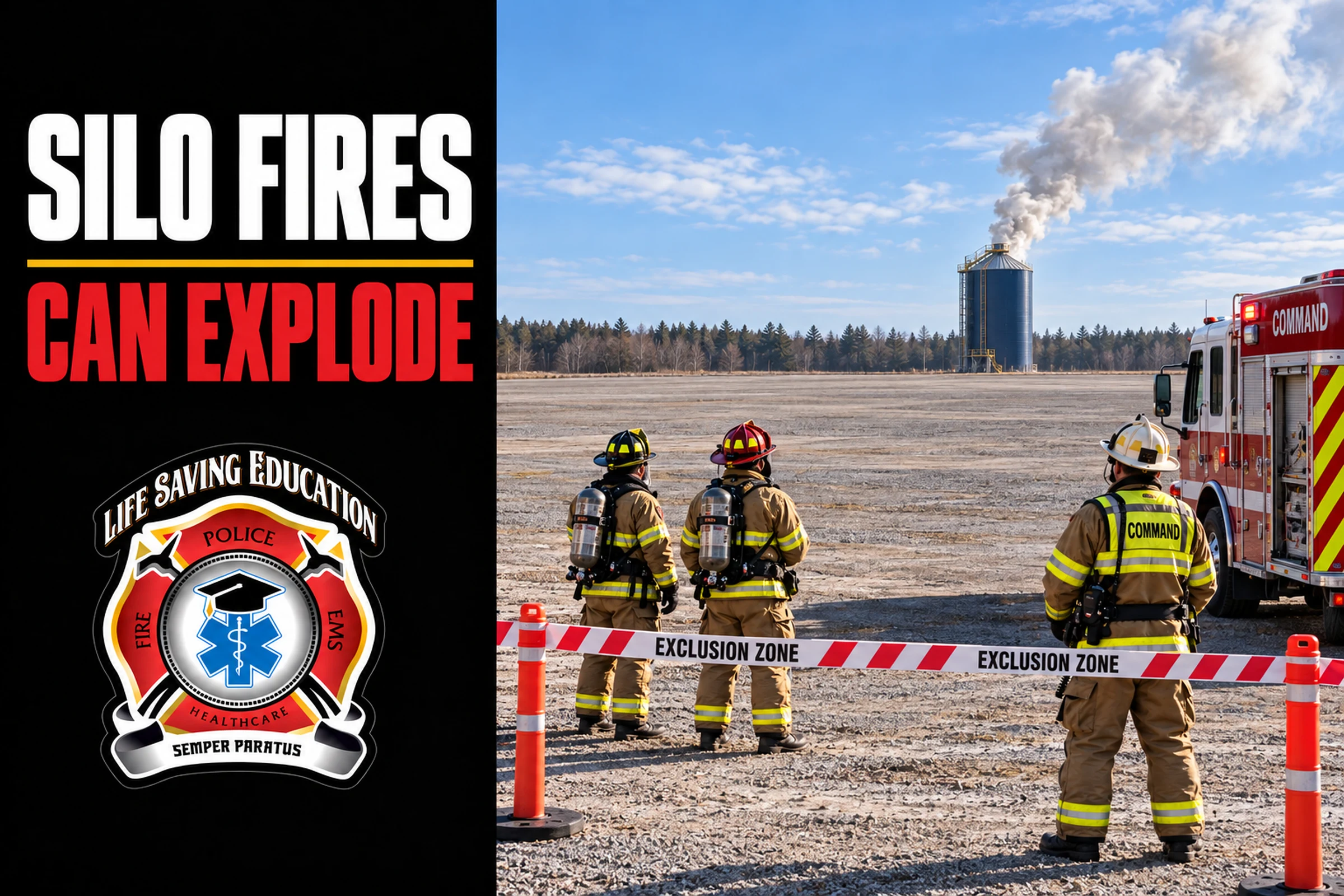
Two firefighters died and thirteen firefighters and EMS providers were injured after an oxygen-limiting silo exploded at a Maine lumber mill. The report carries a lesson every fire officer should know before the next silo alarm.
✅ Key Takeaways
- The May 15, 2026 Maine incident killed two volunteer firefighters and injured 11 firefighters and two EMS providers.
- Responders and facility personnel did not recognize that the involved silo was oxygen-limiting or that the wood shavings and sawdust inside presented a combustible-dust hazard.
- Firefighters directed water into the base of the silo before the explosion.
- NIOSH advises firefighters not to direct water or foam into an oxygen-limiting silo.
- The broader lessons include training, suppression strategy, unified command, accountability, preincident planning, facility emergency planning, combustible-dust mitigation, and hazard identification.
- The lesson is not “never use water at a silo.” The first job is identifying what type of silo is involved and what is inside it.
🔥 The Fire Looked Like It Was Getting Better
At approximately 10 a.m. on May 15, 2026, a fire alarm activated at a Maine lumber mill. Employees found smoke around a silo used to store wood shavings and sawdust, and responding fire departments deployed hoselines and directed water toward the fire.
For a time, conditions appeared to improve.
NIOSH’s investigation says firefighters believed the fire was largely knocked down. The atmosphere around the scene became more relaxed as crews moved toward what they believed would be overhaul.
Then, at approximately 11 a.m., witnesses heard a “whoosh.”
Smoke rapidly began venting from equipment at the silo’s top.
The roughly 60-foot silo launched into the air.
Fire erupted beneath it.
The explosion threw firefighters, EMS providers, facility personnel, and debris outward.
One firefighter died at the scene. A second died four weeks later from burn injuries. Eleven other volunteer firefighters and two EMS providers were injured. Facility employees were also injured.
NIOSH treated the event as a repeatable fire-service problem rather than an unpredictable anomaly. The tactic was familiar, but the silo’s design changed the risk.
▸ The first mistake was not the nozzle
Focusing only on the nozzle misses the earlier failure. Crews had not identified the silo as oxygen-limiting before water was introduced.
Responders and facility personnel did not recognize that the silo was an oxygen-limiting silo and did not recognize the contents as a combustible-dust hazard.
That meant strategy was built on an incorrect mental model of the structure.
The facility had another silo where fires had occurred previously. Those previous events involved a conventional silo, and firefighters had successfully used water-based suppression tactics there.
Prior success with a different silo likely made the familiar tactic feel reasonable. The problem was that the two silos did not behave the same way.
🔥 What is an oxygen-limiting silo?
An oxygen-limiting silo is designed to reduce the movement of outside air into the stored product.
That design changes fire behavior.
A fire can continue in a reduced-oxygen environment without displaying the aggressive flame conditions firefighters expect from an ordinary compartment fire.
The absence of dramatic flame does not mean the hazard is stable.
Opening the system or introducing air can alter the atmosphere.
NIOSH’s safety advisory emphasizes that responders may have time during these incidents because oxygen-limiting silo fires can be relatively slow-burning. The agency advises departments to identify the silo type, analyze the situation, obtain expert information, and avoid introducing water or foam into an oxygen-limiting silo.
This is very different from the instinctive fire-service response:
Get water on the fire.
🌊 Why water can make the situation worse
Water itself is not combustible.
The danger is what can happen while introducing water into an oxygen-limiting silo.
NIOSH obtained manufacturer emergency procedures for the silo involved in the Maine incident. Those procedures warned against introducing water or foam because the action could force air into the silo and contribute to an explosive mixture.
NIOSH concluded that applying water likely entrained oxygen, disturbed stored material, suspended combustible dust, and helped create an explosive concentration.
That sequence matters.
A combustible-dust explosion needs several conditions:
- combustible material,
- sufficiently small particles,
- dispersion in air,
- an oxidizing atmosphere,
- confinement,
- and an ignition source.
Inside a burning silo, ignition is already available.
If firefighting operations introduce oxygen and disturb fine combustible material, responders may unintentionally supply the missing pieces.
▸ Sawdust is fuel
The lumber mill produced wood shavings and sawdust.
Those materials were conveyed into the silo and later moved through augers and piping for packaging.
NIOSH found that facility personnel did not understand the material as a combustible-dust explosion hazard, so responders were not warned about it.
That knowledge gap matters well beyond lumber mills.
Combustible dust can arise from many materials, including:
- wood,
- grain,
- food products,
- plastics,
- coal,
- chemicals,
- and certain metals.
Fine combustible material can release tremendous energy once it is dispersed in air. Firefighters therefore have to treat suspended combustible dust differently from ordinary Class A material lying on a floor.
⚠️ The structure is part of the hazard
Fireground size-up begins with a question:
What do I have?
At a silo fire, that question cannot stop with:
A fire in a tall storage structure.
The incident commander needs to determine:
- What type of silo is this?
- What product is stored inside?
- How full is it?
- Is it oxygen-limiting?
- What access points exist?
- What conveying equipment is connected?
- Are augers operating?
- What electrical and mechanical energy remains?
- What does the manufacturer recommend?
- Does the structure have explosion venting?
- What happens if an opening is created?
- Where will pressure and debris travel if the vessel fails?
- Where are firefighters, apparatus, and EMS positioned relative to that hazard?
The Maine silo was approximately 20 feet in diameter and 60 feet high. It had been purchased used decades earlier. Firefighters and facility workers did not appreciate its oxygen-limiting characteristics.
A structure can stand on the same property for years and still remain operationally unfamiliar.
▸ Familiarity is not the same as preplanning
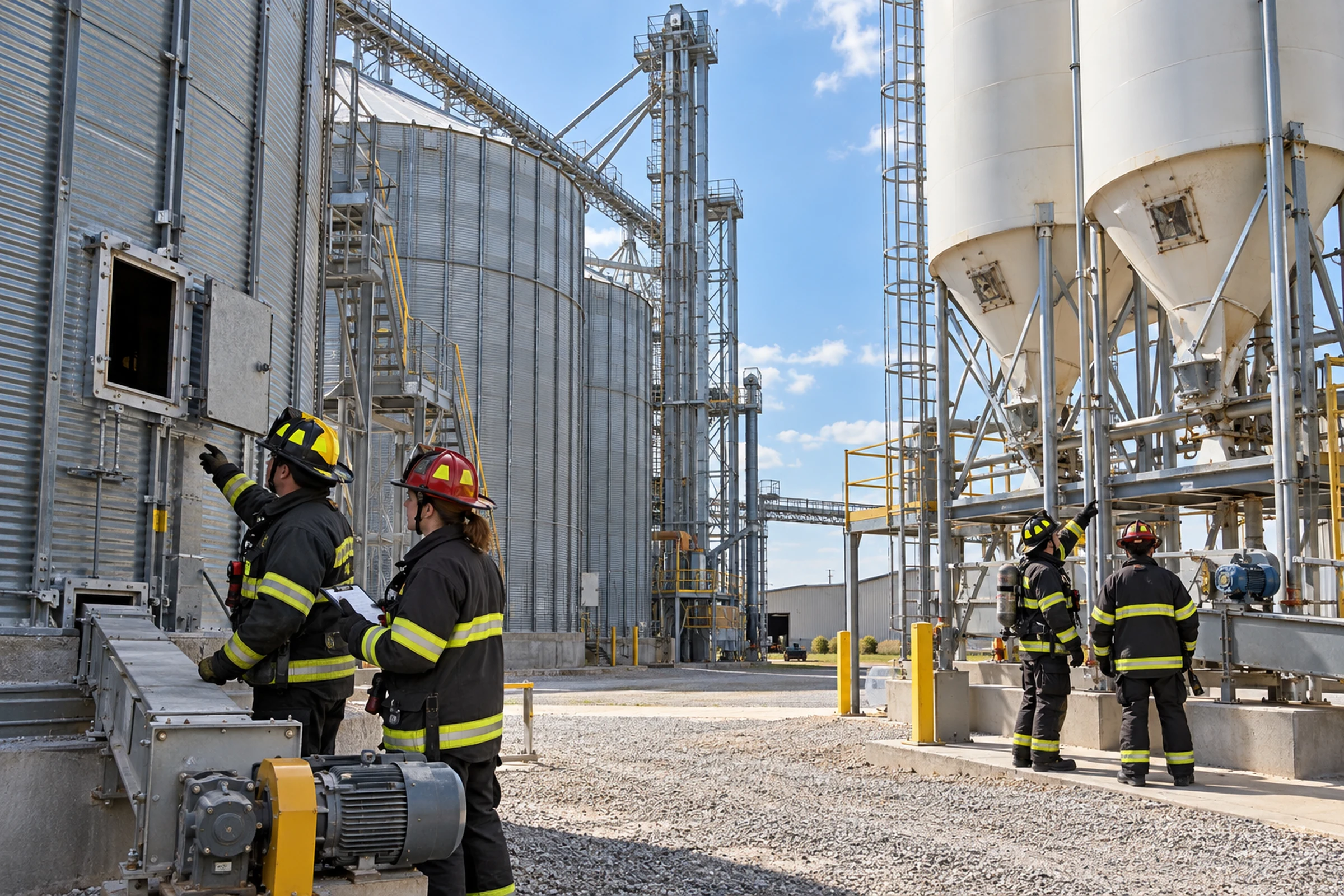
The lumber mill hosted familiarization walk-throughs for area departments.
Firefighters knew the facility.
They knew access and hydrant locations.
They had responded there before.
Yet the specific hazard that ultimately drove the catastrophe had not been identified to responders.
That illustrates the difference between a walk-through and a hazard-based preincident plan.
A useful industrial preplan needs more than:
- gates,
- hydrants,
- sprinkler connections,
- building numbers,
- and access roads.
High-hazard occupancies may require responders to understand:
- process hazards,
- combustible dust,
- hazardous energy,
- pressure vessels,
- confined spaces,
- specialized suppression systems,
- incompatible extinguishing agents,
- explosion zones,
- and manufacturer emergency procedures.
NIOSH specifically recommends preincident planning for high-hazard occupancies such as lumber mills.
▸ Put the facility expert into the command process
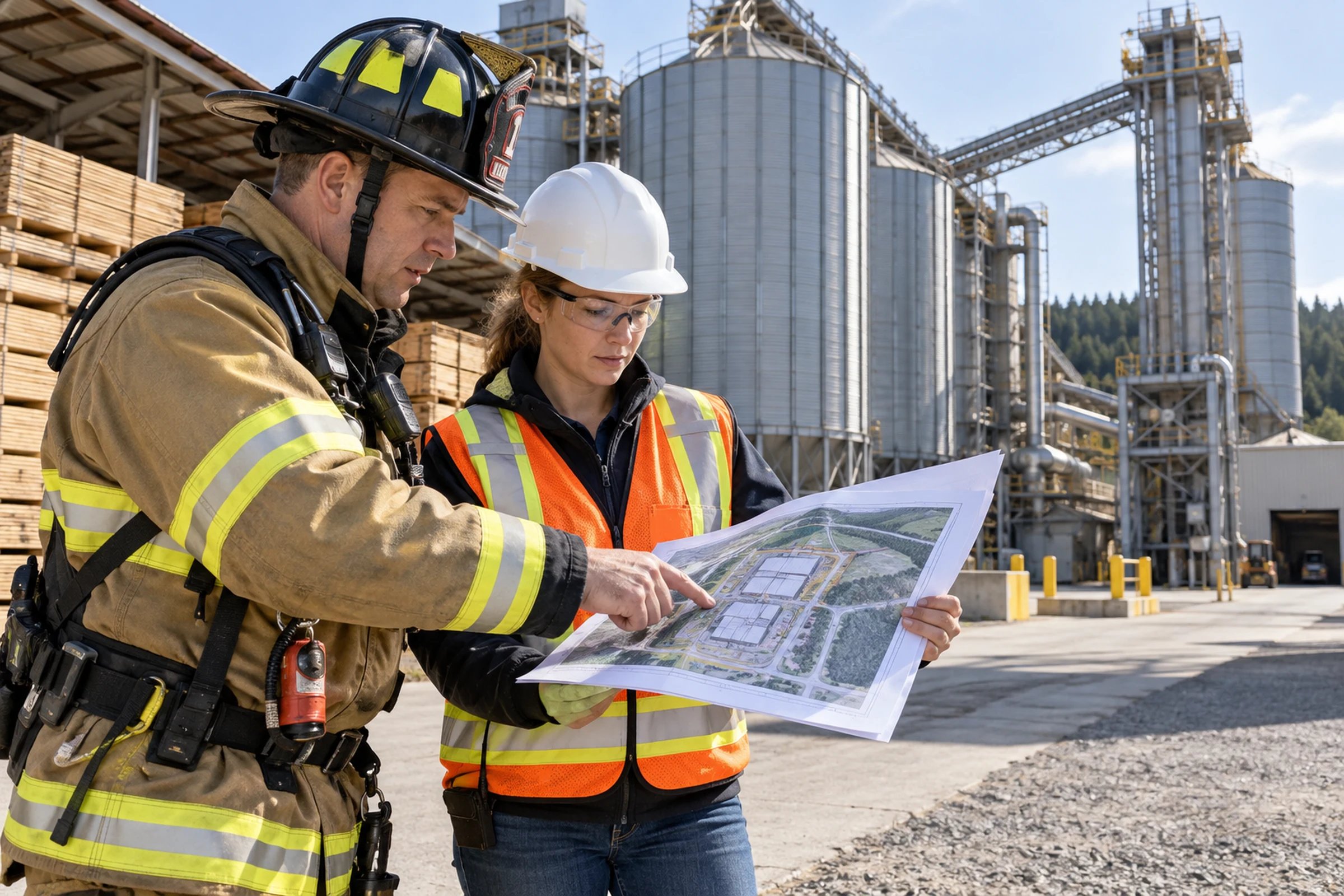
Industrial emergencies frequently place firefighters beside people who understand the process better than anyone on the fireground.
That knowledge is invaluable, but it needs to be integrated into command.
NIOSH recommends establishing and maintaining unified command with representatives from high-hazard occupancies.
The facility representative may know:
- what product is stored,
- how the silo is configured,
- what has been shut down,
- where emergency instructions are stored,
- what suppression systems exist,
- what modifications have been made,
- and what occurred during previous fires.
Fire command contributes:
- responder risk assessment,
- accountability,
- incident organization,
- tactical control,
- communications,
- and emergency-response decision-making.
Neither side should have to guess what the other knows.
▸ “We’ve done this before” can be dangerous
The departments had handled other silo fires at the same facility.
Those fires involved a different silo.
The tactic worked before.
That history may have reinforced confidence.
But a successful outcome does not prove that a tactic is universally safe.
This principle appears repeatedly in modern emergency response:
- A conventional silo is not necessarily an oxygen-limiting silo.
- An electric-vehicle fire is not identical to every internal-combustion vehicle fire.
- A combustible-metal fire is not an ordinary dumpster fire.
- A high-voltage equipment room is not an ordinary commercial occupancy.
Recognition changes strategy.
⚠️ Personnel positioning matters before the hazard becomes obvious
Shortly before the explosion, firefighters and facility personnel were operating around the silo.
EMS personnel had established treatment and rehabilitation nearby.
When the silo exploded, the blast affected not only the firefighters applying water but people positioned around the structure.
That is a critical operational lesson:
If catastrophic failure is credible, the hazard zone must reflect the worst credible event, not just current fire conditions.
Industrial incidents may involve:
- blast pressure,
- structural collapse,
- missile hazards,
- falling equipment,
- stored-product release,
- secondary explosions,
- and fire extension.
EMS staging and rehab must respect those hazards.
The Maine explosion injured two EMS providers.
Responder safety does not end at the nozzle team.
▸ Accountability after catastrophic failure
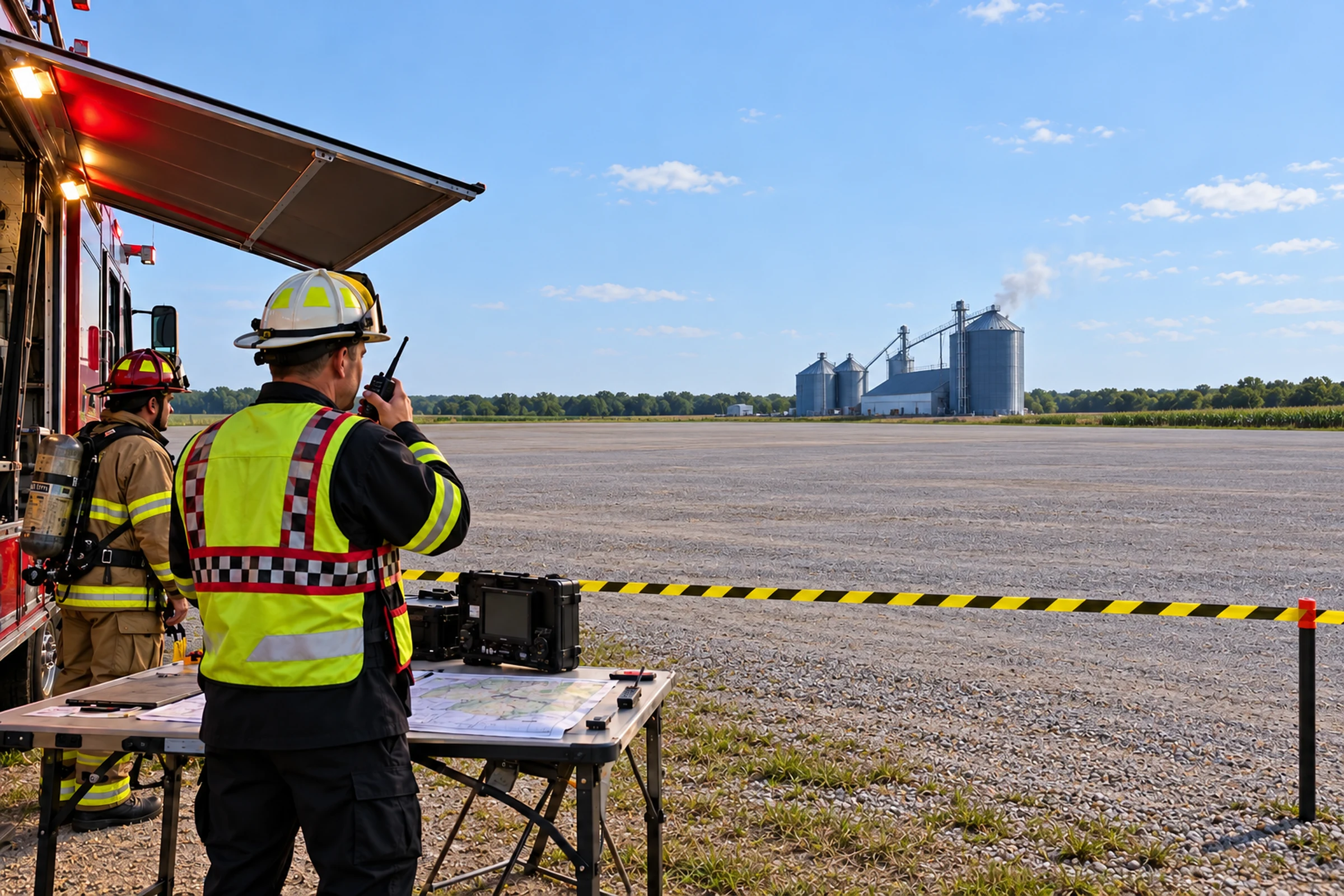
NIOSH identified personnel accountability as one of the prevention areas.
After the explosion, the incident changed instantly into a mass-casualty rescue.
Injured firefighters helped other injured firefighters.
Multiple departments attempted accountability.
Nearly two hours after the explosion, a comprehensive check determined that one firefighter remained missing. His remains were later found beneath burning material.
Ultimately, 299 firefighters from 46 departments across four counties responded before the incident was controlled.
That scale magnifies the need for:
- staging,
- resource tracking,
- PAR procedures,
- divisions and groups,
- mutual-aid integration,
- disciplined communications,
- formal command transfer,
- and a personnel-accountability system that can survive chaos.
Accountability systems matter most when the scene stops being orderly.
🔎 NIOSH’s eight prevention areas
NIOSH identified eight major areas for prevention:
- Combustible-dust training
- Appropriate silo fire-suppression tactics
- Incident command
- Personnel accountability
- Fire-department preincident planning
- Facility emergency planning
- Combustible-dust explosion prevention and mitigation
- Hazard identification and labeling
These should not be treated as isolated recommendations.
They form a chain.
If the facility identifies the hazard, it can appear in the preplan.
If it appears in the preplan, firefighters can train on it.
If firefighters train on it, command is more likely to recognize it.
If command recognizes it, safer tactics and exclusion zones are more likely.
If the scene is organized correctly, accountability and EMS placement improve.
Responder survival rarely depends on one heroic decision. It depends on systems built before the alarm.
▸ What departments should do now
Identify silos in your district
Do not wait until smoke is showing to determine whether a silo is conventional or oxygen-limiting.
Determine what is stored inside
“Grain silo” or “wood silo” is not enough.
Know the actual product and its combustible-dust characteristics.
Obtain manufacturer emergency procedures
If the facility cannot immediately produce them, that is useful information to discover during preplanning.
Add silo type to dispatch and preplan information
A company officer should not have to identify an oxygen-limiting silo from appearance alone at night.
Build a silo-fire decision aid
At minimum, require confirmation of silo type and contents before suppression strategy is selected.
Train mutual-aid departments
One fire department knowing the hazard is not enough if multiple companies arrive at once.
Establish a conservative exclusion zone
Do not allow people to gather at the base of a potentially explosive vessel simply because the fire appears small.
Integrate facility expertise
High-hazard incidents require process knowledge.
Practice accountability under catastrophic conditions
Do not test accountability only during orderly residential scenarios.
🎓 What instructors should teach differently
Silo incidents are an excellent way to teach recognition before tactics.
Instead of asking students immediately:
What line would you stretch?
Ask:
What information do you need before deciding whether a line should be opened at all?
That changes the thought process.
Fire training often rewards speed. Some industrial incidents demand deliberate intelligence gathering.
There are emergencies where seconds count.
There are also emergencies where slowing down prevents responders from creating a worse emergency.
✅ What to remember
Two firefighters died in Maine because of an event the fire service has encountered before.
That is what makes the report difficult and important.
NIOSH has investigated multiple deaths and injuries involving silo fires and explosions over decades.
The operational takeaway is straightforward:
Identify the silo before choosing the tactic.
For an oxygen-limiting silo, introducing water or foam can add air, disturb combustible material, and contribute to explosive conditions. NIOSH therefore advises firefighters not to direct water or foam into these silos.
Preplanning, hazard identification, facility coordination, command, exclusion zones, accountability, and training all have to support that decision.
At some incidents, a deliberate pause to identify the system is safer than moving immediately to the tactic that worked last time.
❓ Frequently Asked Questions
Does NIOSH say firefighters should never use water at any silo fire?
No. The warning applies specifically to oxygen-limiting silos. The broader lesson is to identify the silo type and stored material before choosing a suppression strategy. A conventional silo and an oxygen-limiting silo may require very different tactics.
Why can introducing water be dangerous in an oxygen-limiting silo?
NIOSH concluded that the water application in the Maine incident likely entrained oxygen and disturbed stored combustible material. In a burning silo, adding oxygen and suspending fine combustible dust can contribute to an explosive atmosphere.
What should the first-arriving officer determine?
At minimum: silo type, contents, fill level if known, manufacturer emergency procedures, connected conveying systems, energy sources, potential explosion or collapse zones, and the location of facility representatives who understand the process.
Should EMS rehab be close to the incident for convenience?
Not when the hazard includes a credible blast, collapse, or missile zone. Rehab and treatment areas should be positioned according to the worst credible event, not merely the current flame conditions.
Why is this a preplanning issue?
Responders at the Maine facility had prior familiarity with the property, but the oxygen-limiting design and combustible-dust hazard were not adequately recognized. A meaningful preplan identifies process hazards and special suppression considerations, not only hydrants, gates, and access roads.
What can a fire department do if it has silos but limited technical expertise?
Start with the facility, manufacturer information, local or state fire marshal resources, agricultural or industrial safety specialists, and hazardous-materials resources. The goal is to know the hazard before the emergency, not to become a silo engineer on scene.
🎓 Instructor Note
Use this incident as a recognition-before-tactics simulation. Do not initially tell students the silo is oxygen-limiting. Provide dispatch information, exterior photos, a facility representative, and limited smoke. Require the incident commander to ask the questions that reveal the silo type before committing to suppression. The learning objective is not “memorize no water.” It is “identify the system before selecting the tactic.”
🦺 LSE Training Connection
Life Saving Education’s fire-service, HAZWOPER, confined-space, and workplace-safety education focuses on recognizing hazards before they become responder emergencies.
Request training for your organization or browse LSE courses.
Training You Can Count On. When Seconds Count.
Images are AI-generated educational illustrations, not photographs of the cited incidents or study participants. Displayed screens and documents are illustrative.
📚 Authoritative Sources
- NIOSH Fire Fighter Fatality Investigation and Prevention Program, Report F2026-07.
https://www.cdc.gov/niosh/firefighters/programs/pdfs/f202607.pdf - NIOSH Safety and Health Advisory, Oxygen-Limiting Silo Fires, August 2026.
https://www.cdc.gov/niosh/media/pdfs/2026/08/2026-114.pdf