Joseph Andrade, Firefighter, Paramedic, RN, OSHA Outreach Instructor, Lead Instructor
Life Saving Education. Practical safety education built around real hazards, real decisions, and skills people can use when seconds count.
There is a point on a hot workday when the equipment that protects you from one hazard can quietly become part of another.
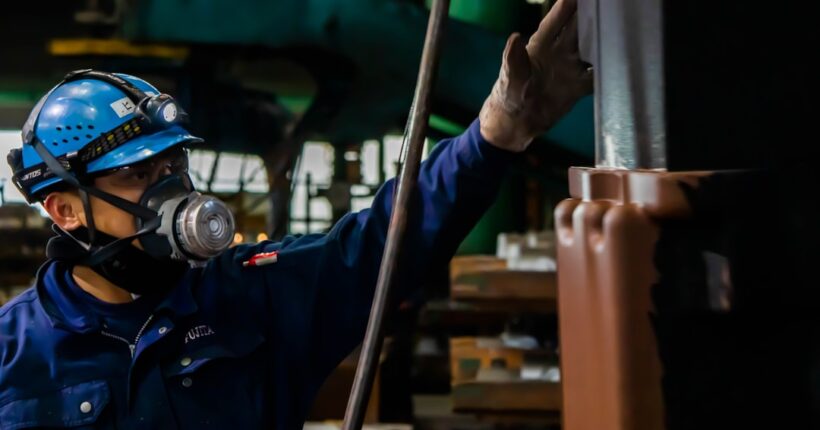
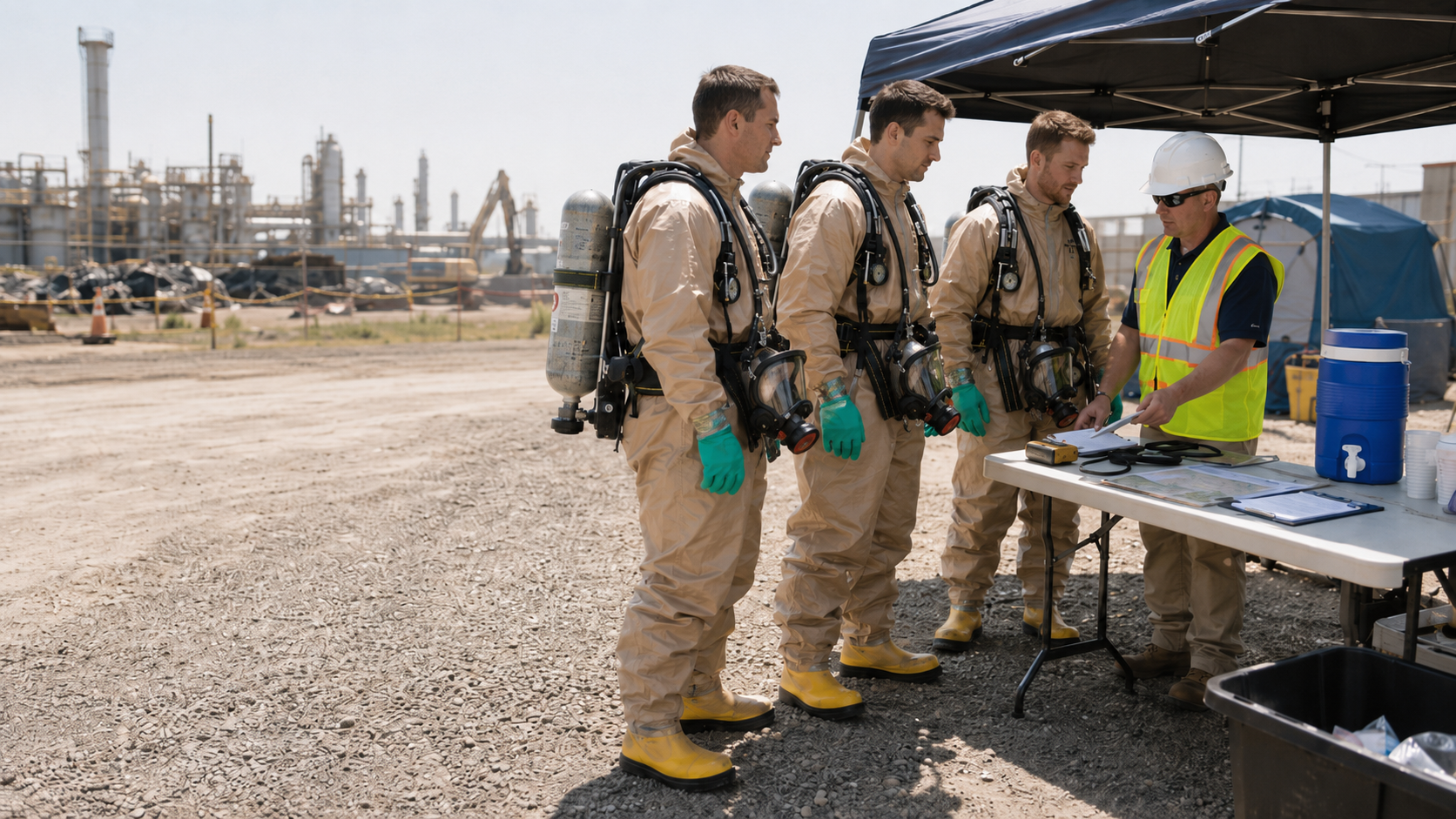
As a firefighter, paramedic, and safety instructor, I think about that tradeoff every time work combines physical exertion, heat, limited airflow, and protective clothing. In hazardous-materials work, the problem can be amplified. Chemical protective clothing, respirators, gloves, boots, and layered PPE can reduce the body’s ability to shed heat at the exact time the worker may be doing difficult physical work.
That is why HAZWOPER heat stress prevention cannot be treated like a summer reminder to "drink more water." It belongs inside hazard assessment, PPE selection, site safety planning, work-rest decisions, medical planning, and supervision.
🔥 The important 2026 distinction: Federal OSHA does not yet have a final nationwide heat-specific standard for general industry and construction. OSHA’s Heat Injury and Illness Prevention rule remains proposed. But employers still have existing obligations to protect workers from recognized heat hazards, and OSHA revised its Heat National Emphasis Program in April 2026. HAZWOPER also specifically requires employers to evaluate site hazards and select PPE accordingly.
🧭 HAZWOPER Heat Stress Prevention Starts With the Site Plan
OSHA’s HAZWOPER standard at 29 CFR 1910.120 is built around planning before exposure. Covered hazardous-waste operations require a safety and health program that addresses organizational structure, a comprehensive work plan, a site-specific health and safety plan, training, medical surveillance, and safe operating procedures.
Heat should be considered inside that system when it is reasonably foreseeable.
OSHA’s own HAZWOPER guidance recognizes that PPE can create hazards. Appendix C notes that PPE can contribute to heat stress, physical stress, impaired mobility, and communication problems. Appendix B also tells employers to consider the effects of PPE on heat stress and task duration when selecting protective equipment.
That creates a practical planning question:
Are we selecting PPE only for the contaminant, or are we also planning for the physiological burden that PPE creates?
The correct answer is both.
🧪 Chemical protection and heat protection must be balanced
Over-protection can be a real hazard. OSHA has described hazardous-waste operations where workers were placed at unnecessary heat-stress risk because protective clothing and respiratory protection exceeded what measured exposures required.
That does not mean lowering PPE below the protection the hazard demands. It means using site characterization, monitoring, and competent hazard assessment to choose the appropriate level of protection rather than automatically defaulting to the most restrictive ensemble.
40-Hour HAZWOPER Initial Training
24-Hour HAZWOPER Initial Training
🌡️ What OSHA Requires in 2026, and What Is Still Proposed
This is where employers need careful wording.
OSHA published its proposed Heat Injury and Illness Prevention in Outdoor and Indoor Work Settings rule in 2024. The public hearing concluded in July 2025. As of August 2026, OSHA still lists the rule in the proposed-rule stage.
That means employers should not describe the proposal’s detailed trigger temperatures or program elements as though they are already a final nationwide federal standard.
At the same time, heat is not an unregulated hazard.
OSHA explains that the General Duty Clause can apply when workers are exposed to a recognized serious heat hazard. OSHA also uses heat-stress evaluation methods, including wet bulb globe temperature, in enforcement and hazard assessment.
In April 2026, OSHA revised its Heat National Emphasis Program, directing inspection and outreach resources toward industries and workplaces where heat risk is likely to be significant.
⚠️ For HAZWOPER employers, the existing standard already matters
HAZWOPER requires PPE to protect employees from hazards and potential hazards identified through site characterization and analysis. Its training guidance explicitly includes PPE limitations during temperature extremes and heat stress.
So even without a final standalone federal heat rule, a HAZWOPER program that ignores predictable heat stress can have a serious blind spot.
🥵 Why HazMat PPE Changes the Heat Equation
- high temperature and humidity
- direct sun or radiant heat
- heavy physical exertion
- lack of acclimatization
- dehydration
- limited air movement
- protective clothing and PPE
- certain medications and health conditions
- previous heat illness
A worker in chemical protective clothing may have less evaporative cooling. Add a respirator, gloves, boots, and a physically demanding task and the metabolic and environmental heat load can rise quickly.
This is not an argument against PPE. It is an argument for managing the whole exposure.
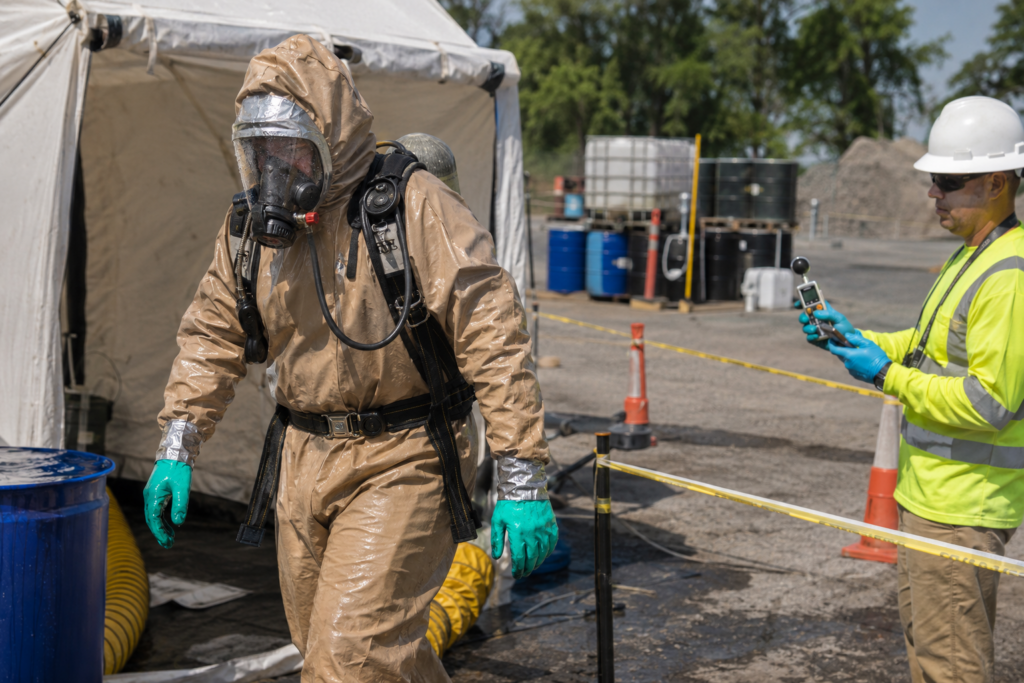
🧠 Field mindset: PPE is a control, not magic. Every control has capabilities and limitations. Good safety planning anticipates both.
💧 The Controls That Matter Most
1. Acclimatize new and returning workers
NIOSH recommends gradually increasing heat exposure over roughly 7 to 14 days for workers who are not acclimatized.
A worker returning after an absence, illness, vacation, or cooler-season assignment may not have the same heat tolerance they had before. New workers are especially vulnerable.
Build acclimatization into staffing and work planning rather than treating every employee as equally heat-ready on day one.
2. Put water where the work is
Hydration only works if employees can realistically drink.
NIOSH recommends providing accessible potable water near the work area and encouraging regular hydration. In moderate conditions with moderate activity, older NIOSH guidance commonly describes roughly one cup every 15 to 20 minutes as a practical benchmark, although actual needs vary with conditions, workload, clothing, medical factors, and acclimatization.
For HAZWOPER operations, hydration planning also needs to respect contamination-control zones. Workers should not casually drink inside areas where that creates an ingestion or cross-contamination risk.
The site plan should answer where hydration occurs, how workers exit and decontaminate when necessary, and who tracks fluid availability.
3. Use work-rest schedules that respond to conditions
Rest needs increase as heat stress rises.
Work-rest decisions should consider environmental heat, radiant heat, workload, PPE burden, acclimatization, worker symptoms, task duration, and the availability of shaded or cooled recovery areas.
A fixed schedule written months earlier may not fit today’s conditions.
4. Use a buddy system and active observation
OSHA’s disaster-response guidance specifically recommends observing workers in non-breathable protective suits and using a buddy system to identify heat-related symptoms.
This matters because judgment can deteriorate as heat illness progresses. A worker may not recognize how impaired they have become.
5. Build cooling into the operation
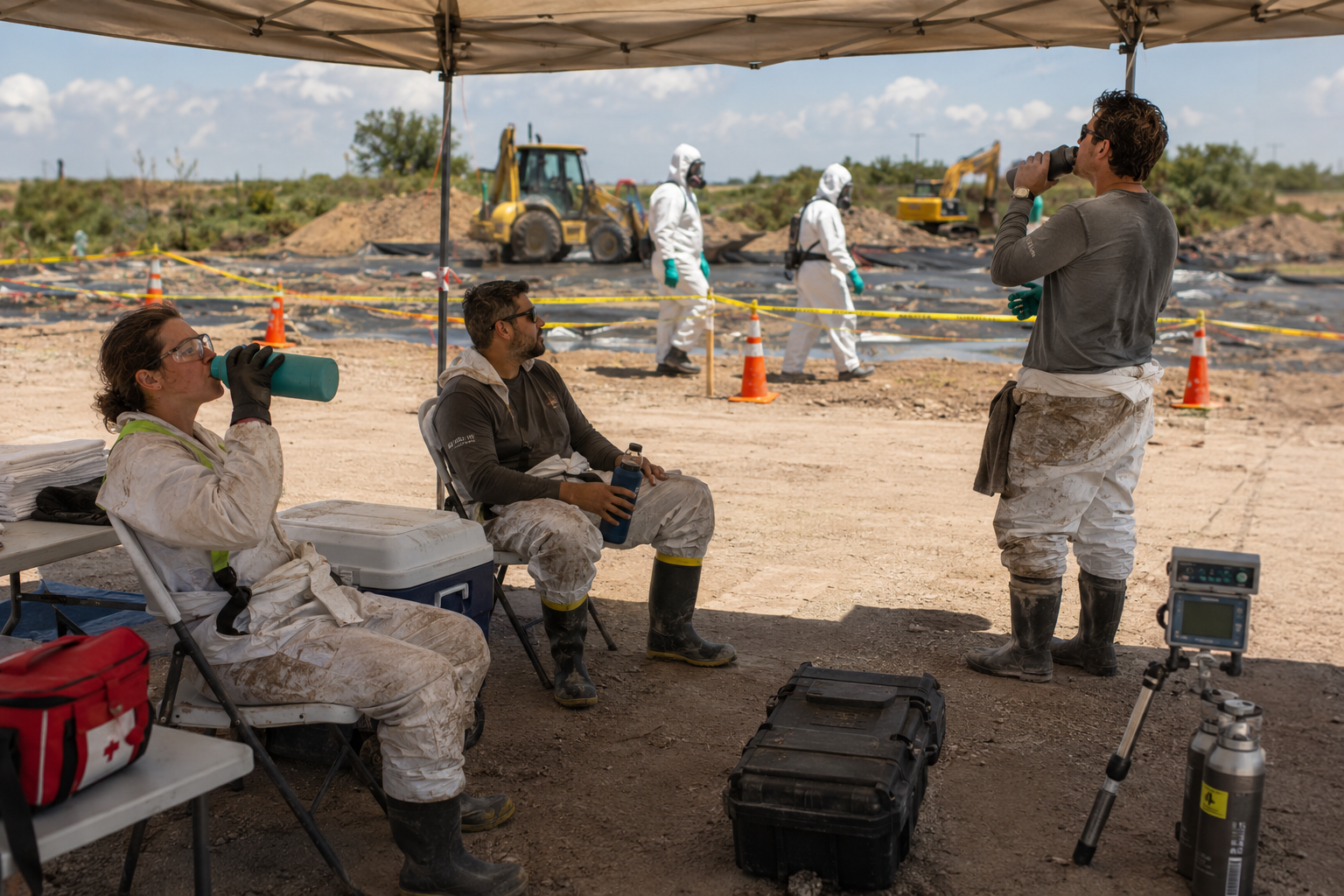
Cooling strategies may include shaded recovery areas, air-conditioned vehicles or shelters, fans where contamination control allows, cooling garments when compatible with the PPE system, and shorter work cycles.
The control needs to fit the chemical hazard. A cooling method that spreads contamination or compromises protective clothing is not a good trade.
🚑 Heat Illness Recognition Has to Be Part of the Briefing
Workers and supervisors should be able to recognize warning signs before a collapse.
Common heat-illness warning signs can include heavy sweating, headache, dizziness, nausea, muscle cramps, weakness, irritability, or unusual behavior.
Heat stroke is a medical emergency. Altered mental status, confusion, collapse, seizures, or other severe neurologic changes in a heat-exposed worker should trigger immediate emergency action.
A HAZWOPER site should not invent the response after the worker becomes sick.
- who stops work
- how contaminated PPE will be removed safely
- how emergency medical services are activated
- where cooling can begin
- how responders avoid secondary contamination
- what information is communicated to EMS
First Aid Training
Onsite Group Training
🧯 A Better Pre-Entry Heat Briefing
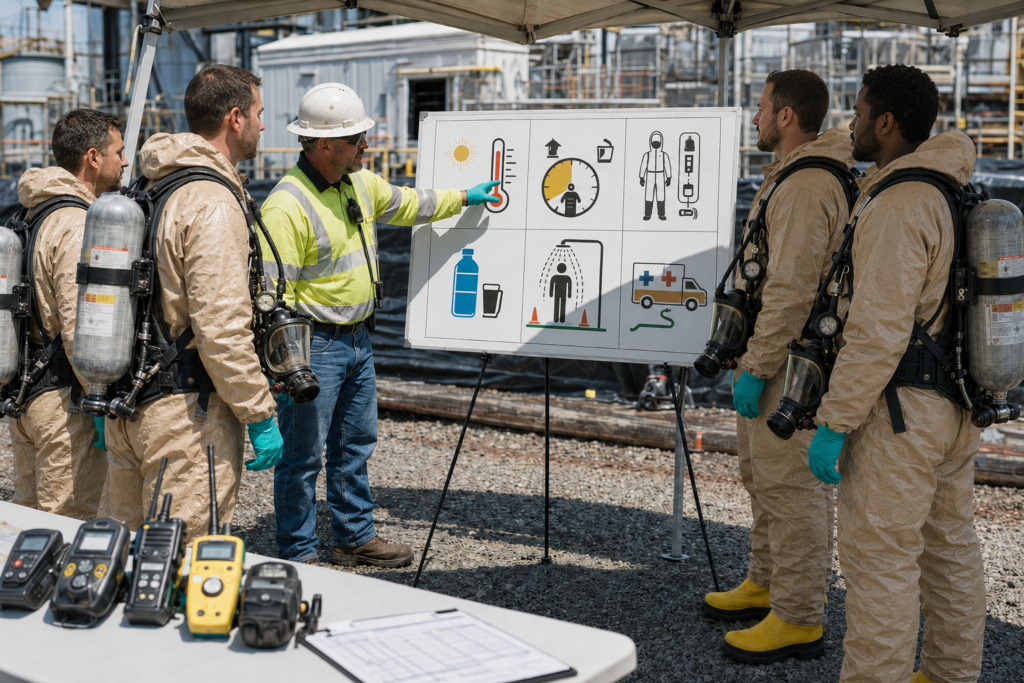
| Question | Why it matters |
|---|---|
| What is the forecast and actual site heat condition? | Conditions can change during the task. |
| What is the expected workload? | Metabolic heat is part of total heat stress. |
| What PPE is required, and how much heat does it trap? | Protective clothing changes cooling and task duration. |
| Are the workers acclimatized? | New and returning workers may need a slower ramp-up. |
| Where are water, rest, cooling, decon, and EMS access? | Controls have to be usable, not theoretical. |
This kind of briefing takes minutes and can expose a weak plan before the team crosses into the work zone.
📋 A Practical HAZWOPER Heat Stress Checklist
- Heat is addressed in the site-specific hazard assessment when applicable.
- PPE selection considers chemical protection and heat burden.
- Workers are trained to recognize heat illness.
- New and returning workers have an acclimatization plan.
- Water is available in a location compatible with contamination control.
- Work-rest cycles can change as conditions worsen.
- Supervisors know when to stop work.
- A buddy or observation system is used when protective suits raise heat risk.
- Cooling and recovery areas are identified.
- The emergency plan addresses contaminated-worker medical emergencies.
- Lessons from heat symptoms, near misses, and work stoppages are fed back into the HASP.
🔗 Related Life Saving Education Guides
- Worker heat safety: prevention, recognition, and response
- HAZWOPER 40 vs 24 vs 8: choosing the right level
- Life Saving Education HAZWOPER training
- Onsite group safety training
✅ Key Takeaways
- Heat stress belongs inside HAZWOPER hazard planning, especially when PPE restricts heat loss.
- OSHA’s nationwide heat-specific rule is still proposed in August 2026, but the General Duty Clause, OSHA’s active Heat National Emphasis Program, and existing HAZWOPER duties still matter.
- PPE should be matched to the hazard. Both under-protection and unnecessary over-protection can create risk.
- Acclimatization, hydration, work-rest cycles, observation, cooling, and emergency planning work best as a coordinated system.
- A hot-weather entry should have a heat plan before the team starts work, not after someone becomes symptomatic.
❓ Frequently Asked Questions
Does OSHA have a final federal heat standard in 2026?
Not yet for general industry and construction. OSHA’s Heat Injury and Illness Prevention rule remains in the proposed stage as of August 2026. Employers still have responsibilities under existing OSHA requirements, including the General Duty Clause where a recognized serious heat hazard exists, and some state plans have their own heat standards.
Does HAZWOPER specifically address heat stress?
Yes, heat stress appears in OSHA’s HAZWOPER appendices and training guidance as a limitation and potential hazard associated with PPE and temperature extremes. HAZWOPER also requires hazard assessment, site planning, training, PPE programs, and safe operating procedures that should account for foreseeable site hazards.
Can an employer simply use lighter PPE because the day is hot?
No. PPE must still provide the protection required for the chemical and physical hazards. The answer is better hazard characterization, appropriate PPE selection, work-rest planning, cooling, monitoring, and other controls, not arbitrary reduction of necessary protection.
How long does heat acclimatization take?
NIOSH recommends gradually increasing heat exposure over approximately 7 to 14 days. The exact schedule depends on whether the worker is new to heat exposure or has recent heat acclimatization.
Should HAZWOPER refresher training cover heat illness?
When heat is relevant to the work, it is a strong topic to include. OSHA’s HAZWOPER curriculum guidance recognizes heat stress and temperature extremes as PPE limitations, and refresher training should reinforce hazards and controls applicable to the employee’s work.
🎯 Train for the Hazard Behind the Hazard
The chemical may be the reason the team is wearing the suit, but the suit can change the worker’s physiology, visibility, mobility, communication, and endurance.
That is why good HAZWOPER training is more than memorizing PPE levels. It teaches people to evaluate the entire job.
Life Saving Education provides HAZWOPER and workplace-safety education built around practical hazard recognition, PPE decision-making, site control, monitoring, and emergency readiness.
Life Saving Education HAZWOPER training
Onsite Group Training
Training You Can Count On. When Seconds Count.
📚 Sources and Further Reading
- OSHA, 29 CFR 1910.120 Hazardous Waste Operations and Emergency Response
- OSHA, HAZWOPER Appendix B: PPE Selection and Heat Stress
- OSHA, HAZWOPER Appendix C: Compliance Guidelines
- OSHA, Heat Injury and Illness Prevention Rulemaking
- OSHA, Heat Exposure Overview
- NIOSH, Workplace Recommendations for Heat Stress
- NIOSH, Heat Stress Acclimatization
⚖️ Educational Disclaimer
This article is provided by Life Saving Education for general educational purposes only. It is not medical, legal, or compliance advice, and it is not a substitute for hands-on training or professional guidance. Regulations and clinical guidance change and may vary by state, jurisdiction, employer, operation, or mode of transportation. Verify the current requirements that apply to your situation. In an emergency, call 911.