Prepared by the LSE Editorial Team. Reviewed by Joseph Andrade, Jr., RN, NRP.
Joseph works across emergency response, healthcare, and workplace safety and develops practical training for civilians, employers, and first responders.
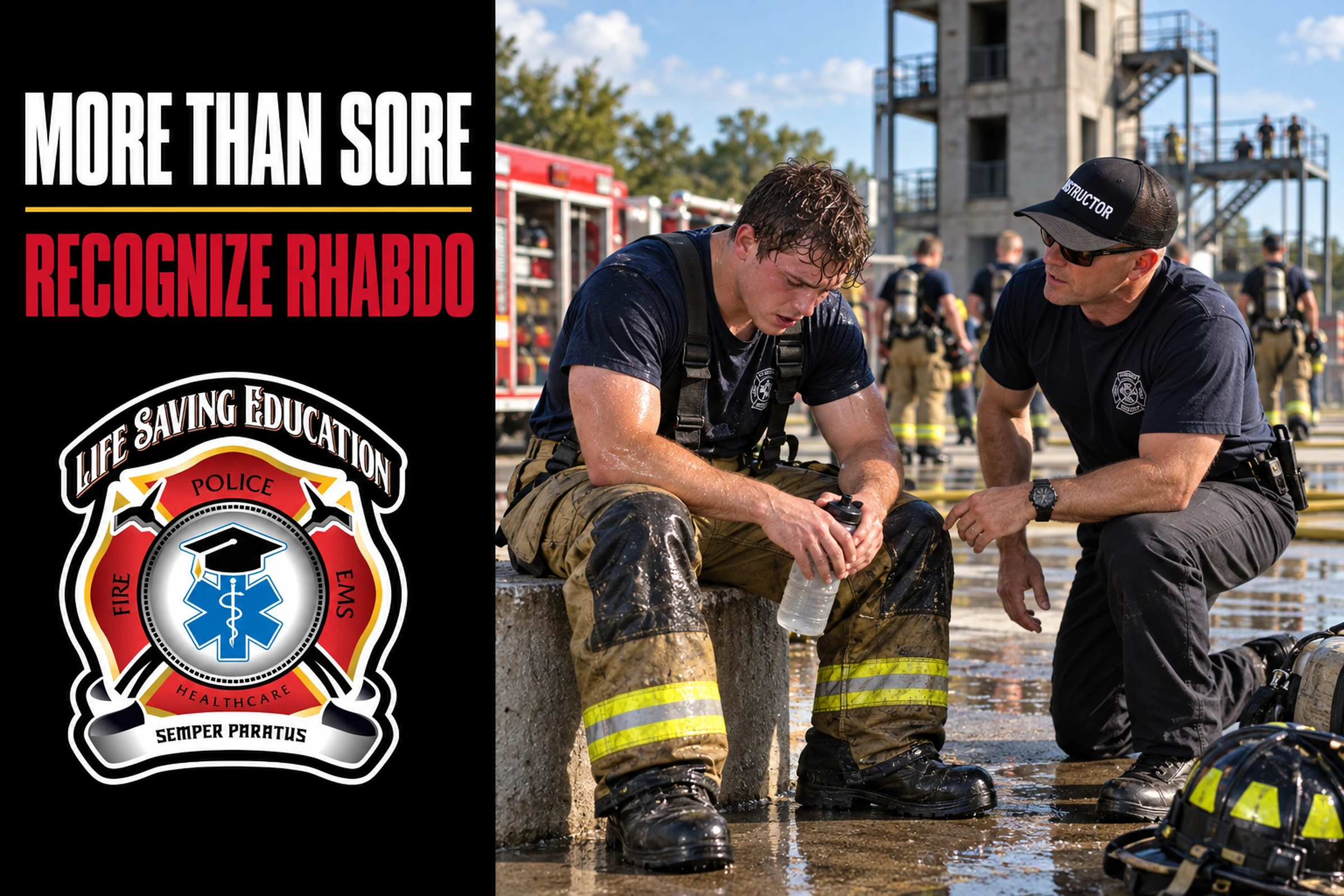
Firefighters train to work when conditions are difficult. They climb stairs in heavy PPE, advance hose, carry equipment, drag victims, force doors, and operate in heat. Soreness is expected. But not every post-training symptom should be dismissed as “just soreness.”
On September 16, 2026, the U.S. Fire Administration highlighted exertional rhabdomyolysis, often shortened to “rhabdo,” as a health risk fire-service leaders should not overlook.
🧬 What Is Exertional Rhabdomyolysis?
Exertional rhabdomyolysis occurs when strenuous physical activity causes significant skeletal-muscle breakdown. Damaged muscle cells release intracellular substances into the bloodstream, including creatine kinase and myoglobin.
- Acute kidney injury
- Dangerous electrolyte abnormalities
- Compartment syndrome
- Other severe systemic complications
This is not a diagnosis instructors should attempt to make on the training ground. The instructor’s responsibility is to recognize when the presentation is no longer consistent with routine post-exercise fatigue and escalate appropriately.
🔥 Why Firefighters Are Vulnerable
USFA identifies overlapping risk factors including heavy muscular work, high heat, dehydration, fatigue, limited recovery, structural PPE and thermal strain, unfamiliar or unusually intense exercise, illness, and certain medications or stimulants.
Thermal load can compound the physiologic stress of hard muscular work.
Unfamiliar or suddenly increased workload can create a much different response than progressive training.
Limited rest, poor recovery, illness, and dehydration can stack risk factors together.
🎓 Academy Recruits Deserve Special Attention
Recruits arrive with different training histories. One may have years of endurance training. Another may be strong but unaccustomed to repeated stair work, crawling, hose movement, carries, and high-output drills in PPE.
A standardized workload does not create a standardized physiological response.
👀 Warning Signs That Deserve Attention
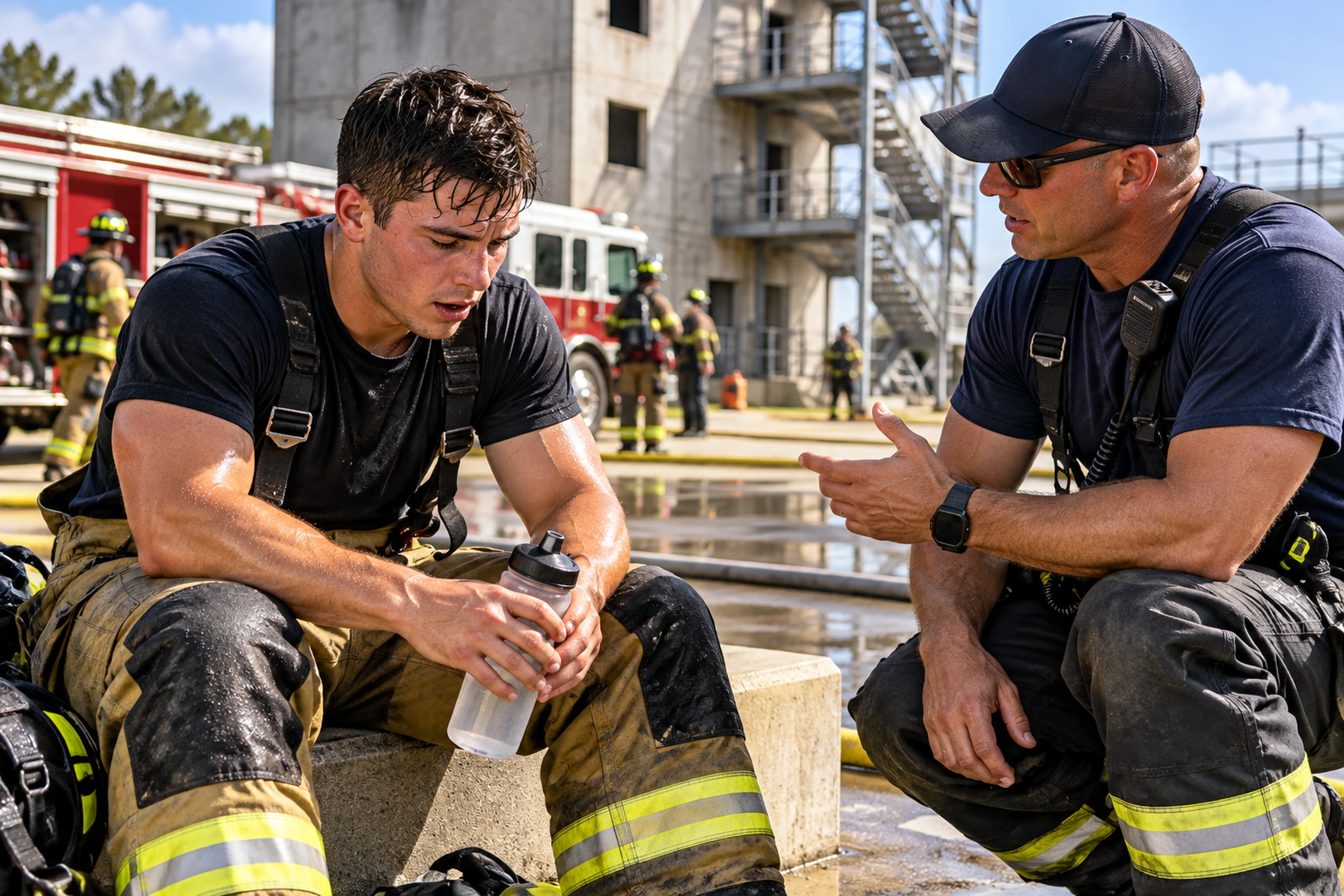
Potential warning signs can include significant muscle pain, weakness, swelling, and dark urine. Instructors should not rely on one classic symptom.
- Severe or worsening muscle pain
- Marked weakness or inability to perform normally
- Significant swelling
- Dark urine
- Collapse or abnormal vital signs
- Altered mental status or other signs of serious illness
- Symptoms that are clearly disproportionate to expected training fatigue
The practical trigger is a firefighter or recruit whose condition does not look like ordinary post-training fatigue or delayed-onset muscle soreness.
🥤 Hydration Matters, but It Is Not Immunity
Hydration is important. It is not a complete prevention strategy.
Avoid abrupt workload spikes whenever training design allows.
Account for heat, PPE burden, and changing environmental conditions.
Build appropriate rest and recovery into demanding training days.
Make it clear that unusual medical symptoms are reported, not hidden.
🏋️ Conditioning Should Progress
Fire-service conditioning should progressively develop stair endurance, loaded carries, lower-body strength, grip endurance, aerobic capacity, anaerobic work capacity, recovery between bouts, and movement under load.
The goal is not to make training easy. The goal is to make hard training productive and progressively specific to the demands of the job.
🛑 Instructors Need Stop-Work Criteria
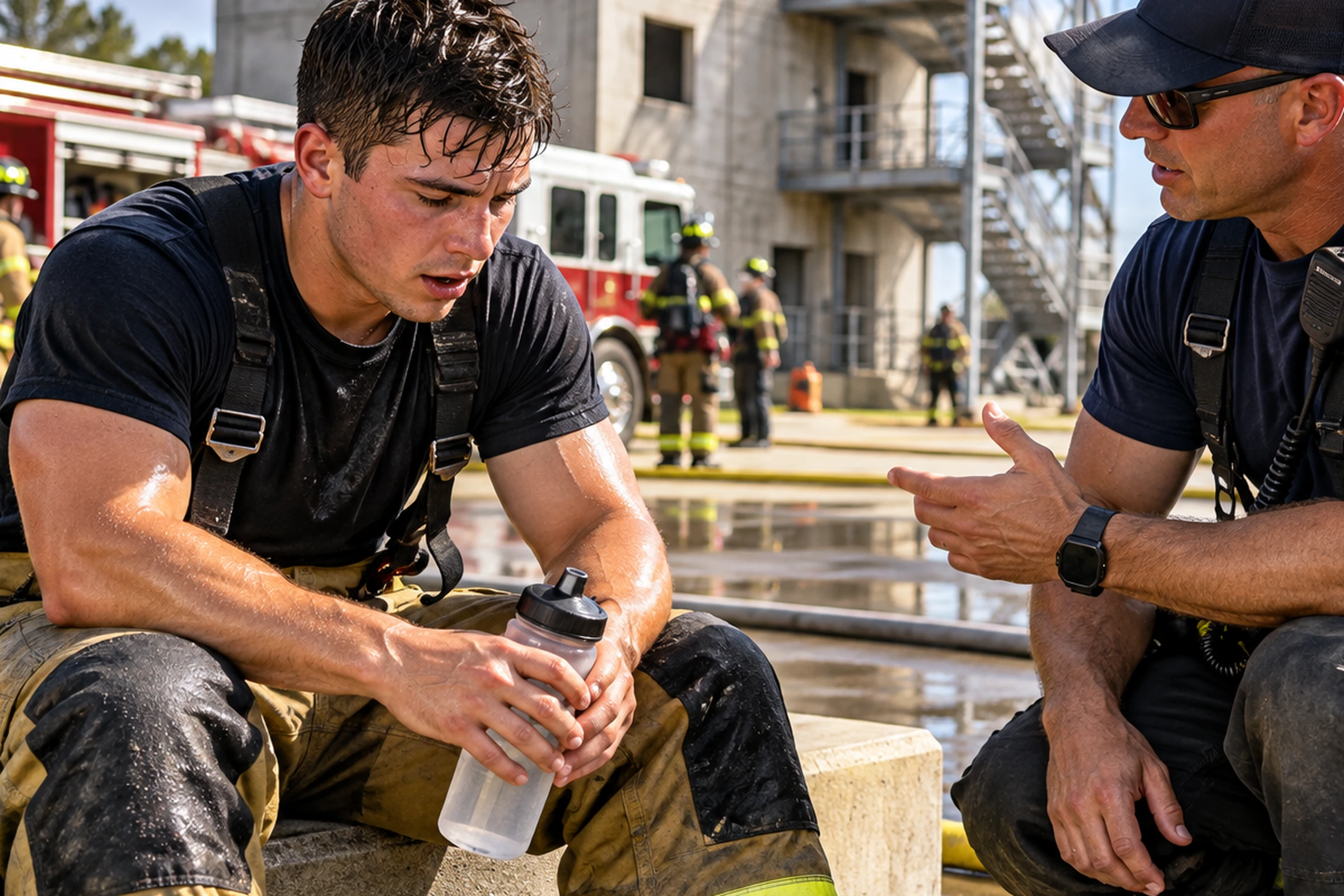
A strong academy culture should make clear that reporting a concerning medical symptom is not weakness. Instructors should know what findings trigger rest, removal from the evolution, cooling, medical assessment, EMS activation, or referral for further evaluation.
🌲 Wildland Operations Add Another Layer
Wildland firefighters may work for long periods over steep terrain while carrying equipment and operating in heat, smoke, and sometimes altitude. Recovery opportunities can be limited and medical access delayed.
The farther a crew is from definitive care, the more important early recognition becomes.
💊 Medications, Supplements, and Stimulants
USFA notes that certain medications or stimulants can be part of the risk picture. Instructors should not practice medicine or interrogate firefighters about private health information.
Agencies should have appropriate occupational-health processes, and individuals should understand that stimulant use, medication effects, illness, dehydration, heat, and intense unfamiliar exercise can interact.
🧪 A Scenario for Instructor Development
A recruit completes multiple stair and hose evolutions on a hot training day. Later, the recruit reports unusually severe thigh pain and weakness and is struggling to walk normally.
Ask the instructor group:
- What makes this different from routine soreness?
- What should happen immediately?
- What additional findings would increase concern?
- What training and environmental factors should be documented?
- How should the remaining training plan change?
- What system changes could reduce recurrence?
The correct training outcome is not diagnosing rhabdomyolysis. It is recognizing that the recruit requires evaluation.
✅ Key Takeaways
- Firefighting combines several risk factors associated with exertional rhabdomyolysis.
- Instructors should focus on recognition and escalation rather than attempting a diagnosis.
- Dark urine is not the only finding that matters.
- Hydration is important but should not be treated as the only control.
- Progressive conditioning, acclimatization, recovery, symptom reporting, and preplanned medical response all matter.
❓ Frequently Asked Questions
Is severe soreness after training always rhabdomyolysis?
No. Muscle soreness is common after demanding exercise. The point is to recognize when symptoms are severe, unusual, worsening, or disproportionate enough to require medical evaluation.
Does drinking enough water prevent rhabdomyolysis?
Hydration is important, but it does not eliminate the risk created by intense exercise, heat, unfamiliar workload, illness, limited recovery, or other contributing factors.
Should instructors diagnose rhabdo?
No. Instructors should recognize concerning symptoms, stop the evolution when appropriate, and activate the organization’s medical evaluation process.
Does this mean academy standards should be reduced?
No. The issue is how training is progressed, monitored, and supported, not whether firefighters should meet demanding occupational performance standards.
Train Hard. Recognize When Something Is Wrong.
Life Saving Education develops practical emergency-response and safety training for organizations that need instructors who understand the operational environment.
📚 Source and Further Reading
This article is for fire-service education and does not replace occupational-health policy, EMS protocols, medical evaluation, or individualized healthcare advice.